Sign In

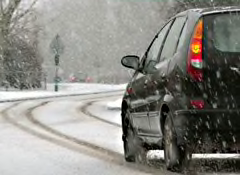
Over most of the country, winter driving presents new challenges and dangers for motorists, including slippery road surfaces, limited visibility, and freezing temperatures. Basic preparation and a gentle driving style will increase your chances of skating through the season unscathed.
If you need to drive a lot in slippery conditions, it's a good idea to replace worn tires before the winter months, rather than wait until spring. Partially worn or worn tires significantly reduce your ability to get going and stop in snowy conditions (see our report on the dangers of worn tires). Also replace summer or all-season tires with a set of dedicated winter tires. These have tread patterns and rubber compounds specially designed to grip snow and ice, for optimum traction on slick roads. Winter tires typically have shorter tread life and generate more road noise than the all-season tires that your vehicle came with. But the extra safety they provide is generally worth the compromise.
For extreme conditions, studded snow tires or even tire chains may be warranted. Because they can be tough on road surfaces, check if they're legal in your area before making the investment. In addition, it's always important to monitor tire pressure, as incorrect inflation can compromise a vehicle's handling and road-holding ability. For more information on our tire Ratings, recommendations, and advice, see our tires section.
If snow has fallen since your car was parked, take the time to thoroughly brush it off the vehicle—including the roof—and scrape any ice from the windows. This will ensure that you have optimum visibility and that no large clumps of snow fall off of the vehicle once you begin driving, which can be a hazard for other motorists. In addition, headlamps and taillights may need to be wiped clean from road salt and grunge. When entering the vehicle, kick as much snow off of your feet as possible. Snow tracked inside the vehicle can contribute to window fogging.
If starting from a standstill on slick snow or ice, start in second gear if you have a manual transmission so the vehicle is less likely to spin the tires. The automatic transmissions on some vehicles have a winter mode that automatically starts in a higher gear.
In slippery conditions, tires lose their grip more easily, affecting all aspects of your driving: braking, turning, and accelerating. The key is to drive as smoothly as possible, avoiding sudden actions or rapid movements of any kind. Drive as if you have a full cup of coffee on the dash board or a bowl of water in your lap and don't want to spill any.
Plan on starting your braking sooner than you normally would in dry conditions to give yourself extra room, and use more gentle pressure on the brake pedal.
Locked wheels can make the vehicle slide or skid. If you have a vehicle without an antilock braking system (ABS), you may need to gently apply the brakes repeatedly to avoid having them lock up the wheels. If your vehicle has ABS, simply depress the brake pedal firmly and hold it down. ABS typically sends a vibration or pulsing sensation through the brake pedal. If you feel this, don't let up; it's normal.
Asking a vehicle to do two things at once—such as braking and turning, or accelerating and turning—can reduce your control. When taking a turn, for instance, slowly apply the brakes while the vehicle is going straight. When it's at the right speed to take the turn, let up on the brakes and smoothly turn the steering wheel. After you're through the turn, slowly depress the accelerator to regain your speed.
A sudden maneuver—such as hard braking, a quick turn of the steering wheel, sudden acceleration, or shifting a manual transmission—can upset a vehicle's dynamics when it's taking a turn. In slick conditions, this can cause it to more easily go out of control.
Should the rear end of the vehicle begin to slide during a turn, gently let off on the accelerator and turn the steering wheel in the direction of the slide. This will help straighten it out. If the front end begins to plow off course, again let up on the accelerator and hold the steering wheel in the direction you want to go. Once the car slows enough to regain traction, it should begin turning again.
4WD and AWD systems only provide extra traction when accelerating. They provide no advantage when braking or cornering. And use the above tips no matter what type of vehicle you're driving.
They may not be driving as cautiously as you.

 WASHING MACHINE REVIEWS
 GENERATOR REVIEWS
 Build & Buy Car Buying Service
Save thousands off MSRP with upfront dealer pricing information and a transparent car buying experience.
 Get Ratings on the go and compare
while you shop