Sign In

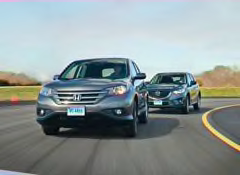
On paper, the redesigned Honda CR-V and new Mazda CX-5 look very similar. They can accommodate five passengers, have comparable dimensions, are available with front- or all-wheel drive, and are priced about the same. They also finished very close in our overall road-test scores—with a 77 and a 75, respectively—just under the class-leading Toyota RAV4 and Subaru Forester.
But these two small SUVs have very distinct characteristics that will probably appeal to different types of drivers. The CR-V is a more family-friendly SUV, with a large backseat, easy access, lots of cargo space, and a comfortable ride. It is also notably quicker and more responsive than the CX-5, with a refined drivetrain. On the downside, the CR-V suffers from pronounced road noise, sizable rear blind spots, and subpar at-the-limit handling. Overall, this SUV is functional and easy to live with, if not particularly exciting to drive.
The CX-5 is more athletic and engaging to drive, thanks to its agile handling, taut cornering, and responsive steering. It's more at home on a twisty road and is more likely to satisfy enthusiast drivers. The CX-5 also delivers the best fuel economy in its class—25 mpg overall—thanks to Mazda's new Skyactiv technology. And even our midlevel Touring version came well equipped, with a full-power seat, keyless ignition, and a blind-spot monitoring system. But the CX-5's trade-offs include a smaller, noisier cabin; a choppy ride on the highway; and slower acceleration.
Only the CR-V is recommended; we expect above-average reliability. Although the CX-5 scored well enough, it's too new for us to have reliability information.
A 185-hp, 2.4-liter four-cylinder engine provides the CR-V's quicker acceleration. The engine delivers smooth, ample power, coupled with a five-speed automatic transmission that provides super-smooth, responsive shifts. That combo delivered 23 mpg, which is among the best in the class: 2 mpg better than the previous CR-V but 2 mpg less than the CX-5.
Although the CX-5 squeezes out better gas mileage thanks to a high compression ratio, direct injection, and a six-speed automatic transmission, its 155 hp, 2.0-liter four feels notably underpowered. The SUV is often sluggish from a launch, and the transmission had to perform frequent gear shifts to maintain speed on some roads. Shifting is smooth and responsive, but we found the gated transmission shifter awkward to use. A manual transmission, which is rare in an SUV, is also available; it has a slick, precise shifter.
Though the CX-5 is sportier, both SUVs handle well in everyday driving, with quick, well-weighted steering and controlled body lean in corners. But when we pushed the CR-V to its handling limits, body lean increased dramatically and the vehicle felt unsteady, although its electronic stability control system kept it in line. The CR-V managed an adequate speed in our avoidance maneuver, but it took a lot of effort to keep it on course and it eroded driver confidence.
Overall, the CX-5 has higher handling limits. But once those limits were exceeded, it showed signs of oversteer and lifted the inside wheel slightly during hard cornering. Ultimately, the ESC system kept the vehicle in good shape, despite kicking in a bit late.
The CR-V is the clear choice if you're looking for a more comfortable ride. Its absorbent suspension provides commendable isolation from bumps and ruts. The CX-5's ride is taut, although it's compliant enough to take the edge off of most bumps. But on the highway, the ride feels choppy and busy. Both SUVs suffer from loud road noise, although the CX-5, with pronounced wind noise and a straining engine boom while accelerating, is noisier than the CR-V and most rivals.
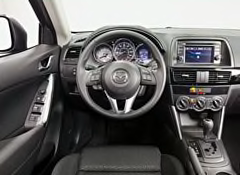
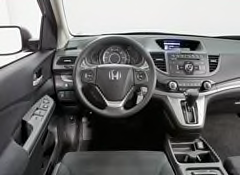
Each SUV treats its drivers well. There's a high seating position, with plenty of room and a tilt-and-telescopic steering wheel that will help most drivers find a comfortable driving position. Some CX-5 drivers wished the wheel pulled out a bit more.
A large windshield and front windows help provide good visibility to the front and sides. In the CR-V, large rear roof pillars create big corner blind zones, and the CX-5's large head restraints intrude into the view straight back. A backup camera is standard in the CR-V and higher-trim CX-5 models, including our Touring. The CX-5's blind-spot detection system generally works well, but it can be a little late in picking up cars in the blind zone, and we had some false-positive warnings.
Front seats in the CR-V are wide and supportive, but there's no lumbar adjustment in LX and EX trim levels. The CX-5's seats are well contoured, with pronounced bolsters that are reminiscent of a sports seat. Some drivers found the bolstering to be too confining around the shoulders. The CR-V is more inviting for rear-seat passengers, with generous leg room and plenty of space for three adults. The seatbacks also recline. The rear seat in the CX-5 is comfortable for two adults, with ample room, but is less comfortable for three.
The cabins in these vehicles are rather basic. In the CR-V, all interior plastics are hard and the door panels look somewhat cheap, although most interior panels fit well. The CX-5's dash is padded, though other plastics are hard. There are some gaps between components in the instrument panel.
Controls are mostly straightforward and easy to use. In the CR-V, a single knob adjusts radio volume and tuning, which takes getting used to. The CX-5 uses a large, in-dash touch screen, although it's a long reach for the driver and some onscreen "buttons" are small and clustered together, making it difficult to select one at a glance.
It's hit or miss with electronic features. Both vehicles provide Bluetooth compatibility, audio auxiliary and USB inputs, and iPod control through the audio systems. But satellite radio, which is included on many competitors, is a steeply priced $525 option for the CX-5 and wasn't available at all for our CR-V; it only comes in leather-trimmed versions. Neither SUV provides hands-free voice control for music players.
The CR-V provides generous interior storage and cargo room. For more space, the 60/40-split seatbacks fold in one motion by pulling a lever in the cargo area or a strap alongside either seat. The CX-5 provides a little less cargo space but more versatility, because the rear seatbacks can fold in either a 60/40 or 40/20/40 configuration. There are releases in the cargo area and on the seatbacks, but the seats don't fold in a single motion unless the front seats are pulled forward.
A version of this article appeared in the June 2012 issue of Consumer Reports magazine with the headline "Honda CR-V vs. Mazda CX-5."

 Build & Buy Car Buying Service
Save thousands off MSRP with upfront dealer pricing information and a transparent car buying experience.
 Get Ratings on the go and compare
while you shop

