Sign In

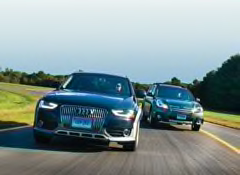
Pop quiz: You want enough cargo space for your gear and all-wheel drive for slippery conditions. So you need an SUV, right? Wrong. Several wagons fill that bill, while usually giving you better handling, ride comfort, and fuel economy than SUVs.
In fact, the new Audi Allroad and the freshened Subaru Outback are sort of "SUV-wagons." They provide rugged styling details and extra ground clearance for light off-road excursions and, yes, that tough SUV look. But we also found notable differences in the cars' driving experience and overall versatility.
This is the second go-around for the Allroad name. The original 2001 model was based on the Audi A6; the 2013 model is a smaller version that replaces the Audi A4 Avant wagon, albeit with a 1.5-inch higher ride height. Its agile handling makes it fun to drive. The cabin is quiet and beautifully finished. And a spunky 211-hp, turbocharged four-cylinder engine, matched with a slick eight-speed automatic transmission, provides decent acceleration and 22 mpg overall, which is competitive with the best small SUVs.
All that helped the Allroad earn a 79 road-test score, which now tops our wagon ratings. Based on the A4, we also expect its reliability to be above average. But at $43,570, the price of our modestly equipped Allroad was about $2,000 higher than the Audi Q5 SUV, which has more rear-seat room, cargo space, and towing capacity.
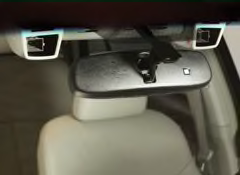
For less money, you can opt for the Subaru Outback, which is much roomier and gets better fuel economy. Changes for 2013 include a redesigned four-cylinder engine and continuously variable transmission, a revised suspension, and the availability of a new suite of safety features called EyeSight.
Not all of the changes were improvements, however. Firmer suspension tuning has reduced body lean and helped tidy up the sloppy emergency handling that we criticized in the 2010 Outback. But it also spoiled the car's previously plush ride.
Fuel economy is still a class-leading 24 mpg overall. But acceleration often feels lethargic, and the coarse engine noise accentuated by the unrefined CVT becomes obtrusive at times. In addition, opting for the navigation system adds some badly designed controls.
Overall, the Outback's road-test score dropped to 73 from its previous 79.
You can buy a basic Outback for under $25,000, but the price climbs steeply as features are added. Our heavily optioned Limited model rang in at a hefty $34,698. Based on our latest subscriber survey, we expect the Outback's reliability to be much better than average.
The Allroad is clearly the more engaging and comfortable car to drive. It feels sporty and tackles corners enthusiastically. At its handling limits, the Allroad displayed tenacious grip and posted a good speed while threading through our avoidance maneuver. The steering is overly light at low speeds, but it firms up nicely and delivers better feedback at higher speeds.
Complementing its sporty demeanor, the Allroad is also a quiet, rock-steady cruiser with a supple, well-controlled ride.
By contrast, the Outback isn't as nimble as some SUVs. It lumbers through turns when rushed, with delayed responses. Electronic stability control kept it secure in our avoidance maneuver, but its pronounced body lean and low cornering limits left drivers feeling harried, not confident. And artificially heavy steering communicates little feedback to the driver.
Response from the Audi's engine sometimes lags from a standing start but feels lively once the car is rolling. The Outback's redesigned 2.5-liter, horizontally-opposed four-cylinder engine added 3 horsepower. Acceleration is slightly quicker but remains just adequate. The CVT is sometimes slow to engage when shifting into gear, resulting in a disconcerting bump. At this price range, many buyers may prefer the optional 256-hp six-cylinder engine, which comes with a five-speed automatic; we expect it to deliver about 20 to 21 mpg.
Both wagons have attractive cabins, but the Audi's uses much nicer materials. Each has a comfortable driving position aided by a tilt-and-telescoping steering wheel. And they provide better visibility than most SUVs. The view out is excellent from the Outback, but a small rear window compromises the Allroad's.
Cabin space is a notable difference. The Allroad's interior is snug; the Outback's is spacious. Some testers found the Allroad's front seats to be supportive but hard. The Outback's seats are softer, but short cushions reduce thigh support. There's no comparison in the rear: The Outback's rear seat is roomy enough to fit three adults across, but even two adults barely fit in the Allroad's.
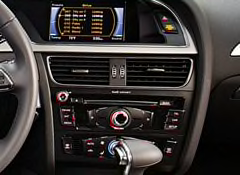
The Subaru wins on controls, sort of. Most are straightforward, though the navigation system is more cumbersome than most, and it relegates various radio functions to tiny onscreen buttons. In the Audi, even basic radio and climate controls are confounding, requiring a lot of steps using controller knobs and onscreen menus.
Bluetooth and iPod controls are standard on the Outback but optional on the Audi.
Both models have nicely finished cargo areas. The Outback's is more versatile, with a clever space underneath for stowing the cargo cover. The Audi's is much smaller but offers a power tailgate on higher trim levels and a two-position cargo net for securing luggage.
| Audi Allroad | Subaru Outback | |
|---|---|---|
| Highs | Handling, fit and finish, transmission, braking | Roomy interior, visibility, fuel economy, EyeSight safety features |
| Lows | Complicated controls, small rear seat and cargo area | Agility, acceleration, engine noise, complicated radio (with optional navigation) |
| Trim line | Premium | 2.5i Limited |
| Drivetrain | 211-hp, 2.0-liter, turbocharged four-cylinder engine; eight-speed automatic transmission; all-wheel drive | 173-hp, 2.5-liter, horizontally-opposed four-cylinder engine; continuously variable automatic transmission; all-wheel drive |
| Major options | iPod control, Bluetooth, HID headlights, heated front seats | Navigation, moonroof, rear camera, EyeSight driver assist system |
| Tested price | $43,570 | $34,698 |
| Audi Allroad | Subaru Outback | |
|---|---|---|
| Braking | Very short stops, with a firm, reassuring pedal feel. | Very good, with a firm, reassuring pedal feel. |
| Headlights | Xenon lamps provide good visibility with excellent light intensity but have a sharp cutoff. | Good low and high beams. |
| Access | Easy to the front, despite a wide, tall sill. A bit snug to the rear. | Large openings make it easy, despite tall, wide door sills that require a somewhat high step in. |
| Visibility | Good to the front and sides. The rear window is somewhat small. A backup camera is optional, but it should be standard at this price. | Large windows and thin roof pillars make it easy to see out. A backup camera is optional. |
| Cabin storage | Modest, with small compartments. | Moderate. |
| Head restraints | The center-rear restraint is not tall enough to protect an adult, even when it's raised. | The center-rear restraint is not tall enough to protect an adult, even when it's raised. |
| Child seats | Safety-belt buckles mounted forward of the seatback may make it difficult to secure some infant-seat bases. LATCH anchors are easy to access. | Owner's manual warns against installing in center-rear, the safest position. Some infant bases may be hard to secure in outboard positions with the safety belt, but LATCH installation is likely to be secure. |

 Build & Buy Car Buying Service
Save thousands off MSRP with upfront dealer pricing information and a transparent car buying experience.
 Get Ratings on the go and compare
while you shop

