Sign In

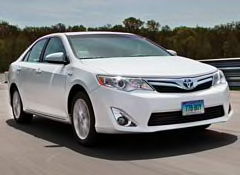
Pros: Potential for excellent fuel economy, run on existing gasoline supplies, and drive just like regular cars, requiring no change in lifestyle habits.
Cons: Some hybrids cost much more than similar conventional cars. Some don't live up to the gas mileage buyers may expect, especially considering the extra purchase price. On a mass scale, they are considered too little, too late, but big savings mean we'll see lots more of them.
Pros: All-electric range can address short commutes for many drivers, home recharging infrastructure is available, gas engine can extend range for long trips, cheaper cost per mile and no vehicle emissions when running in electric mode.
Cons: Big, expensive batteries plus a gas engine drive up prices, daytime recharging could strain electric grid, and they need to be plugged in to deliver any benefit. Gas-mileage benefits are highly dependent on driving habits and frequently overstated.
Pros: Quiet running, instant torque from electric motor, no emissions from the car, cost per mile is a fraction of that for a gasoline-powered car, widespread electric infrastructure, and electricity can be partially derived from renewable sources.
Cons: Long recharging times, limited range, expensive batteries, electricity production in much of the country uses coal—not a clean-burning source. High-voltage home chargers can be expensive, and public chargers scarce.
Pros: Thirty-percent better fuel economy than an equivalent gasoline vehicle, widely available, lower cost premium than for hybrid vehicles, engines deliver lots of torque for a given displacement, and any diesel car can run on a blend of renewable biodiesel fuel. With effort and investment, older diesel engines can be converted to run on pure waste vegetable oil.
Cons: Traditionally more engine noise and vibration. Additional emissions equipement drives up vehicle prices, which along with currently higher cost of diesel fuel takes a big bite out of any savings. Most clean diesels require refills of urea solution. Manufacturers won't warranty biodiesel blends of more than 5 percent biodiesel.
Pros: Renewable, fairly widely available, and older diesel cars can seamlessly burn biodiesel or diesel. Used vegetable oil can sometimes be free.
Cons: Using vegetable oil requires a costly conversion and a lot of effort. Quality of biodiesel varies widely, so carmakers will only honor warranties up to 5 percent biodiesel. And biodiesel costs more than petroleum diesel. So far, supply issues have prevented biodiesel supply from becoming widespread.
Pros: Reduces demand for foreign oil, low emissions, high octane, and can potentially be produced from waste materials; existing cars can use 10-percent blends (called E10), and more than 8 million cars already on the road can use E85.
Cons: Twenty-five percent lower fuel economy on E85 than gasoline. Less than 1 percent of U.S. gas stations carry E85. Federal fuel economy credits awarded to automakers for E85 cars lower overall fuel economy for all cars. Ethanol made from any food crop can adversely affect food prices. Farm equipment involved in crop production runs on petroleum, limiting the net benefits.
Pros: Costs much less than gasoline, burns much cleaner, and provides comparable power. It is an abundant natural resource in the United States.
Cons: Huge gas tanks reduce trunk space and carry the equivalent of only a few gallons of gasoline. CNG provides limited range, and there are few places for consumers to refuel in most of the country, plus refueling is relatively slow.
Pros: No vehicle emissions other than water vapor. Fuel economy equivalent to about twice that of gasoline vehicles. Hydrogen is abundant, and can be made from renewable energy.
Cons: This space-age technology is expensive. Acceptable range requires extremely-high-pressure, on-board hydrogen storage. Few places to refuel. Hydrogen is very expensive to transport and there is no infrastructure in place yet. Currently hydrogen fuel is made from nonrenewable natural gas in a process that creates enormous CO2 emissions.

 Build & Buy Car Buying Service
Save thousands off MSRP with upfront dealer pricing information and a transparent car buying experience.
 Get Ratings on the go and compare
while you shop

