Sign In

Menu
Suggested Searches
Recent Searches
Suggested Searches
Product Ratings
Resources
Chat With AskCR
Resources
All Products A-ZThe payment for your account couldn't be processed or you've canceled your account with us.
Re-activateMy account
Sign In
My account
Sign In

Update: See below for a correction related to this article.
Americans are buying more fish-oil supplements than ever, but in industry-standard tests of 15 top-selling brands conducted by an outside lab for Consumer Reports, five fell a bit short.
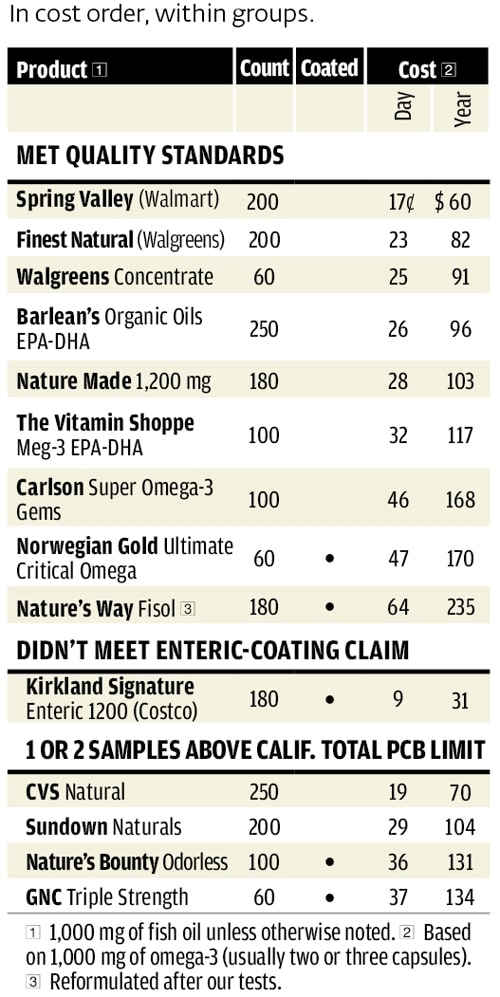
The lab tested three lots of each brand, bought in New York-area stores. All had their labeled amount of EPA and DHA, omega-3 fatty acids that can reduce the risk of heart attacks and strokes. And none exceeded limits for lead, mercury, dioxins, or polychlorinated biphenyls (PCBs) set by the U.S. Pharmacopeia (USP), a nongovernmental standard-setting group, or by the European Union.
But the test results revealed total PCBs in amounts that could require warning labels under California's Proposition 65, a consumer right-to-know law, in one sample of the CVS, GNC, and Sundown products, and in two samples of Nature's Bounty.
Most tested pills are claimed to be "purified" or "free" of PCBs, mercury, or other contaminants, claims that have no specific regulatory definition, the Food and Drug Administration says. The agency has taken no enforcement action against any omega-3 maker over PCBs or other contaminants, an FDA spokeswoman said, because it has seen no public-health risk.
And two samples of Kirkland Signature failed the USP's disintegration test for pills with enteric coatings (designed to prevent fishy aftertaste): Their coating could break up in the stomach, not in the small intestine as intended. Oddly, that was one of few tested products labeled "USP Verified," which indicates that the USP has tested and verified the claimed ingredients, potency, and manufacturing process.
Bottom line. Most people can get enough omega-3s by eating fatty fish—such as salmon and sardines, which are also low in mercury—at least twice a week. But people who have coronary heart disease require about a gram a day of those fatty acids, an amount that often requires taking a supplement. Check with a doctor before taking omega-3 pills because they can interact with some medications. Choose one listed under "met quality standards." Those cost anywhere from 17 to 64 cents a day for 1 gram of EPA and DHA combined, the amount the American Heart Association recommends for people with coronary heart disease.
Read "Is Fish Oil Right for You?" for more information on this supplement.
Correction: The version of this story that appears in the January 2012 issue of Consumer Reports magazine reported that our tests found "elevated levels of compounds that indicate spoilage" in samples of Nordic Naturals Ultimate Omega 1000mg (180 count). Just as digital versions of the story were being readied for publication, however, the company challenged our conclusion based on the fact that its product includes natural lemon oil as a flavoring. Upon further review, we have found that the industry-standard spoilage test we used cannot reliably detect spoilage in products with lemon oil, and we could not identify any current well-established methodology for doing so. (Nordic Naturals was the only lemon-flavored product in our study.) Because the spoilage test cannot be applied, we couldn't keep Nordic Naturals Ultimate Omega in a report that required all products to undergo all tests. Nordic Naturals did meet every other quality measure in our study. The pills, which cost about 67 cents per day, or $243 per year, contained their labeled amount of omega-3 fatty acids and met other U.S. Pharmacopeia (USP) and European Union standards, including those for contaminants such as lead, mercury and dioxins. They also met the stricter California Proposition 65 standard for total polychlorinated biphenyls (PCBs). A correction will appear in the February 2012 issue of Consumer Reports magazine.

 Build & Buy Car Buying Service
Save thousands off MSRP with upfront dealer pricing information and a transparent car buying experience.
 Get Ratings on the go and compare
while you shop