Sign In

An estimated 14 percent of Americans will experience a serious bout of depression during their lifetime, and 20 percent will experience an anxiety disorder. The ubiquitous advertisements for antidepressant drugs suggest that pills are the only answer—and that they work for everyone. Neither is really true, but you don't have to take our word for it: We surveyed more than 1,500 respondents toConsumer Reports' 2009 Annual Questionnaire who had sought professional help for depression, anxiety, or both.
Our results provide a window onto mental-health treatment as it's practiced in the real world, as opposed to the carefully controlled environment of clinical trials of psychiatric drugs.
Among our key findings:
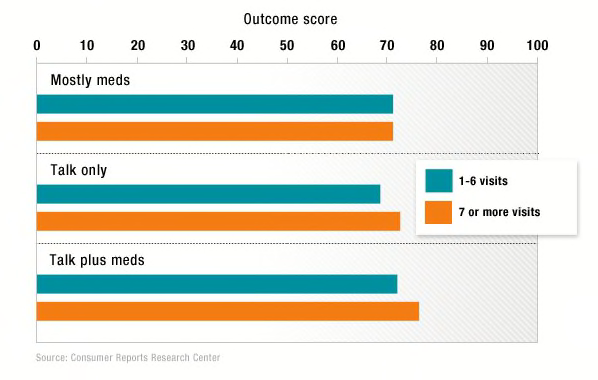
Respondents to our survey who stuck with talk therapy for just a little while—at least seven sessions—reported as much improvement as those who only took medication (though people who did both fared even better).
People who took medications from the SSRI class of antidepressants—which includes citalopram (Celexa), fluoxetine (Prozac), sertraline (Zoloft), and their generic equivalents—reported lower rates of side effects than those taking SNRIs, a newer, often more expensive class of antidepressants that includes venlafaxine (Effexor and generic) and duloxetine (Cymbalta). Yet patients found SSRI treatment at least as helpful.
Of readers who sought help for a mental-health difficulty, 58 percent had experienced anxiety, up from 41 percent in our previous mental-health survey, in 2004. Most drugs currently used to treat depression also work for anxiety, a boon for the many people who experience the two problems simultaneously.
As in our previous survey, rates of reported side effects among people taking antidepressants were higher than those reported in studies funded by drug companies. But rates for the most common side effect, loss of sexual interest or ability, were substantially lower among people taking the drugs than the last time we surveyed.
Psychologists (Ph.D.s), social workers (M.S.W.s), and licensed professional counselors (L.P.C.s) received equal helpfulness ratings from those who had talk therapy.
Our survey sample consisted of subscribers to Consumer Reports who had sought help for depression, anxiety, or another mental-health problem between January 2006 and April 2009. This report focuses primarily on the 1,544 respondents who experienced depression only (30 percent of the total), anxiety only (18 percent), or anxiety and depression at the same time (52 percent). They're not necessarily representative of the general U.S. population. Their average age was 58, and 55 percent were male.
Talk therapy offers two advantages over medication: no drug side effects and tools you can use for the long term.
"When you take medication, you stop the medication and the problem may come back," says Michael First, M.D., professor of clinical psychiatry at Columbia University. "When you have a run of cognitive behavioral therapy, you actually learn a skill. It's something that sticks with you."
Going to therapy requires a time commitment, and the insurance claims process might be more cumbersome than with medications. Still, if your plan will pay or you can swing the out-of-pocket portion of the cost, our survey suggests it's an investment worth making. Of the respondents who visited a mental-health professional for talk therapy, either alone or in conjunction with taking medication, 46 percent said the therapists had made things "a lot better" and 45 percent said they had made things "somewhat better."
That finding was consistent regardless of whether the person had seen a psychologist, a social worker, or a licensed counselor. Helpfulness scores were somewhat higher for people who had seen a psychiatrist, a medical doctor who can prescribe medication. Of patients who went to psychiatrists, 59 percent received some talk therapy, usually in combination with medication; the rest got only meds. (We also asked people if they had seen psychiatric nurses, practitioners who specialize in mental health and, in some states, can prescribe medications on their own. But only 2 percent of our respondents got their care from nurses, too few to be included in our analysis.) In two states, appropriately trained psychologists have a limited authority to prescribe medications, but in general psychologists typically specialize in talk therapy.
People who stuck with talk therapy for at least seven sessions had significantly better outcomes than those who went to six or fewer sessions. What's more, they scored as high as people treated mostly with medication on our overall outcome scale, which combined respondents' perceptions of their provider's helpfulness, satisfaction with their treatment, and change in their self-reported mental-health status after treatment.
Depending on the severity of your symptoms, therapy may be a good first step; you can always talk to your therapist about adding medication later if needed. The best-studied talk therapy is cognitive-behavioral therapy, or CBT, in which you learn to recognize and change thoughts or behaviors that contribute to your distress. Many therapists practice a hybrid approach that may combine aspects of CBT with other strategies. Some research suggests that the quality of your relationship with your therapist, regardless of the degree on the wall or the style of treatment, is an important key to success. So put your energy into finding a compatible one.
Our past surveys have shown that people who find a therapist through a recommendation from a friend, family member, or doctor have more success than those who pick someone at random from the phone book or their health plan's provider directory. If you can't find one that way, try the online therapist finders at the Association for Behavioral and Cognitive Therapies, the Anxiety Disorders Association of America, or the American Psychological Association, or check with the employee assistance program at your workplace.
When you're interviewing possible therapists, these questions can help you determine whether it's a good fit:

Most respondents—78 percent—received medication for their depression or anxiety, reflecting the tremendous growth of the use of antidepressant drugs in the past 15 years. According to IMS Health, a group that monitors drug sales, U.S. doctors prescribed $9.9 billion worth of antidepressants in 2009, a 3 percent growth over the previous year. They're the third most prescribed class of drugs in the country, after cholesterol-lowering drugs and codeine-based painkillers, thanks at least in part to years of aggressive marketing.
Drugmakers spent almost $300 million in 2009 on ads for two newer antidepressants alone: duloxetine (Cymbalta: "When you're depressed, where do you want to go? Nowhere.") and desvenlafaxine (Pristiq: "I feel like I have to wind myself up just to get out of bed.").
Reflecting national trends, most recipients of medication in our survey got an SSRI (selective serotonin reuptake inhibitor) such as fluoxetine or sertraline; many others got an SNRI (serotonin and norepinephrine reuptake inhibitor) such as venlafaxine or duloxetine. The drugs alter the levels of certain brain chemicals, or neurotransmitters, that carry signals between nerve cells. The Food and Drug Administration has approved SSRIs and SNRIs as standard first-line treatments for depression and anxiety disorders.
Forty-seven percent of respondents got their prescription from a psychiatrist; the rest obtained it from their primary-care physician, whom they saw separately or as an adjunct to talk therapy with a mental-health professional. That's consistent with national data that show primary-care doctors, not psychiatrists, prescribe the majority of SSRIs and SNRIs and have done so for at least the last five years.
Some SSRIs and SNRIs are promoted for particular types of anxiety, such as social anxiety or obsessive-compulsive disorder. But clinical evidence shows that they work equally well for each major form of anxiety. And individuals don't all react the same way to these drugs, so it can take some trial and error to find the one that works best for you. Among respondents who took medication for anxiety or depression, the median number of drugs tried was three. Respondents who tried three medications had slightly better outcomes than those who tried fewer or more, suggesting that trial and error is an important part of pharmaceutical treatment.
As with all drugs, antidepressants have side effects. But our findings suggest they can be a lot more common than what's reported in the package inserts you get when you fill your prescription. For example, 31 percent of people we surveyed who took SSRIs and 36 percent of those who took SNRIs reported a decrease in sexual interest or ability. That's more than double the rate reported in studies sponsored by drug companies, which can carefully choose their participants and tend to pick those least likely to experience adverse effects.
Interestingly, men reported more sexual side effects than women, while women complained more often about weight gain. It may be a true physiological difference, or women may simply be more bothered by weight gain and men by sexual difficulties.
The sexual side-effect rates from the current survey are lower than those we found in 2004, when up to 53 percent of respondents reported them. "It's possible that health-care providers are either prescribing antidepressants that are less likely to cause these problems, such as bupropion (Wellbutrin and generic) or are adding another drug in as an antidote to help counteract the sexual side effects," said Anita Clayton, M.D., a professor of psychiatry and obstetrics and gynecology at the University of Virginia.
For many respondents, side effects proved more than mere annoyances: Of those who'd stopped taking an antidepressant, 33 percent said they did so because of intolerable side effects. Still, the drugs helped a lot for about half of the people who took them and at least somewhat for another 30 percent. And people who took the drugs in conjunction with talk therapy fared especially well.
For the 58 percent of respondents who experienced anxiety, we also asked about benzodiazepines, an older class of anti-anxiety drugs that includes alprazolam (Xanax and generic) and lorazepam (Ativan and generic). About one-quarter had tried a benzodiazepine; of those, 57 percent said it helped "a lot." The drugs can cause dizziness and drowsiness, though, and unlike SSRIs and SNRIs, their daily use can lead to dependence. Our medical consultants say they're best for short-term "rescue" situations, such as quelling a panic attack or helping a fearful flyer board a plane.
Consumer Reports Best Buy Drugs, a public education project that generates drug recommendations based on safety, efficacy, and price, says that generic bupropion, citalopram, fluoxetine, and sertraline are among the best initial options to consider for depression. Ask your doctor whether you can start at the lowest dose possible. If the first drug hasn't helped within six to eight weeks, talk with your doctor about increasing the dose or switching to a different drug. Don't take bupropion if you have a history of seizures, since it carries a risk of seizures at high doses. Discuss with your doctor the potential side effects and how long you'll probably need to take the drug (most respondents had been taking theirs for at least two years). Don't stop taking an antidepressant suddenly, which could cause withdrawal symptoms.
We asked readers who took drugs for anxiety, depression, or both within the past three years to rate them. Responses are based on 1,386 experiences. (Some reported on more than one drug.)
Side effects were rated by 872 respondents based on the most recent medication they tried. Sixty-nine percent of those who tried medication experienced at least one side effect. They rated SSRIs at least as helpful as SNRIs but with fewer side effects. Note that bupropion (Wellbutrin and generic) has approval only for treating depression, not anxiety. It is displayed in a separate category because it is neither an SSRI nor SNRI.
Retail prices for the drugs range from about $20 a month for generic SSRIs to more than $400 a month for some name-brand drugs.
| Drug class | Effectiveness | Side affects | |||||
|---|---|---|---|---|---|---|---|
| Helped a lot |
Helped somewhat |
Loss of sexual interest or ability |
Weight gain |
Dry mouth |
Sleep problems |
Difficulty stopping the drug |
|
| SSRIs (Celexa, Lexapro, Prozac, Zoloft) | 53% | 35% | 31% | 16% | 13% | 12% | 8% |
| SNRIs (Cymbalta, Effexor) | 49 | 36 | 36 | 22 | 31 | 16 | 13 |
| Bupropion (Wellbutrin) | 48 | 38 | 23 | 12 | 20 | 17 | 5 |
Source: Consumer Reports National Research Center
We measured improvement by combining 1,544 readers' reports of satisfaction with their treatment for anxiety or depression, how helpful they found their doctor or therapist, and the degree of change they reported in their emotional state since starting treatment. We then converted the results to a 100-point scale. Readers who used both drugs and talk therapy for at least seven visits fared best.

Media outlets were abuzz early this year with the news that antidepressant drugs don't get rid of depression. The source was a Jan. 6, 2010, report in the prestigious Journal of the American Medical Association analyzing data from six clinical trials of antidepressants conducted between 1980 and 2009, involving 718 patients. The study concluded that when people with mild or even moderate depression took a pill, their symptoms improved. The kicker: The improvement was the same, on average, whether the pill was a real drug or a lookalike placebo. Only among people with more severe symptoms did the real drugs have an edge over the placebo.
Studies like those make great headlines. Far more complicated is how to apply the findings in real life. You can't diagnose or track depression with a blood test or an X-ray. Assessing improvement relies completely on the patient's subjective reporting of his or her state of mind. Plenty of studies have shown that the drugs work, though placebo effects are notoriously high in antidepressant trials, and the drugs' advantage over placebos is usually modest.
Then there's the fact that placebos can and do work in and of themselves. "It's always been known that people with milder depression are more likely to respond to placebo than people with more severe depression," says Michael First, M.D., a professor of clinical psychiatry at Columbia University. That may result from the power of suggestion, the reassurance of care from an empathetic therapist, or the confidence that comes from taking action to get better.
Depression also tends to improve over time naturally, so the placebo improvement might be, in part, just the illness running its course. "But practically speaking, how do you get around that?" First says. It's unethical for doctors to give patients placebos without telling them, unless they've agreed to be part of an approved clinical trial. But for a placebo to work, the doctor has to lie; research has documented that once people know they're getting the placebo, the effect goes away. As effective as the placebo response can be, "there's an inherent impossibility in real life to harness it," First says.
If you're not sure you need an antidepressant any more, talk with your doctor about reducing the dose or weaning off of it. Never stop an antidepressant suddenly or on your own; you may be risking severe withdrawal symptoms.
There's no question that talk therapy helps. But it's hard work, emotionally speaking, and can be costly: Therapists charge by the session, and insurance reimbursement varies widely.
"A lot of people aren't covered for therapy where they may be covered for the medications," said Michael First, M.D., professor of clinical psychiatry at Columbia University. In our survey, people taking medication were more likely to report that insurance paid more than half the cost than those who opted for talk therapy by itself.
That situation is about to change for many people, thanks to a new federal law, the Mental Health Parity and Addiction Equity Act, which takes effect for plan years beginning on or after July 1, 2010. The law says that group health plans that offer mental-health coverage must charge the same co-pays and deductibles, and allow the same number of provider visits, for mental-health and substance-abuse treatment as they do for other medical care. In other words, your plan can't cut you off after 20 therapy visits in a year if it allows unlimited doctor visits for other types of treatment. You'll still have to deal with your plan's normal coverage rules—using only in-network providers, for example. Individual health plans aren't covered by this law, but the national health reform law signed on March 23, 2010, will extend the same mental-health protections to these plans in 2014. A similar parity law for Medicare went into effect in 2010 but won't phase in fully for several years and imposes limits on inpatient treatment.
If you have a flexible spending account, consider depositing money into it to help defray out-of-pocket therapy costs. If the therapist takes insurance, will he or she submit the claim or will you take care of that chore? If you're paying out of pocket and have a limited income, ask whether the therapist will give you a discount off the regular fee.
"I'm taking an antidepressant, but I'm still not where I want to be with my symptoms."
If that line sounds familiar, it's because you might have heard it in recent television commercials for the powerful psychiatric drug aripiprazole (Abilify). Originally approved to treat the disabling mental illnesses of schizophrenia and bipolar disorder, Abilify is now, with permission from the Food and Drug Administration, being pitched to people with depression who haven't gotten relief from milder drugs such as SSRIs.
In December 2009, Abilify's competitor quetiapine (Seroquel XR) succeeded in winning the same approval as an add-on for depression.
The mass marketing of hard-core psychiatric drugs is worrisome, said Julie Donohue, Ph.D., an assistant professor at the University of Pittsburgh Graduate School of Public Health. "People might think from the commercial that everybody's going to get better, when really it's a minority of patients who respond to the treatment," she said.
Another issue is that the studies conducted to secure Abilify's approval as a depression add-on lasted only six weeks. "That means we don't know the long-term benefits or harms of the drug for this use, which is a problem because people will take Abilify for months—and probably years," said Steven Woloshin, M.D., a professor of medicine at Dartmouth Medical School.
Side effects include significant weight gain and elevated blood sugar. The drugs can also cause akathisia (inner restlessness or urge to move around), decreased white blood-cell counts, and rarely an irreversible condition called tardive dyskinesia that causes repetitive, involuntary movements of the face or body.
The ads tend to gloss over the fact that Abilify is just as likely to produce a bad side effect as it is to rid depression. In one of the six-week trials, depression went away in 25 percent of people taking Abilify, compared with 15 percent on a placebo. But 26 percent of the Abilify group experienced akathisia, compared with 4 percent of those on the placebo.
Something else the ads don't mention is the cost of the drugs: up to 45 times as much as many antidepressants.
The severe side effects associated with antipsychotics underscore the importance of considering them only as a last resort for hard-to-treat depression. Of the two antipsychotics approved as add-ons, Abilify appears to have fewer side effects than Seroquel.

 Build & Buy Car Buying Service
Save thousands off MSRP with upfront dealer pricing information and a transparent car buying experience.
 Get Ratings on the go and compare
while you shop

