
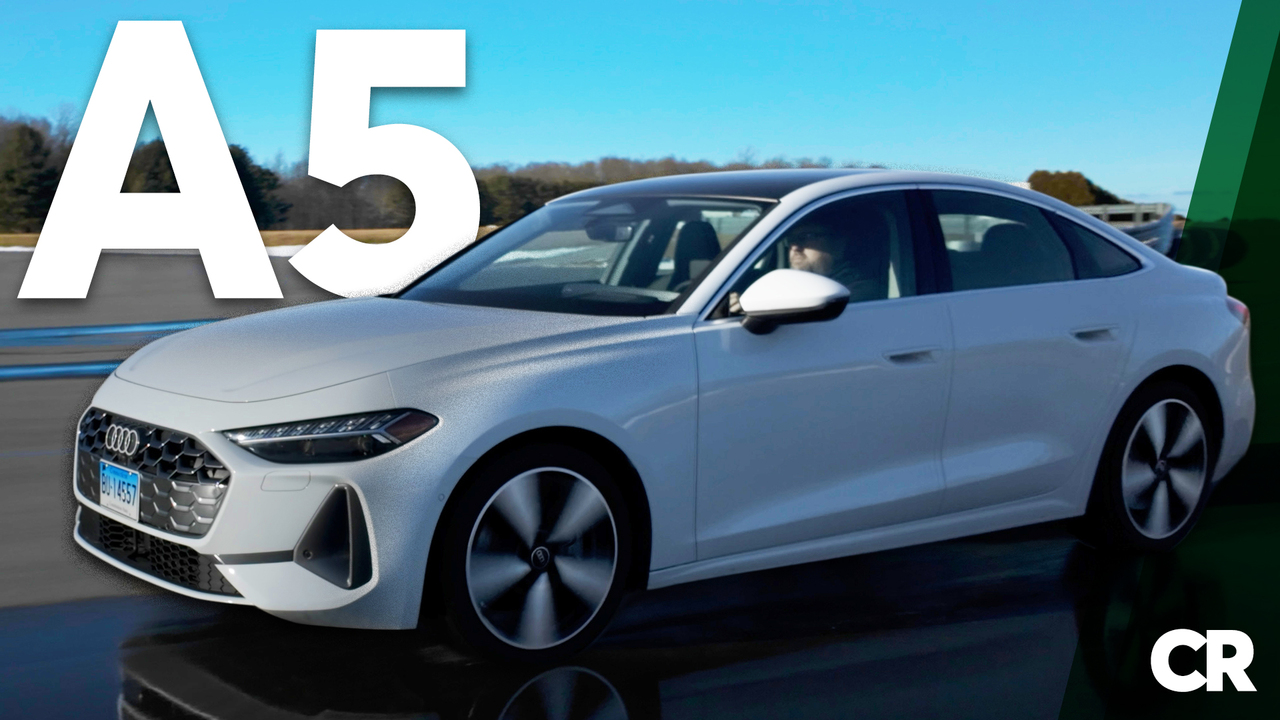

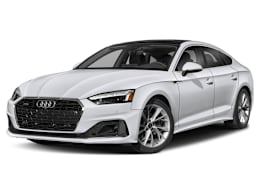
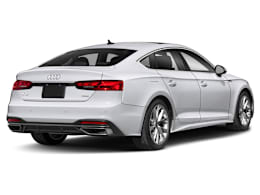
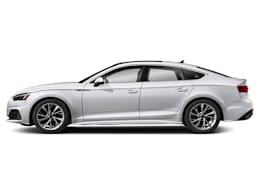
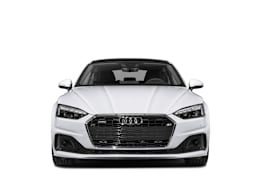
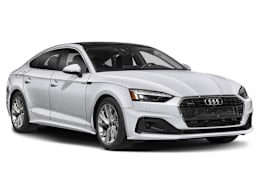
The redesigned A5 is the result of Audi consolidating the A4 and A5 into one model. For the North American market, the German automaker dropped the A4 sedan, convertible, and wagon (Avant) body styles, choosing to go with just the A5 four-door, which has a roofline that looks like it slopes into a conventional trunk, but is actually a hatchback. This isn’t a completely surprising move; more and more automakers have been moving away from cars as consumers tend to favor SUVs. Still, it’s a major change of direction in the luxury car market, as main competitors BMW and Mercedes-Benz still offer an array of small sedans, coupes, and convertibles in the U.S.
Regardless of Audi’s design and marketing choices, we found the new A5 pleasant and confidence-inspiring to drive, with quick steering, well-controlled body roll, and strong brakes, which together make it an engaging car to hustle along a curvy road. It also benefits from a quiet cabin, comfortable and supportive front seats, and the added cargo-carrying ability that comes with its hatchback design.
It garnered a commendably high road-test score, but it would have done even better if not for two fairly flagrant issues: The first is the seven-speed dual-clutch automatic transmission’s low-speed lurching and hesitation, which mars the driving experience. The other standout sore point is the A5’s unintuitive controls, many of which are frustrating to use while driving.
“Looking past the electronic glitches that our car initially suffered from, there are some glaring problems with the capacitive-touch controls,” said one of our testers. “You can get used to them, for sure, but it won’t make them any better. The powertrain is a mixed bag—it has a really nice, punchy engine, but it’s held back at times by the dual-clutch transmission. Handling is a high point for this car, and it's quite fun to drive on a twisty road. It's nice and quiet and feels very well built, even though the ride is stiff at times. The digital sunroof shade is cool, but it's gimmicky.”
“Nice powertrain most of the time, and good handling, but you're stuck with finicky controls and an overly complex and dense infotainment system,” said another tester. “Not that we rate styling, but I feel like Audi has taken a step back in both exterior and interior appearances of late. The exterior design is a bit boring, and I don't like the cheap-feeling steering wheel buttons and door controls. There’s something about pressing ‘buttons’ on a shared plastic panel that feels more like it belongs in a $35,000 model. The A5 isn’t a bad car, mind you; but I don't think it's an overly compelling choice at almost $60,000 as-tested.”
Further, the sentimental car-geeks on our staff (which is most of us) are sad to see the A4 name drive off into the sunset after more than 30 years of rivalry with the BMW 3 Series and Mercedes-Benz C-Class. After all, the A4 was a key part of Audi’s resurgence in the U.S. market in the late 1990s.
We bought a 2025 Audi A5 Premium Plus Quattro for $57,575—anonymously from an area dealer, as we do with every vehicle we test—for the purpose of this road test review. Our A5 was assembled in Neckarsulm, Germany.
Of note, just a few days after we took delivery of our A5, it developed a host of technology-related teething pains. First, the capacitive-touch controls on the right side of the steering wheel stopped working; then the blind spot warning indicators started randomly illuminating; it would notify the driver for a few miles after startup that the Front Assist system (Audi-speak for automatic emergency braking) needed to initialize; and the rear belt minder system would consistently alert the driver that someone was sitting in the back seat unbuckled, even when the seat was empty or folded flat.
While these problems don’t affect our testing or reliability ratings, it’s troublesome to see them appear on a brand-new car.
Driving experience
The A5 is available with a choice of two powertrains. Mainline versions use a 268-hp, 2.0-liter turbocharged four-cylinder engine, while the higher-performance S5 comes with a 362-hp, 3.0-liter turbocharged V6. Both cars use a seven-speed dual-clutch automatic transmission and have standard all-wheel drive.
While dual-clutch transmissions are known for their fuel-efficiency and sporty driving characteristics, they often cause low-speed delays and hiccups, and unfortunately that’s the case with the A5. There’s almost always some level of delay when taking off from a full stop or a rolling one, and at times you can feel the clutches slipping. It’s a similar situation when you go to get back on the power after slowing down to turn onto another road—the driver is met with a delayed downshift to the correct lower gear.
That’s a shame, because once underway, the turbocharged four-cylinder and dual-clutch transmission work well together. The engine provides strong power and the transmission shifts smoothly the majority of the time. The engine and exhaust deliver a polished sound and, when driven hard, the full 268 hp can scoot the car along with force. That was borne out by our acceleration testing, where the A5 sprinted from 0 to 60 mph in 6.7 seconds, a competitively quick time. Fuel economy is decent, too, at 27 mpg overall on the required premium fuel.
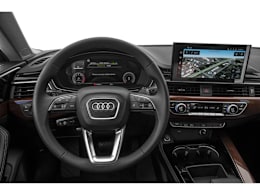
While the powertrain is less than perfect, the A5’s handling is nearly spot-on. It has quick and responsive steering that’s nicely weighted. Our testers also appreciated that there is a good deal of feedback sent through the steering wheel, giving the driver information about how much grip the front tires have. We found it an easy car to drive quickly through corners, and it inspires the driver to push the pace where appropriate. We were also happy to find a fully-round steering wheel, something that is becoming more of a rarity these days.
The ride has the quintessential tautness that’s a hallmark of German vehicles. On well-maintained roads, the suspension does an effective job of absorbing bumps without any harshness. But the taut ride can transmit pretty large hits over imperfections such as potholes or recessed manhole covers, and undulations in the road can cause noticeable front-to-rear pitching sensations.
Cabin noise is nicely hushed in most ways. The engine stays quiet in regular driving, and it has more of a cultured note than some turbocharged four-cylinders. Road noise is the biggest offender, but it typically doesn’t get intrusive, beyond some “boominess” on certain surfaces, such as concrete roads.
Cabin comfort
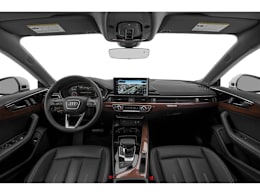
There was a time when Audi was known for its fancy-looking interiors, but things have gotten a bit dour—literally. The A5’s cabin is a very dark space. To be fair, the first model we could get our hands on had a black interior. Lighter interiors are available, and they have more contrast with the black door and dash panels. But regardless of the interior color, there’s an abundance of plastic surfaces, and it just doesn’t look or feel all that special. Even the bits of wood trim are so subtle and small that you barely notice them. The door panels are rather boring, and the center console is adorned with glossy black plastic, a surface which collects dust and fingerprints, and tends to scratch easily. At least the door pockets have a grippy rubber base, and the glove box is nicely lined.
The A5’s low-slung design makes it a bit challenging to get in and out. Once in, most of our testers found plenty of headroom, but also a few issues that made it difficult to feel fully comfortable behind the wheel. For example, the center console forms a fair amount of intrusion with the driver’s right knee. And while it’s nice to have a power steering column, several drivers wished the steering wheel could tilt down quite a bit lower. As it is, its lowest position means the rim of the wheel blocks some items in the driver’s instrument screen from view, most notably the turn-signal icons.
On the other hand, a majority of our testers praised the A5’s front sport seats, which are included with the optional “Warm weather package.” They have a wide variety of adjustments for both the driver and front passenger, including four-way lumbar support. Further, the seats have firm, supportive bolsters to keep occupants from sliding about in turns, and the bottom cushion has a manual extension for additional thigh support. The rear seat is snug. Average-sized adults and up will find headroom tight, and foot space is a bit squished under the front seats. If you fit, the seat is reasonably hospitable, with a good amount of underleg support and comfortable padding. The seatback is quite upright, though.
The move to make Audi’s sole compact luxury car a hatchback pays dividends. This design makes it easier to load and unload large objects (say, a bicycle or long boxes) into the A5’s cargo area than into the old A4’s trunk. In our cargo test, we were able to fit 3 large suitcases, 1 overnight duffel bag, and 2 travel backpacks behind the upright rear seat, which is a decent amount of luggage.
Controls and usability
The A5 features not one but two large screens that appear as a single unit: An 11.9-inch driver’s instrument screen and a 14.5-inch infotainment touchscreen, the right side of which curves toward the driver. The infotainment system comes across as initially overwhelming, and this isn’t aided by the fact that the A5 mostly has capacitive-touch controls, with few physical knobs or buttons. As such, common tasks, like adjusting the climate system, headlights, or media, require extra attention, and the touchscreen suffers from small text and inconsistent menu structures.
We also weren’t fans of the all-too-easy-to-engage capacitive-touch buttons on the door panel, which not only take care of the usual suspects—door-lock/unlocking and mirror controls—but also handle seat memory, child lock, and headlight controls. This arrangement pushes the window controls farther back on the armrest, making them awkward to access.
Active safety and driver assistance
Standard active safety and driver assistance features include automatic emergency braking with pedestrian and cyclist detection, automatic emergency braking that operates at highway speeds, blind spot warning, rear cross traffic warning, reverse automatic emergency braking, lane departure warning, lane keeping assistance, adaptive cruise control, and automatic high beams.
Audi’s Adaptive Cruise Assist comes on the second-tier Premium Plus. It gives the driver the ability to simultaneously use adaptive cruise control and lane centering assistance, with detailed map data and anonymized data collected from other vehicles. It uses radar, cameras, and ultrasonic sensors to maintain the following-gap distance to the vehicle ahead and allows the A5 to accelerate, decelerate, and stay within the travel lane at both city and highway speeds, including in traffic jams. However, the A5 does not have a direct driver monitoring system (DDMS) that gives an alert if the driver looks away from the road for too long.
We’re happy to see that both a rear occupant alert system and a belt minder come standard. The former is designed to remind the driver—based on rear-door logic—to check the rear seat when they turn the A5 off to help prevent children and pets from suffering heatstroke or hypothermia if unintentionally left behind in the vehicle. The rear belt minder alerts the driver if a rear passenger unbuckles their seat belt during the trip. There’s also a feature called “Exit warning” that will alert occupants not to open a door when parked on the street if the system detects a cyclist or vehicle approaching from behind.