
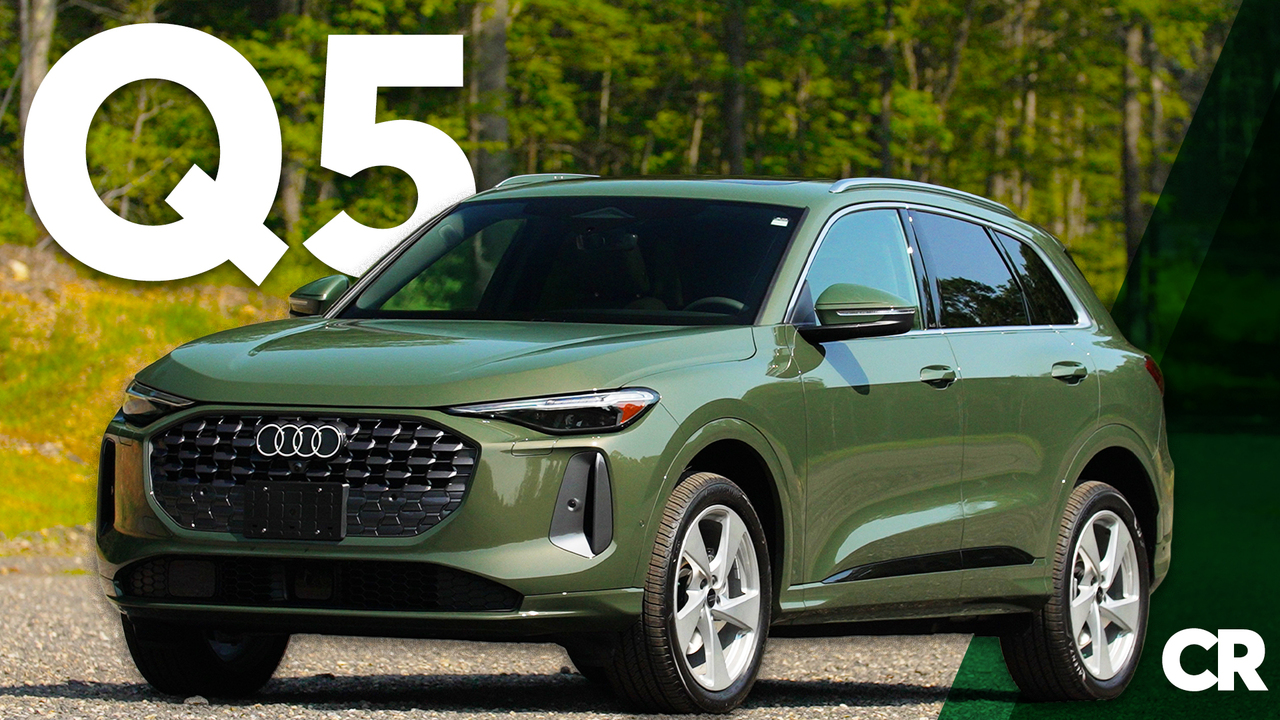


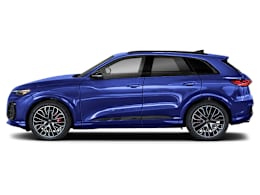
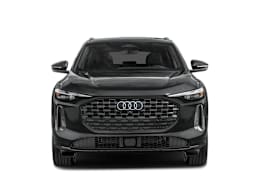
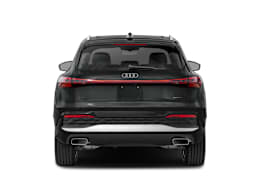

Last redesigned for the 2018 model year, the previous Q5 had been among the better luxury compact SUVs in our ratings. The latest Q5 retains many of the aspects that made the previous version a strong competitor, including agile handling, comfortable seats, ample passenger space, and a quiet, well-appointed cabin. The SUV also keeps its “just-right” sizing, which makes it easy to park or navigate in urban settings, while still comfortably carrying four adults and their cargo.
But we don’t love the new Q5’s stiffer ride, and the lurches from the dual-clutch automatic transmission really mar the driving experience at low speeds—this could be especially problematic for those who encounter traffic jams on their daily commute. Plus, Audi’s big push toward capacitive-touch controls has gone a little too far, and it’s easy to get bogged down trying to navigate through the infotainment system’s menus. After months of testing were completed, we weren’t all that surprised to find that the Q5’s road-test performance had actually dropped compared to the previous version, having slipped in some key areas, such as the smoothness of its powertrain, ride quality, and the usability of the controls.
“It's a premium SUV that is pretty quiet, handles well, and feels solidly-built,” said a tester. “But the powertrain’s low-speed hesitations and jerky response detract significantly from the experience, though things get a lot smoother at higher speeds. The ride is occasionally too firm, but it lends itself to a sporty and responsive driving experience. The controls become less annoying the more time you spend with them.”
“I enjoyed driving the Q5,” said another tester. “It’s an ideal size, mostly drives well, and the interior has a nice look and feel. The dual-clutch transmission is a mistake, though. It really degrades its low-speed driveability, and the power delays can be rather annoying. The ride can feel pretty stiff on the highway, too.”
We purchased a 2025 Audi Q5 Premium Plus Quattro for $60,040—anonymously from a local dealer, as we do with every vehicle we test—for the purpose of this road test review. Our Q5 was assembled in San Jose Chiapa, Mexico.
Driving experience
The Q5 uses a 268-hp, 2.0-liter turbocharged four-cylinder engine paired with a seven-speed dual-clutch automatic transmission and standard all-wheel drive, the last known as “Quattro” in Audi parlance. Although the powertrain works well once up to speed, it can feel somewhat clunky in your driveway, parking lots, and around town. The transmission seems indecisive as you try to get going from a stop, and often seems to be in the wrong gear when re-accelerating after slowing down for a car ahead of you, or when turning onto another road.
It’s a shame about those low-speed hiccups, because once the Q5 gets going, the powertrain works quite well. It has plenty of strong passing grunt, and the transmission upshifts smoothly, even at wide-open throttle. It took 6.9 seconds for the Q5 to accelerate from 0 to 60 mph in our tests, which is a few tenths of a second slower than the BMW X3 and Mercedes-Benz GLC, although still a competitive time.
Fuel economy hasn’t seen an improvement, with the Q5 managing the same 24 mpg overall on the required premium fuel as the previous model. That’s significantly lower than the X3’s 29 mpg overall and the GLC300’s 26 mpg. Further, drivers are likely to turn the fuel-saving engine stop/start system off, as it restarts the engine with a noticeable shudder, followed by a big delay of power.
Handling is another story, though. The Q5 shines when the road gets twisty, with good turn-in response and well-contained body roll. It proved quite fun to drive at its limits on our road course. This, despite the steering not doing a particularly good job of communicating the feel of the road surface or the grip level of the tires to the driver through corners. The tautly sprung suspension keeps the Q5’s body under control, allowing very limited side-to-side motions. But, along with our test vehicle’s optional 20-inch wheels and tires, the Q5 doesn’t do a very good job absorbing and softening impacts from bumps and other road imperfections.
Cabin noise is kept to a fairly quiet level, as expected of a luxury SUV. Wind and engine noise stay well muted, with road and tire noise only getting slightly elevated at times.
Cabin comfort
Between the brown seats contrasting with the black and gray trim panels, the natural wood inlays, and chrome trim, the Q5’s interior has a high-quality look and feel. The driver benefits from excellent headroom and plentiful seat adjustments. However, the steering wheel has a limited range of tilt and telescope adjustment, and the wide, plastic center console proved to be a near-constant intrusion with the driver’s right knee.
The front seats deliver a good balance between support and plushness, and benefit from four-way lumbar adjustment. The rear seat is a fine space for two adults to take a multi-hour trip. There’s sufficient headroom, plenty of knee room, and a reasonable amount of foot space underneath the front seats. Getting into and out of the front and rear seats is pretty easy, too.
Controls and usability
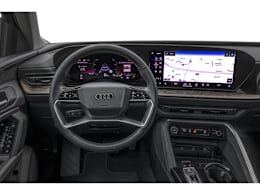
The infotainment system consists of a 14.5-inch center touchscreen and an 11.9-inch driver’s instrument screen. The two screens appear to blend seamlessly, creating the illusion of a single large display. The center screen features a high degree of customization and good contrast; however, the sheer number of icons and text can be overwhelming. Further, Audi relies too heavily on capacitive-touch controls, rather than physical knobs and buttons. Common tasks, like adjusting the climate system or media, require extra attention and driver involvement.
Pairing a phone via Bluetooth is straightforward, and both wireless Android Auto and Apple CarPlay come standard on all trims. The system allows access to multiple paired phones at once, with one phone able to be used for projection while the other’s contacts can be dialed.
We aren’t fans of the all-too-easy-to-engage capacitive-touch buttons on the door panel, which not only take care of the usual suspects—door-lock/unlocking and mirror controls—but also handle seat memory, child lock, and headlight functions. This arrangement also pushes the window controls farther back on the armrest, making them awkward to access.
The Q5 has fairly large front door pockets and decent storage underneath the center armrest for keys, a wallet, sunglasses, and more. The wireless charging pad is under the center stack of controls and is easily accessible. The front two cup holders have grippy rubber bases and plastic anti-tip measures to help hold drinks in place.
Active safety and driver assistance
Standard active safety and driver assistance features include automatic emergency braking with pedestrian and cyclist detection, automatic emergency braking that operates at highway speeds, blind spot warning, rear cross traffic warning, reverse automatic emergency braking, lane departure warning, lane keeping assistance, adaptive cruise control, and automatic high beams. Lane centering assistances comes with the Premium Plus and Prestige trims.
Audi’s Adaptive Cruise Assist gives the driver the ability to simultaneously use ACC and LCA, with detailed map data and anonymized data collected from other vehicles. It uses radar, cameras, and ultrasonic sensors to maintain the following-gap distance to the vehicle ahead and allows the Q5 to accelerate, decelerate, and stay within the travel lane at both city and highway speeds, including in traffic jams. However, the Q5 does not have a direct driver monitoring system (DDMS) that gives an alert if the driver looks away from the road for too long.
We’re happy to see that both a rear occupant alert system and a belt minder come standard. The former is designed to remind the driver, based on rear-door logic, to check the rear seat when they turn the Q5 off, helping to prevent children and pets from suffering heatstroke or hypothermia if unintentionally left behind in the vehicle. The rear belt minder alerts the driver if a rear passenger unbuckles their seat belt during the trip. There’s also a feature called “Exit warning” that will alert occupants not to open a door when parked on the street if the system detects a cyclist approaching from behind.