Your membership has expired

The payment for your account couldn't be processed or you've canceled your account with us.

Re-activate

2027
BMW iX5

EPA Range: 435 miles

BMW iX5 First Drive

Summary

Introduction

2027 BMW X5 Will Be Available With Fully Electric, Mild-Hybrid, and Plug-In Hybrid Powertrains

New styling includes X-shaped headlights and a slimmed-down grille, while a windshield-width display dominates the screen-laden interior. A turbocharged six-cylinder remains the standard engine.

Overview

The redesigned 2027 BMW X5 is a dramatic change to the current Consumer Reports Top Pick among luxury midsized SUVs. BMW’s second-best-selling model, behind the X3 luxury compact SUV, will again feature a turbocharged six-cylinder as the standard engine with the mild-hybrid system’s electric motor integrated into the transmission.

It marks the debut of a dual-motor iX5 60 all-electric model with an estimated 435-mile driving range along with BMW’s plug-in hybrid X5 50e xDrive returns with an expected improvement in its electric-only range. Both of these models are expected to arrive in early 2027. A V8-powered M Performance version will be available in late 2027, and a hydrogen-powered model is slated for the future.

As important as the powertrains are, the redesigned 2027 X5 features a plethora of advanced technology, from a windshield-wide screen featuring selectable widgets to a display for the front-seat passenger. The touch-sensitive exterior door handles, a unique steering wheel, and an expanded iDrive infotainment system that includes more third-party apps are just some of the new features in the X5.

Here's what we know.

The iX5 competes with the Audi Q6 E-Tron, Cadillac Vistiq, Mercedes-Benz EQE SUV, and Volvo EX90.

It is powered by dual electric motors with 570 hp combined (245-hp front motor, 325-hp rear motor); direct drive transmission; and all-wheel drive.

There is only a single trim 60 xDrive with a price of $79,800, plus $1,450 destination charge. The on sale date is Spring 2027.

The final assembly point is Spartanburg, S.C.

Impressions

Outside

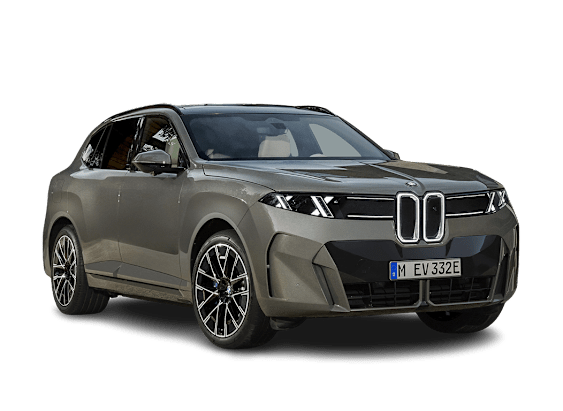
While its silhouette makes the redesigned 2027 X5 instantly recognizable as a BMW, it looks much like a significantly bulkier version of the new BMW iX3. From the throwback-styled grille that harks back to past models like the BMW 2002, to the stylized headlights, the X5 is the latest example of BMW dialing back the extroverted styling of recent models. The large dual-kidney of the iX and i4 may be relegated to BMW’s history—at least for now.

Like the iX3, the X5 variants forgo a wide chrome grille surrounding the kidneys, opting instead for surrounding illumination and horizontal lighting elements that extend toward the fenders. At the end of each light bar is a pair of lights that form a large X, an evolution of BMW’s classic four round headlights.

While the X5 40 and 50e versions have various intakes below the illuminated grille that direct air toward the engine and brakes, the EV has a continuous panel that differentiates it from the rest of the line.

Each version has prominent, flat wheel arches and deeply sculpted lower door sills, with matte-black side skirts.

The redesigned 2027 BMW X5 lacks traditional-looking door handles. Instead, the BMW Winglet door handles are integrated into the B- and C-pillars. An optional electric open-and-close feature allows passengers to touch the surface to power-open the doors, press the winglet to close the doors, and lock the X5 by holding the locking surface. All X5s come with soft close, which pulls the door fully shut when it is rested in a “near closed” state, as a standard feature.

Like the iX3, the roof spoiler and a rear bump-out for the taillights are significant design elements. Light bars extend from the BMW roundel mounted at the center of the rear hatch to the fenders.

Inside

The new technology inside the 2027 BMW X5 is more of a focal point than the luxury appointments. Front-seat occupants are greeted with a slim panoramic display that sits at the base of the windshield and stretches its width. It replaces the traditional driver’s gauge cluster and works in conjunction with the standard 3D head-up display and 17.9-inch center touchscreen. The driver or front-seat passenger can use drag and drop movements to adjust widgets around the center screen or up to the panoramic screen.

There are few physical controls in the X5, other than the crystal glass used for the gear selector, volume controls, and seat controls. Nearly everything else is a touch-sensitive surface with haptic feedback. The steering wheel will illuminate icons for active or available features, in what the automaker says is an effort to keep their eyes on the road. The BMW Personal Assistant uses machine learning to understand commands for operating the windows, climate settings, and entertainment system, and a Routines function will automate user habits, such as predicting when to raise or lower the temperature or activate seat heating.

An optional 14.6-inch screen for the front-seat passenger lets them stream content, use apps, or join video conferences. Driver-monitoring cameras prevent the driver from viewing the screen and becoming distracted while the X5 is in motion.

Wireless Android Auto and Apple CarPlay are standard. 

The center console has two cup holders, two USB-C ports, and a smartphone tray with inductive charging and a magnetic holder. Heated sport seats come standard and offer improved cushioning compared with the seats in the previous-generation X5. Optional multifunction seats include ventilation and active massage.

The rear seat features more knee room and revised seat angles to improve long-distance travel comfort. Like past X5s, the seats fold in a 40/20/40 split to expand cargo room. While a three-zone climate system is standard, the optional Climate Package includes a four-zone system with a touchscreen for the rear-seat passengers, ventilated front seats, and heating for the rear seats, steering wheel, and armrests.

What Drives It

The all-electric iX5 features two electric motors that combine to produce 570 hp. The rear is the primary drive axle and uses a synchronous motor that produces 325 hp. As part of the 800-volt architecture, the system does not use permanent magnets; instead, it uses electrically excited electromagnets that reduce losses at low loads and allow for stronger magnetic fields when higher torque is needed.

The asynchronous motor at the front axle produces 245 hp and uses induction rather than magnets, which is a relatively common strategy with modern EVs and allows it to switch off under low load to improve efficiency.

A North American Charging Standard (NACS) port is standard and supports DC fast charging at speeds up to 460 kilowatts. According to BMW, this means the battery can be charged from 10 to 80 percent in 22 minutes, which is about 170 miles of range in 10 minutes. The standard AC charging system operates at up to 15.4 kW. The iX5 features bidirectional charging to support device charging (vehicle-to-load), emergency power (vehicle-to-home), and vehicle-to-vehicle charging.

Safety and Driver Assistance Systems

All X5s will feature standard automatic emergency braking with pedestrian detection, blind spot warning, and rear cross traffic warning. In addition, the AEB and RCTW systems have brake intervention to avoid impacts when turning or backing out of a parking space. The AEB system has been upgraded to detect and respond to wildlife, and the exit warning system can delay a door opening if it determines that a cyclist or vehicle is approaching from behind when parked on a city street.

An optional highway hands-free driving system lets the driver operate the X5 on limited-access highways at speeds up to 85 mph. As part of that Highway Assistance package, the X5 can recommend a lane change, which the driver can confirm by looking in the appropriate side-view mirror.

The standard Driving Assistant Plus package includes lane centering assistance and will adjust the X5’s speed depending on speed limits and traffic patterns, such as corners, roundabouts, and turns.

Change Vehicle