
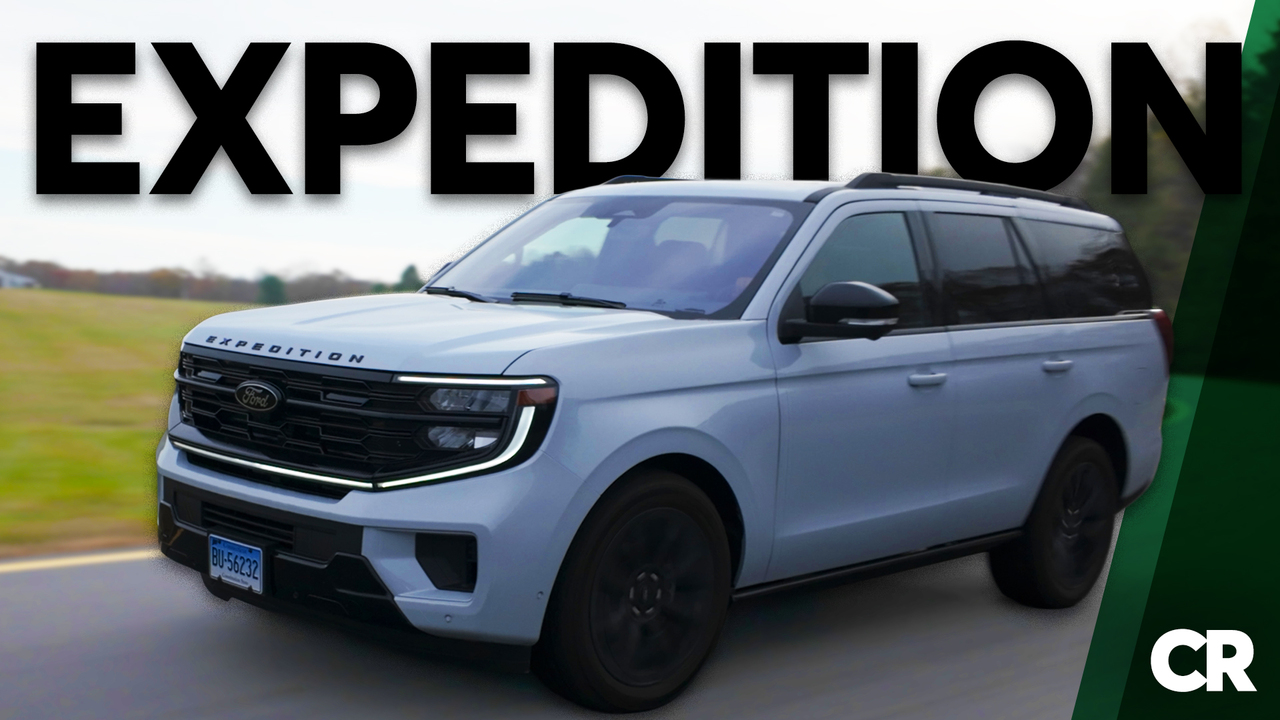
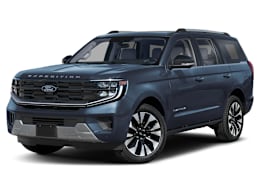
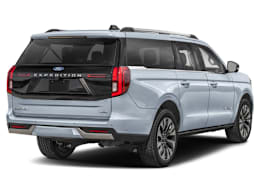
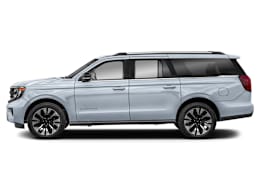
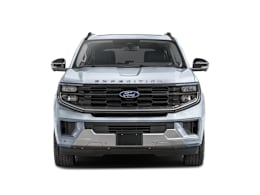
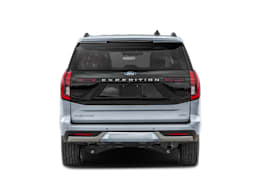
Revamped for 2025, the fifth-generation Expedition offers increased capabilities and more convenience features than ever before. This large three-row SUV is once again offered in two lengths: The standard version measures almost 210 inches bumper to bumper, and the Max stretches to almost 222 inches, with a 9-inch-longer wheelbase, for buyers who want to maximize cargo space. (The size essentially didn’t change from the previous generation.)
The revitalized Expedition arrives alongside the redesigned Lincoln Navigator, which pushes the boundaries of technology and luxury even further. The Expedition faces established rivals like the Chevrolet Tahoe and Suburban and the Toyota Sequoia, along with the Jeep Grand Wagoneer and the Nissan Armada. Shoppers looking for a full-sized SUV have some compelling choices to consider.
Overall, the redesigned Expedition improved in some ways, but regressed in others.
On the positive side of the ledger, the cabin is more modern, and the powertrain is glorious, with abundant thrust and a muscular soundtrack. Our testers also had high praise for the Expedition’s comfortable, spacious quarters and the capable BlueCruise hands-free active driving assistance system.
However, we were disappointed with the big Ford’s somewhat long braking distances and mediocre fuel economy. Further, several testers found the driver’s seat to be uncomfortable, while the Expedition’s oddly-shaped oblong steering wheel—and its unlabeled capacitive-touch controls—was so universally hated by our testers that for many of us, that aspect alone could very well be a deal breaker.
As one tester said, “Ford has succeeded in making a generally decent vehicle a nightmare, from the controls to the driver’s seat to the steering wheel; it's just not a good time.”
“It’s competitive within the three-row full-sized segment in terms of packaging, space, and capabilities,” countered another tester. “It's pleasant enough to drive and ride in, has tons of space, a great powertrain, and Ford went the extra mile to make a class-leading third-row seat. It's too bad you have to deal with the steering wheel shape, controls, and the impossible-to-ignore screen in front of you while you drive.”
We bought a 2025 Ford Expedition Platinum 4WD with the standard wheelbase for $79,995 —anonymously from an area dealer, as we do with every vehicle we test—for the purpose of this road test review. Our Expedition was assembled in Louisville, Kentucky.
Driving experience
The Expedition’s standard 400-hp, twin-turbocharged 3.5-liter EcoBoost V6 engine delivers abundant, smooth power and a satisfying V8-like growl. The 10-speed automatic transmission shifts smoothly. A softness to the accelerator pedal’s action adds a premium feel, with a gentle tip-in that awakens the turbocharged power plant and enables effortless passing.
Tested on our track, this powertrain took the chunky Expedition from 0 to 60 mph in an impressive 6 seconds flat.
We also sampled the optional 440-hp V6 in a Lincoln Navigator, which was lent to us by the automaker. (This engine is standard on the Tremor and King Ranch trims, and optional on the Platinum.) It sounds even more robust when pushed. Technically, the added oomph would help pull a large trailer, but in daily driving, we didn’t see a meaningful advantage—the regular engine is so potent that we don’t think most drivers will be pining for more power.
Fuel economy—never a high point for these truck-based three-row behemoths—actually improved by 1 mpg over the previous model, now coming in at 17 mpg overall. This puts it in familiar company with the Armada (17 mpg overall) and Grand Wagoneer (18 mpg overall).
As the Expedition is primarily bred for hauling families on the open road, we had low expectations for its ability to carve corners. Not surprisingly, we found that it exhibits significant body roll through turns and handles, well, like a truck. Beyond its ample girth, the dull steering, lackluster chassis response, and odd steering wheel shape further deter taking turns with enthusiasm.
The ride is good for a mainstream, full-sized, body-on-frame SUV—riding on 22-inch wheels, no less. But some road irregularities and expansion joints become quite noticeable, shuddering the body and sending vibrations through the steering wheel. Generally, the Expedition’s ride is comfortable most of the time, a notable feat given its wide range of capabilities, from transporting up to eight passengers and cargo to towing up to a 9,600-pound trailer.
Panic-brake stopping distances proved disappointingly long compared to competing models, especially in the wet. Our testers also found that the pedal didn’t always feel reassuring, as it can feel a bit grabby when you first press down on it.
The last Expedition was quiet for the class, but the new one is even slightly more hushed. As speeds increase, a bit of wind noise does creep in on the highway, and some road surfaces can be heard at times.
Cabin comfort
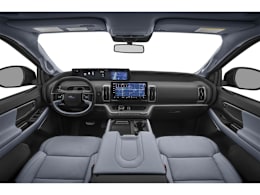
We bought the Platinum version for our test program, which sounds fairly decadent even though it’s just the second-tier trim; it’s definitely not as swanky as the top-level King Ranch model. Still, the interior is creatively designed, with thoughtful details like the carbon-look trim and ample exposed stitching. And, of course, there are the two large dashboard screens that dominate the cabin. We did find a few rough edges here and there, such as behind the steering wheel and on the door pockets—surprising for an $80,000 vehicle.
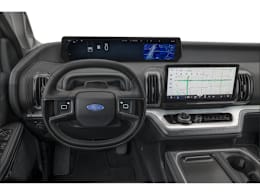
The Expedition’s driving position is upright and commanding, with ample headroom and a generally spacious feel. But the whole experience is mortally flawed by the oddly shaped steering wheel, which is squared off at the top and bottom to improve the view of the instrument screen and create pass-through room for the driver’s thighs when entering or exiting the vehicle. While the steering wheel feels fine with hands at the 9 and 3 positions, it feels utterly unnatural anytime you have to shuffle your hands, such as during parking maneuvers.
Testers were split when it came to the Expedition’s front seats. Several said that the seats didn’t work for them, citing inadequate bolsters on the seat base, and intrusive lumbar support—even in its most dialed-back setting. Others argued that the seat was comfortably wide and soft, with good cushioning and ample adjustability. Potential buyers should scrutinize these seats thoroughly before making the plunge.
The second-row seats provide ample legroom and headroom, even for taller passengers. The cushions are plush and supportive, offering good long-term comfort. The third-row seat is impressive, from both a roominess and comfort standpoint—even among large SUVs. Unlike most third rows, the one in the Expedition is truly adult-friendly.
As you’d expect from a vehicle with such outsized proportions, the Expedition has a ton of cargo space. Even with the third-row seat in its upright position, you can still fit two large suitcases and one overnight duffel bag back there. Fold both the second and third rows down, and you can practically move your whole house (well, maybe the contents of a studio apartment). But the coolest feature here is the Expedition’s split liftgate design—rather than just a giant, barn-door-sized liftgate that you see with most SUVs. The top three-quarter hatch hinges up, as is tradition on SUVs, while the remaining lower quarter forms a tailgate, which comes in handy for pregame festivities.
Controls and usability
As with many modern vehicles, the Expedition’s controls are via a central touchscreen display that gives access to common features like navigation, media, and your phone. It offers a split-screen layout, allowing you to view commonly used features, such as the navigation system and your media selection, simultaneously. Unfortunately, most testers found that the screen was too far out of reach to use comfortably.
Not only did none of our testers care for the shape of the oblong steering wheel, but they also despised the wheel’s unlabeled touchpads, which you need to use for media selections, cruise control, and to adjust the steering wheel and pedal position. This approach means the driver has to look back and forth between the buttons and the corresponding pop-up on the driver's instrument screen, and requires a couple of delicate manipulations to accomplish the desired task; most vehicles have dedicated physical buttons with icons for functions like volume and setting the cruise control following-gap distance. It feels like much of the flashy tech in the Expedition is meant to dazzle buyers in the dealership showroom rather than make driving easier. As one engineer wrote in the logbook, “It’s a usability nightmare.”
Besides the infotainment touchscreen, the Expedition also comes with a prominent 24-inch driver’s instrument screen. It’s mounted high on the dash, making it easy to monitor the vehicle’s speed and other driving information. But its near-domineering presence made us weary, especially when driving at night.
Active safety and driver assistance
The Expedition comes standard with Ford’s Co-Pilot 360 Assist 2.0, which incorporates several active safety and driver assistance features, including automatic emergency braking with pedestrian, bicyclist, and motorcycle detection; automatic emergency braking that operates at highway speeds; adaptive cruise control; lane centering assistance (but not hands-free); a blind spot warning system that can incorporate a trailer into its geometry; rear cross traffic warning; lane keeping assistance; intersection assistance; and a parking assist system with trailer assistance, which helps hook up a trailer. Also standard is a surround view camera system and automatic high beams.
Adding on the optional BlueCruise package brings hands-free lane centering assistance with adaptive cruise control. Ford says the BlueCruise hardware will be installed on all new Expeditions, and buyers who don’t spring for the optional suite will get a free 90-day trial included with their purchase. The BlueCruise features can be continued after the trial by paying short-term subscription fees or by paying a one-time lump sum to keep it for at least seven years.
A rear occupant alert system comes standard. It’s designed to remind the driver—based on rear-door logic—to check the rear seat when the Expedition is turned off to help prevent children and pets from suffering heatstroke or hypothermia if unintentionally left behind in the vehicle. There’s also a rear belt minder, which alerts the driver if a rear passenger unbuckles their seat belt during the trip.