
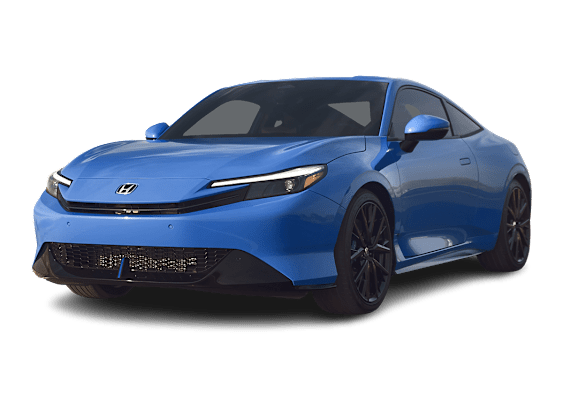
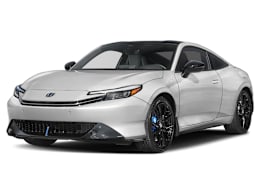
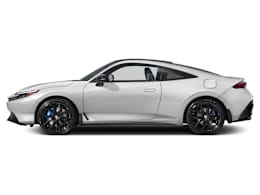
The new Honda Prelude is at its best when the road gets twisty. Its sharp handling, communicative steering, and super-strong brakes inspire confidence through challenging corners and make it genuinely fun to drive. We also like the smoothness and fuel economy of the Prelude’s hybrid powertrain. Plus, Honda continues to equip its vehicles with easy-to-use controls, bucking the touchscreen-everything trend. But at $42,000 before the destination charge and options, the Prelude falls within the same price range as some entry-level luxury cars.
Key Takeaways
- Superb handling makes the new Prelude a joy to drive on curvy roads
- Hybrid powertrain is smooth and efficient, but acceleration trails other sporty coupes
- The interior features easy-to-use controls, including many physical knobs and buttons
- Front seats are extremely supportive yet also comfortable
- The rear seat is tiny and lacks headroom, making it best for small cargo rather than humans
- The Prelude is priced similarly to small luxury cars, but it lacks the features and premium cabin ambience to justify it
ROAD TEST REVIEW
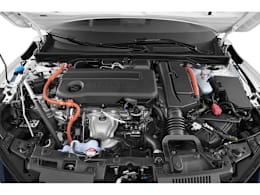
Like its predecessors, the new Prelude draws from the broader Honda parts bin to create a unique, more upmarket two-door model. Its powertrain comes from the Civic Hybrid, pairing a 2.0-liter four-cylinder engine with a dual-motor hybrid system that produces a combined 200 hp.
Many of the Prelude’s chassis and braking components come from the high-performance Civic Type R. The result is an unusual combination: acceleration that’s modest compared with other sporty coupes, and a suspension that some testers found too firm for the Prelude’s grand-touring mission.
After we spent months compiling results from more than 50 specific tests and evaluations at Consumer Reports’ 327-acre Auto Test Center, along with many miles behind the wheel on public roads, we concluded that the Prelude would have been a great Civic Hybrid Coupe if it had been priced accordingly. But with the Prelude’s high price comes higher expectations, which makes what Honda didn’t include all the more noticeable. Things like a power-opening hatch, power seats, a heated steering wheel, and a sunroof are not only conspicuously missing from the Prelude, but they aren’t offered as optional upgrades, either.
The BMW 230i Coupe starts at roughly the same price as the Prelude, but it’s a true entry-level luxury model with a quieter interior and brisk acceleration. Then there’s the Nissan Z, a more focused sports car with twice the Prelude’s horsepower and an available manual transmission. Other small, sporty cars undercut the Prelude’s price by thousands and offer various niceties and/or performance chops that the Prelude lacks. For example, the Ford Mustang, Mazda MX-5 Miata, Subaru BRZ, Toyota GR86, and Volkswagen Golf GTI all start in the low- to mid-$30,000s. For buyers craving a nicer version of the Civic who don’t mind four doors, the Acura Integra starts in the mid-$30,000s.
None of this is to say that the Prelude is a bad car, but it certainly isn’t the best value.
“If you ignore the price, it's a pretty impressive little car,” said one of our testers. “It's sleek, efficient, has a supersmooth powertrain, sharp handling, and comfortable seats. It's certainly unique and fun to drive, and I was quite excited for it. But the steep price can't be ignored, and ultimately, I was left a bit disappointed. Plus, it needs about 50 more horsepower.”
“As much as I love the Prelude’s styling, I felt totally let down by the lack of power,” agreed another tester. “To have such a capable-handling vehicle with such a weak powertrain seems like a crime. Just because it’s producing extra noises doesn't make me believe it's going any faster.”
We bought a 2026 Honda Prelude Hybrid Two-Tone for $44,350—anonymously from an area dealer, as we do with every vehicle we test—for the purpose of this road test review.
Driving experience
The Prelude features one of the most refined hybrid powertrains we’ve driven, with such a smooth blend between electric-only and hybrid operation that it’s hard to tell when the gas engine turns on and off without intentionally listening for it. Strong electric torque makes it particularly responsive from a standstill, and it’s easy to drive thanks to the predictable power delivery. Of note, the Prelude doesn’t have a traditional transmission. Instead, it uses one of its electric motors to drive the front wheels while the second motor charges the hybrid battery. The engine can also directly drive the front wheels when cruising at higher speeds.
“I loved this powertrain in the Civic Hybrid, and I love it here too. Ample torque off the line, reasonably quick initial acceleration, well-timed simulated upshifts that keep the revs from rising out of control, and a nearly undetectable blending of electric and hybrid operation,” said a tester.
The Prelude is one of the most fuel-efficient sporty cars on the market, achieving 40 mpg overall in Consumer Reports’ tests. That’s considerably better than the 230i Coupe (31 mpg overall), Golf GTI (28 mpg), BRZ (27 mpg), and Z (24 mpg).
While the Prelude’s power is adequate during regular driving, it feels underpowered compared to its sporty peers. The Prelude needed 7.8 seconds to go from 0 to 60 mph in Consumer Reports’ tests—significantly slower than the 6.4 seconds set by the 230i Coupe or the BRZ’s 6.3 seconds. Surprisingly, the Prelude is also a quarter-second slower than the Civic Hybrid Sport we previously tested.
“My only gripe with the powertrain is that I wish it had more oomph, especially since this is supposed to be a performance car,” said a tester. “Even though it’s a hybrid, that’s no excuse for not having a more engaging powertrain.”
Power isn’t everything, of course. A car with modest output can still be rewarding to drive, especially if you can rev it out as high as you’d like. But the Prelude only sort of allows for that through its S+ Shift mode. It mimics a paddle-shift gearbox, allowing the driver to “flip” through eight simulated gears using the paddles behind the steering wheel. This mode also pumps extra engine noise into the cabin. But the paddles don’t actually give the driver full control. Instead, the Prelude still “shifts” on its own if the system feels that the engine is revving too high or too low.
The Prelude’s superb, responsive handling is easily the car’s standout feature. All the chassis components and trick adaptive suspension technology borrowed from the Civic Type R conspire to give the driver lots of confidence to push hard on curvy roads. Our testers appreciated its quick steering and near-lack of body roll. That’s why we were surprised when the Prelude only managed a merely average-for-the-class 54 mph through our avoidance maneuver exercise. Our test drivers chalked it up to mediocre tire grip.
“Phenomenal handling. Equipping the Prelude with the Type R’s suspension takes the already great handling of the Civic Hybrid and makes it that much better,” said a tester. “The car feels glued to the road through corners, aided by steering that loads up intuitively and offers good feedback about tire grip and the road surface.”
Not surprisingly, handling takes precedence over ride comfort. By sports-car standards, the Prelude’s suspension is totally livable, but those expecting a grand tourer more akin to the Preludes of yore may find it too stiff and tiring, especially on longer trips. Even with the adaptive suspension system in its softest setting, some seriously hard hits will punch through into the cabin.
The Prelude’s massive Civic Type R-sourced brakes may look like overkill for a hybrid coupe of modest power, but they deliver consistent, short stops without being too grabby, noisy, or awkward to use. The Prelude performed well in both our dry and wet panic-braking tests, taking 130 feet to stop from 60 mph on our dry surface and 141 feet in the wet.
Cabin comfort
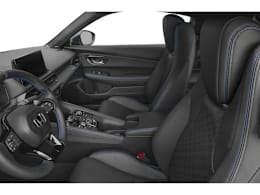
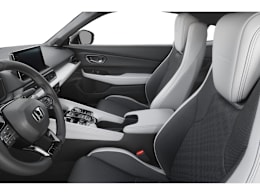
The Prelude’s interior borrows heavily from the Civic, which is both a blessing and a curse. Some testers felt that having a nearly identical dashboard to the Civic’s wasn’t special enough to justify the sporty coupe’s extra expense. Others felt it was fine, especially with our test car’s snazzy blue-and-white upholstery and the generally solid-feeling build quality.
As expected, there is some ducking and crouching required to get into the Prelude’s low front seats, and some serious hoisting to get yourself back out. Far more annoying, however, are the awkward pop-out exterior door handles, which eventually retract even if the Prelude is unlocked.
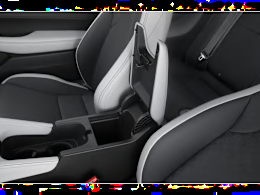
Once inside, the driver enjoys a clear, mostly unobstructed view out the front. Rear visibility is quite limited due to the large, sloping back pillars. Most testers found the well-bolstered, leather-trimmed front seats provided excellent lateral support while remaining comfortable. However, the lack of power adjustments, seat ventilation, adjustable lumbar support, and a heated steering wheel (even as options) is a glaring omission at this price point. Some drivers found that the plastic center console hemmed in their right knee, and the center armrest proved too far rearward for those who sit closer to the dashboard.
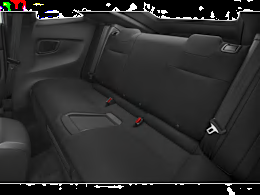
Like its predecessors, the Prelude has a 2+2 interior layout—but with the concept taken to the extreme. The aggressively raked roofline results in abysmal rear headroom; the rear head restraints are too low to support adults’ heads in a rear crash; and the seat provides hardly any underleg support. It’s also awkward to move the front seats out of the way to even get back there. As if to prove that the rear seat truly is an afterthought, the thin padding and plain black fabric upholstery don’t match what’s found up front.
At least the rear seats fold down mostly flat, enabling us to fit 5 large suitcases and 7 backpacks in the cargo area, equal to about 23.5 cubic feet of cargo space. Even with the rear seats up, the Prelude’s trunk is surprisingly roomy.
Controls and usability
The Prelude’s interior is a breath of fresh air in today’s touchscreen-heavy world. It’s full of straightforward physical buttons, knobs, and switches. We’re especially fond of the 10.2-inch driver’s instrument screen, which is cleanly laid out and easy to see, as most of our testers could position the steering wheel without blocking any of its information.
The real highlight of the interior is the Prelude’s array of climate controls, which consists of tactile dials and buttons that are easy to use while driving. While a few functions are blocked from view by the steering wheel, the most-used controls are grouped toward the center where they’re easy to see. An automatic dual-zone climate system comes standard, as do heated exterior mirrors and heated front seats.
Features on the Prelude’s 9-inch center infotainment touchscreen are fairly easy to navigate, with large menu tiles and icons. While many of the audio controls are onscreen, there is still a physical volume knob and separate buttons to flip through radio stations or tracks. The steering wheel also has a number of easy-to-use physical controls for common functions. The infotainment system has Google built-in, which includes popular services like Google Maps, the Gemini voice assistant, and other downloadable apps through the Google Play store. Wireless Android Auto and Apple CarPlay are standard.
Active safety and driver assistance
Standard active safety and driver assistance features include automatic emergency braking with pedestrian detection that operates at highway speeds, blind spot warning, rear cross traffic warning, reverse automatic emergency braking, lane centering assistance, lane departure warning, lane keeping assistance, adaptive cruise control, and automatic high beams.
We’re happy to see that both a rear belt minder and a rear occupant alert system come standard on the Prelude. The former alerts the driver if a rear passenger unbuckles their seat belt during the trip. The rear occupant alert end-of-trip reminder system uses rear-door logic to prompt the driver to check the rear seat when they turn the Prelude off, helping prevent children and pets from being unintentionally left behind in the vehicle.