
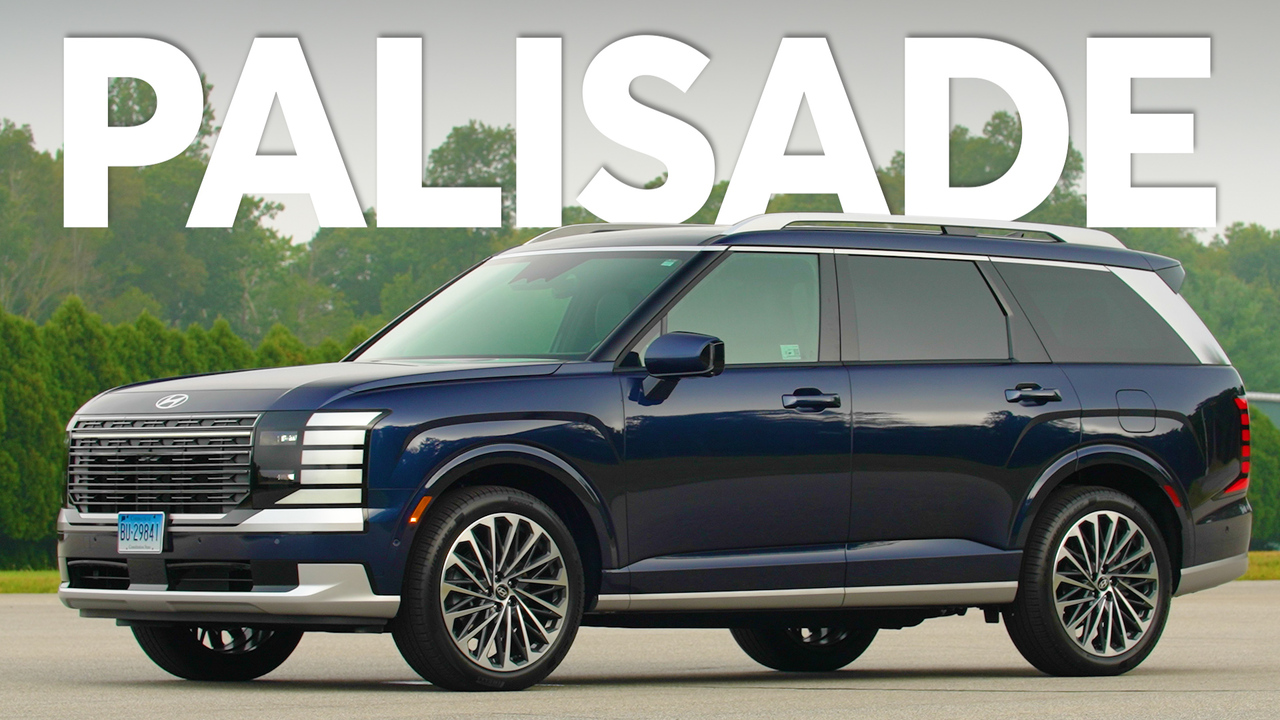

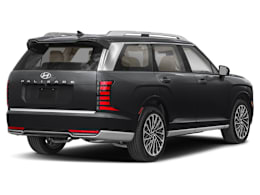
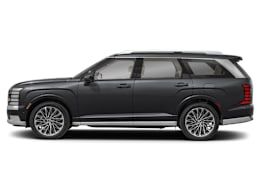
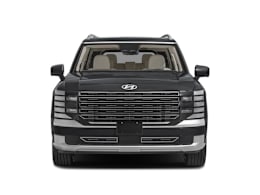
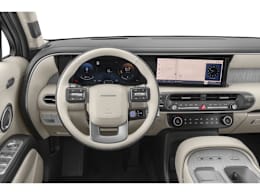
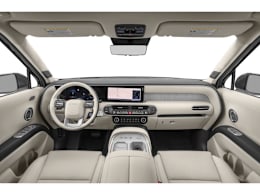
For its second generation, the popular Hyundai Palisade has gone big, with an increase in size and a significant gain in weight, along with more premium features, and even a mildly off-road-capable trim. The new Palisade’s stylish interior and exterior might make you wonder if this is yet another refreshed model that prioritizes aesthetics over intuitiveness. Luckily, the three-row midsized Palisade remains refreshingly logical. The exterior door handles are simple, it has large windows for excellent outward visibility, and a straightforward infotainment system and mostly easy-to-use controls.
This is a thoroughly modern, well-equipped (especially in the top Calligraphy trim we tested), capable, and functional SUV. In fact, it’s better appointed than some midsized luxury models that cost tens of thousands more.
But it isn’t all wins across the board for the new Palisade. Yes, it delivers a smoother and more comfortable ride, has a quieter interior and a roomier cabin. But being larger and heavier (it’s carrying an extra 500 pounds over the last Palisade we tested!) with roughly the same power output as before results in a vehicle that is quite a bit slower, while also less fuel-efficient. While we love the silky hum of the V6, the eight-speed automatic transmission can be hesitant to react to the driver’s demands, which, along with the extra weight at play, can make the powertrain feel lazy at times.
The original Palisade (and its mechanically similar cousin, the Kia Telluride) was a disruptor in the midsized three-row SUV segment. This second generation is quite good, too. The difference is that, this time around, there are now more models for shoppers to choose from.
For most of our testers, spending time in the new Palisade was a positive experience. “This is a pretty fantastic entry in the three-row SUV segment. It does a lot of things well, with a super smooth engine and transmission, refined ride quality, low levels of noise, and a luxurious interior. All of this for just under $60,000 feels like a strong value,” said one tester.
“Overall, this is a really nice vehicle,” agreed another tester. “It’s quiet, uber comfortable, spacious, and loaded with features. It’s stylish too. I wish we had something like this growing up for family vacations and road trips. It will be interesting to see if it sells as well as the first one, though. Hyundai made a splash with the first Palisade, as it was somewhat unexpected from them at the time. The midsized three-row segment was smaller with fewer options back then, and it’s no longer as clear of a choice.”
We bought a 2026 Hyundai Palisade Calligraphy AWD for $58,195—anonymously from an area dealer, as we do with every vehicle we test—for the purpose of this road test review. Our Palisade was assembled in Ulsan, South Korea.
Driving experience
Hyundai downsized the Palisade’s V6 from 3.8 liters to 3.5, although, at 287 hp, it only lost 4 hp. The engine itself remains quite good. It’s smooth and silky, and produces strong grunt up high in the rev range. Floor it, and the big SUV will move on down the road with some good speed, while the V6 belts out a pleasing note. The eight-speed automatic transmission delivers subtle upshifts the vast majority of the time.
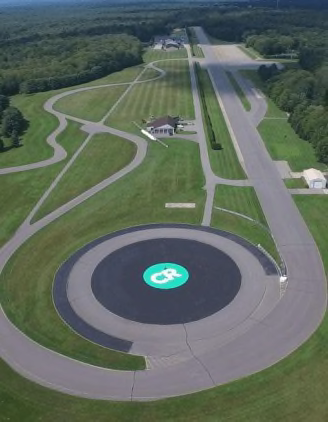
But Hyundai has a math problem on its hands: Down 4 hp but up an extra 500 pounds doesn’t add up to a frisky-feeling SUV. In our instrumented testing, the new Palisade needed 8.4 seconds in the run from 0 to 60 mph, which is nearly 1.5 seconds slower than the previous model. That’s a significant number, no matter how you do your equations, and it makes it one of the slowest vehicles in the class.
Away from the track and out on the road, the Palisade doesn’t feel slow so much as the powertrain seems a bit apathetic. The engine’s weak low-end torque and the transmission’s reluctance to downshift create a delayed and often inconsistent response that occasionally leaves the SUV feeling underpowered, even during everyday driving.
All that added weight isn’t helping fuel economy, either. It dropped 1 mpg from the outgoing model, now down to 20 mpg overall in our testing.
The Palisade isn’t a sporty vehicle, but its handling is appropriate for a big three-row SUV. The suspension does a good job quelling body roll in corners, especially for a vehicle this size, and the steering delivers good feedback to the driver about front-tire grip. More important for the target audience (meaning families), the Palisade delivers a comfortable ride. Its suspension soaks up most bumps quite well, yet without feeling floaty. Large wheels, like the 21-inch rims that come standard on the Calligraphy, typically make for a rough ride, but the Palisade does a great job isolating impacts from the cabin.
Cabin noise is kept to a minimum. It’s more hushed inside the Palisade than most three-row SUVs, feeling more like a luxury model than a mainstream vehicle. Expect “Lexus-level interior solitude,” said one of our testers. Wind noise doesn’t start to pick up until around 70 mph. The engine stays quiet most of the time, and gives a polished and pleasant growl when revved.
Cabin comfort
Most buyers spring for the Palisade’s upper trim levels, like the Limited and Calligraphy. We can see why: The Calligraphy we tested has an impressive-looking interior. The seats are upholstered in Nappa leather and the headliner, sun visors, and windshield pillars are covered with a super-soft suede-like material. On the features front, the front seats have a massage function, and second-row passengers get comfy heated and ventilated captain’s chairs and their own climate controls.
The Palisade is longer than its predecessor, and seats either seven or eight, depending on how it’s configured. Its boxy design makes for a predictably large interior, with no sloping roofline cutting into headroom. Still, our nitpicking testers found some items to complain about with the driving position, such as the overly-firm armrest padding and how some important items toward the upper portion of the driver’s instrument screen get blocked when the steering wheel is adjusted to a lower position.
Most testers liked the Palisade’s front seats, though they didn’t necessarily love them. The seats offer a wide range of adjustments and good support, but comfort depends on body type, not to mention patience with the controls. The second-row captain’s chairs are excellent in most ways, with lots of room, plenty of adjustability, and good comfort. As with up front, the door armrests are on the too-firm side.
Third-row space isn’t bad among midsized SUVs, but comfort is lacking. There’s enough headroom for average-sized adults, and knee room is manageable if the second-row passengers are kind and move their seat slightly forward. But foot space under the second-row seats is squished, and the bottom cushion is low enough to the floor that there is hardly any underleg support, and it forces adult passengers into an uncomfortable knee-bend. Further, it’s a tight squeeze to get back there, and the power-operated second-row seats move almost comically slowly.
We were able to fit 2 large suitcases and 5 backpacks behind the Palisade’s upright third-row seat, which is competitive with other three-row midsized SUVs. Maximum cargo volume, with the second- and third-rows folded down, is slightly less than before, now at 43.5 cubic-feet. That’s 9 cubic feet less than the Chevrolet Traverse, for example.
Controls and usability
The Palisade proves that the future doesn’t have to be confusing when it comes to vehicle interiors. Many automakers have gone minimalist, replacing physical buttons and knobs with massive touchscreens and capacitive-touch panels. While the Palisade looks pleasantly modern, most of the controls are familiar enough that they’re easy to use. The center infotainment touchscreen offers quick access to media, phone, navigation, and other vehicle features in a clutter-free and logical menu structure. The bright, large labels and icons contrast highly with the dark background, making it easy to quickly find different features.
Unfortunately, the climate controls are located down low on a separate capacitive-touch display beneath the center screen. This panel isn’t always responsive to quick inputs, and its small buttons are difficult to accurately tap. Most safety-related functions—including wipers, headlights, and the emergency flashers—use physical controls that are straightforward and easy to operate. We like that there are knobs for audio volume and tuning, and temperature adjustment knobs.
There’s a good mix of concealed and open storage up front, although we wish the front door pockets were a little more generous.
Active safety and driver assistance
Standard active safety and driver assistance features include automatic emergency braking with pedestrian and cyclist detection, automatic emergency braking that operates at highway speeds, blind spot warning, rear cross traffic warning, reverse automatic emergency braking, lane centering assistance (LCA), lane departure warning, lane keeping assistance, adaptive cruise control, and automatic high beams. Hyundai's standard "Highway Driving Assist" uses HD mapping to support LCA and is designed for use on limited-access highways. However, LCA itself can be activated on any road with clear lane markings, not just mapped highways. Higher trims come with Highway Driving Assist II, which adds automatic lane-change assistance.
We’re happy to see that both a rear occupant alert system and a belt minder come standard. The former is designed to remind the driver—based on rear-door logic—to check the rear seat when the Palisade is turned off to help prevent children and pets from being unintentionally left behind in the vehicle. The belt minder alerts the driver if a rear passenger unbuckles their seat belt during the trip.
The Palisade also comes with a Safe Exit Assist system, which can sense if a vehicle or bicycle is approaching from behind or alongside when parked on a city street, and an occupant is about to open a door into traffic.