Your membership has expired

The payment for your account couldn't be processed or you've canceled your account with us.

Re-activate

2026
Ineos Grenadier

EPA MPG: 15 mpg

Ineos Grenadier First Drive

Summary

Introduction

The 2026 Ineos Grenadier Is Built for Trails, but Compromised on Pavement

The Grenadier is exceptionally capable off-road, but buyers must accept plenty of trade-offs in everyday driving

Overview

Ineos has been in the petrochemical business for decades, but its foray into cars is a more recent pet project of the company’s chairman and CEO, Jim Ratcliffe. Ratcliffe wanted another Land Rover Defender, but felt as if the new model had strayed too far from its utilitarian roots. When Land Rover wouldn’t build (or let him build) a continuation of the old Defender, Ratcliffe came up with the idea to build his own off-roader in London’s Grenadier pub, hence the name of Ineos’s first model.

Key Takeaways

  • The Ineos Grenadier is purpose-built for off-roading, trading the creature comforts of similarly priced luxury SUVs for rugged components designed for serious overlanding.
  • Four-wheel drive, locking differentials, low-range gearing, and thick off-road tires make controlling the power from the Grenadier’s smooth 282-hp turbocharged six-cylinder engine a breeze in all conditions.
  • Many features that make the Grenadier highly capable off-road also make it less than ideal to live with day-to-day, including slow and awkward steering, a bare-bones interior, and an unsettled ride.


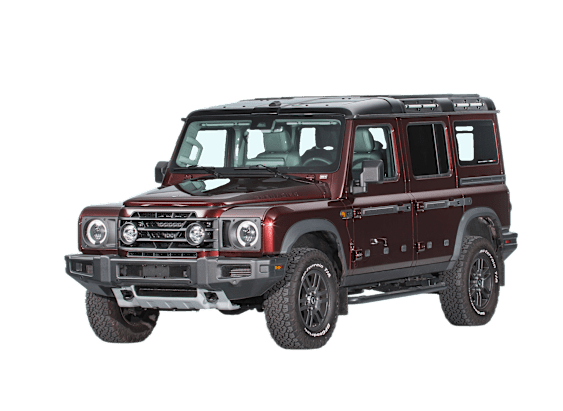
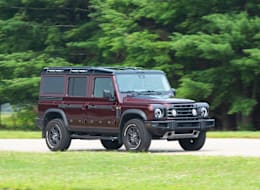
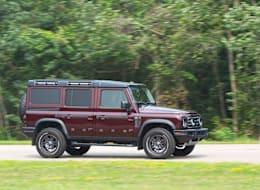
Two body styles of the Grenadier are available: a Station Wagon, which has a traditional boxy SUV shape, and the Quartermaster, which has a small pickup bed. It’s a true body-on-frame truck with rugged, solid beam axles from Carraro, a supplier that makes axles for a lot of tractors and heavy equipment. All Grenadiers come with a BMW-sourced, turbocharged 3.0-liter inline-six engine producing 282 hp and 332 lb.-ft. of torque, which is paired with an eight-speed automatic transmission. Permanent four-wheel drive with high- and low-range gearing is standard, as is a central locking differential.

The Grenadier’s engine and transmission are shared with a long list of other BMW vehicles, such as the BMW Z4, and also the Toyota Supra. Ineos touts this as a positive, as it means parts are more widely available if—or when, given the extra wear and tear of crawling over rocks—the Grenadier breaks down.

The “by off-roaders, for off-roaders” nature of the Grenadier really shows in its attitude toward repairs. Much of the Grenadier is designed with trailside fixes in mind, from easily removable fenders to the non-galvanized frame rails. The frame is wax-filled and coated instead to deter rust, as galvanized steel emits toxic fumes when it has to be welded back together. Many other components, from physical climate controls to a manual handbrake lever, were kept refreshingly simple. Company representatives told us that they want the Grenadier’s design to remain unchanged for 30 years unless they’re forced to change it, making it even easier for them to maintain a supply of spare parts.

We borrowed a Grenadier Station Wagon Fieldmaster from Ineos for the purpose of this review. The Fieldmaster Edition includes a few extra creature comforts over the base model, including 17-inch alloy wheels, leather trim, and carpeted flooring. Adding several option packages, the total cost of the borrowed Grenadier came to $89,555.

Two other trims are available: a base model, plus a Trialmaster Edition that’s geared more heavily toward overland use. The Trialmaster includes features like front and rear differential locks, all-terrain tires, auxiliary switches, additional storage attachments, and a tow hitch. (Other Grenadier trims, including our borrowed model, can add features that come on the Trialmaster and Fieldmaster as options.) We currently do not plan to purchase one to test.

The final assembly point is Hambach, France.

Impressions

Driving Experience

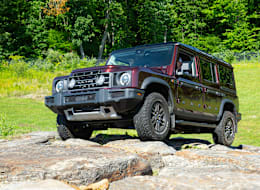
The Grenadier may share its 282-hp turbocharged inline-six engine with the Toyota Supra, but it was retuned to be better-suited for rock crawling, sacrificing a bit of horsepower for extra low-end torque. Acceleration builds progressively, without a sudden rush of power as the turbocharger spools up. Its ample torque helped it climb the rock hill at the Consumer Reports’ Auto Test Center effortlessly. With low-range, the center differential, and the front and rear differentials all engaged, it could practically idle up the whole hill, with only a few steeper surfaces needing an extra, gentle touch of throttle.

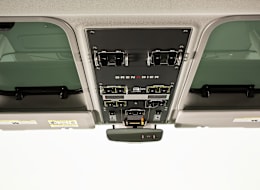
Engaging those differentials is a bit of a process due to their mechanical nature. While the main center differential and low-range gearbox are engaged with a simple, physical lever next to the gear selector, the optional front and rear differentials are engaged using a pair of overhead buttons, and there’s a specific sequence and timing needed for them to mechanically shift into place. 

There isn’t a simple button to disconnect the swaybars as there is in some of the more modern off-roaders, either. (This allows for more wheel articulation, which lets those four drive wheels maintain contact with the ground more often on rougher terrain.) Disconnecting these requires climbing underneath the Grenadier to do so manually.

Additionally, the Grenadier features a Wading Mode, which turns off the cooling fans to allow the SUV to ford water up to about 30 inches deep. It also has Off-Road Mode, which lets the driver operate the Grenadier at low speeds with the door open and seat belt off (for example, to check wheel placement or to get in and out frequently to judge an obstacle) and use extra auxiliary lights that aren’t legal for road use. Downhill Assist can also keep the Grenadier traveling at a set speed down an incline without the driver needing to manually balance the throttle and brake.

One thing that isn’t manual is the Grenadier’s eight-speed automatic transmission; the company says it has no plans to offer a manual gearbox, either. As strange as it is to look down at a curvy, modern BMW gear selector lever in the middle of the Grenadier’s airplane-like cockpit, the transmission itself functions quite well. It’s generally responsive and shifts smoothly, and we appreciated its ability to hold on to whichever gear we selected without the vehicle shifting for us.

The powertrain’s biggest issues are in everyday driving, where takeoffs from a stop could be somewhat jerky, an issue compounded by a relatively short first gear and an unrefined stop/start system that sometimes has a brief delay before it restarts the engine. (Fortunately, there’s a simple button to disable the fuel-saving engine stop/start function.) It also has a brief delay in downshifting with more aggressive throttle use. Highway passing power is adequate, but actually pulling off a pass requires heavy throttle input and multiple downshifts.

One of the biggest downsides of forcing a roughly 7,700-pound, brick-shaped vehicle through the air is poor fuel economy. (Perhaps that isn’t a surprise coming from a petroleum company.) The EPA rates it at 15 mpg combined, 15 mpg city, and 15 mpg highway, which mirrors what we saw when driving the truck.

Off-road capability also takes precedence over handling. The Grenadier’s recirculating-ball steering rack is very slow, and while this makes it easy to put its wheels in precisely the right place to climb over a tricky obstacle, it’s a royal pain to drive daily. Normal turning maneuvers require much more steering input than the average road-going SUV, and turn-in feels delayed as a result. This mechanical steering rack is electronically assisted, but that assistance isn’t very evenly distributed. The steering is very heavy at low speeds and, combined with a wide turning radius, makes it difficult to maneuver in parking lots and other tighter spaces. Prepare to expend a lot of effort doing multiple-point turns where most vehicles don’t need to. It also doesn’t have much return-to-center force to unwind the wheel after a turn, which forces the driver to manually pull the steering wheel back to center.

That electric assistance kicks in a little too much at higher speeds, making the Grenadier’s steering feel light and vague, to the point where it’s hard to tell what its tires are doing. The Grenadier’s steering also has a large dead spot in the center, which forces drivers to make constant corrections even when traveling in a straight line. Several of us compared it to steering a ship.

Few things about the Grenadier inspire much on-road confidence. The soft suspension that gives the Grenadier a respectable amount of wheel articulation (even with the swaybars connected) also gives it considerable body roll on the road. Combined with the vehicle’s tall stance, this makes the Grenadier a nonstarter for corner-carving at speed. Its chunky all-terrain tires do an excellent job of maintaining grip in slippery off-road conditions, but don’t offer much feedback or warning when they start to slip on the road.

Ride quality can get bouncy at times, with the sort of looser body control you’d expect from the SUVs of yore. Sizable bumps, such as frost heaves, recessed drainage grates, or larger dips, jostle the occupants around somewhat and produce loud impacts that are transmitted directly to the occupants. However, some testers said the Grenadier did a commendable job of absorbing smaller imperfections on roads and trails, such as potholes or embedded rocks, especially when compared to other old-school, body-on-frame SUVs.

Cabin Comfort

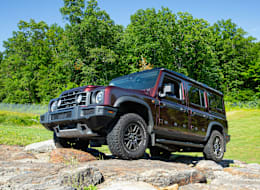
Getting into and out of the Grenadier is a climb, as the same tall ride height that gives it excellent approach, departure, and breakover angles over off-road obstacles requires a large step up to get into the cabin. Grab-handles and the steps on the available side runners can help, but the lack of a grab-handle on the driver’s side forced some testers to grab the steering wheel to climb in instead.

The Grenadier’s doors are double-sealed to keep the interior dry, as a result of which more effort is required to close them securely. The vehicle gives no warning that a door isn’t fully closed and won’t lock if one door or the rear hatch is even slightly open. As expected with a vehicle this bare-bones, there is no capacitive-touch lock/unlock button on the door handles.

The interior itself is very utilitarian, with lower surfaces designed to be hosed off and drain plugs in the floor. Certain components didn’t feel substantial enough for a vehicle that starts in the low-$70,000s, including thin-feeling knobs and plastic loops dividing some of the rocker switches. Padded surfaces are few and far between, and in those few spots, the padding is thin.

Heated front seats are standard. However, they are manually adjusted, which some testers took issue with given the Grenadier’s premium price. The seat-back angle adjustment lever is awkwardly thick, sits in a narrow space between the seat and the B-pillar, and rotates counter to most adjusters, making it very clumsy to use. The seats are well bolstered, but have a firm, flat center portion. There is no adjustable lumbar support for the front seats, and no armrests on the doors, which can be uncomfortable on longer trips. The thinly padded windowsill becomes a narrow de facto armrest and still sits too high for comfort for many testers, especially given that the center-console armrest sits low.

Front-seat headroom is generous, but the wide, hard-plastic center console intrudes upon occupants’ knee space. The lowest setting for the tilting and telescoping steering wheel is still angled upward more than some of us would have liked. The tall seating position was a love-or-hate item; some testers liked it for forward visibility, but others complained that this made their legs and feet sit at an awkward angle when driving.

Overall, forward visibility is quite decent, as the thin A-pillars afford most drivers a clear view over the hood. The Grenadier’s squared-off corners make it easy to tell where the front corners of the truck are when navigating through tight spaces. However, overhead traffic lights were frequently blocked by the edge of the roof, and drivers who sit farther back are even with the B-pillar, making over-the-shoulder blind-spot checks more difficult.

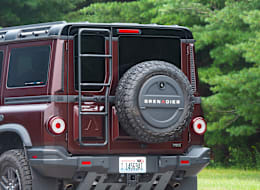
The Grenadier’s 70/30-split rear door, thicker rear pillars, and spare tire block much of the rear view. Some testers also felt as though the narrow side mirrors lacked an adequate adjustment range to get a good rear-side view.

The rear seats are rather tall, and there are no rear grab handles to pull yourself into the seat. Using a child car seat can be difficult, with one tester noting that his wife had to stand on the running boards just to reach their son. The seats themselves are nicely padded and provide good under-leg support thanks to their height, and the slightly raked angle of the bottom cushion, combined with the Grenadier’s flat roof, provides ample headroom. However, the rear bench seat’s upright seat back, limited foot space, and lack of both a drop-down center armrest and an armrest on the door can be uncomfortable over longer distances.

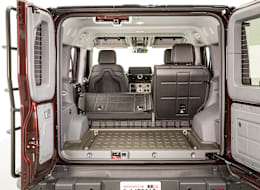
It’s good that the Grenadier comes with a bladed key to insert into the steering column, as small-item storage is minimal. The center console only has a small open tray tucked under the dashboard controls and a small locking storage area under the armrest. Small, unlined cup holders lack the firmer grip we’d prefer to see to keep cups from rattling around off-road. At least there are sizeable door pockets with larger bottle holders, plus a generous rear cargo area for big items. The 70/30-split rear door still allows access to the rear in tighter spaces, but without securing cargo on the smaller door’s side, it can roll out of arm’s reach anyway. The 60/40-split rear bench can fold down for extra space, but does not fold flat.

Dual-zone automatic climate control is standard, but the air conditioning felt weak during the mild late-summer days we spent with the truck. Part of the issue was the Grenadier’s standard “safari windows,” which are two pop-up, removable windows over each front seat. These are neat for letting fresh air in or standing on the seat to grab something from a roof box, but the lack of a standard shade to cover them forces the air conditioning to work overtime on sunny days.

The interior also isn’t isolated much from noise or powertrain vibrations, especially at highway speeds. One tester said, “The engine howls, the road screams, the tires constantly remind you that they despise being on pavement, and the brick-like shape hates the wind as much as a Yankees fan hates someone rooting for the Red Sox.” Extra sound insulation may not be required for crawling around off-road, but at higher speeds some testers would have liked to hear less low-frequency booming from the engine or whistling through the roof rails and other less-than-aerodynamic attachment points.

Controls and Usability

The Grenadier’s retro charm extends into its interior, which can be operated entirely via physical controls. Even the 12.3-inch infotainment touchscreen can be controlled with a physical knob on the center console, just like older BMW iDrive infotainment systems. Personality abounds, with airplane-inspired controls on the ceiling, rocker switches that make satisfying clicks, and a bright red “Toot” button on the steering wheel. “Toot” sets off a shorter, quieter horn designed to be more polite to cyclists and pedestrians.

While we generally prefer physical controls for vehicles’ most frequently accessed features, these could be implemented better. The monostable gear selector—which you bump to engage—sits uncomfortably close to the volume knob. Knobs have weak detents and could use more distinguishing features, such as varied colors or larger labels, to make them easier to tell apart at a glance. The volume knob doesn’t allow for precise adjustments, with large steps in intensity between each detent. The dim indicator lights on some buttons are easily washed out by sunlight. 

Some testers also didn’t like the extra play in the physical controls, which makes buttons require a firmer press to engage. Ineos attributes this to internal sealing to keep water out, so it’s one of many trade-offs made for off-road readiness.

There is no instrument panel in front of the driver—only a small cluster for warning lights at the edge of the dashboard. While Ineos intended this to give the driver better visibility, we didn’t like having to look out of our line of sight to the center screen for basics like the speedometer and fuel level. This setup also makes the infotainment system’s portion of the screen smaller. A head-up display is not available.

The infotainment system’s menus are relatively straightforward and easy to navigate. It can be laggy at times, and its smaller icons and text-based menus were hard to see for some. Unfortunately, drivers have to interact with it every time they turn on the car, which resets the safety and driver assistance system settings to default with each restart.

The only such feature that will remain on or off when restarting the car is Intelligent Speed Assist, which provides an audio or visual alert when the Grenadier exceeds the speed limit. The others reset upon startup, and the menu for readjusting them adds to the confusion, given the fact that Ineos uses nonstandard names for some of these features. Having to turn off lane keeping assistance every time you start the car, for example, can be tedious for drivers who live down a narrow road that frequently sets it off. It’s even more so if you forgot that Ineos calls it “Emergency Lane Keeping” in the menu.

Wireless Android Auto and Apple CarPlay are standard, and they worked well for us. SiriusXM satellite radio is also included, although the Grenadier we borrowed had poor reception.

Safety and Driver Assistance

Standard features include automatic emergency braking with pedestrian and cyclist detection, lane departure warning, lane keeping assistance, speed limit warning, a direct driver monitoring system, and front and rear parking distance sensors.

The Grenadier’s driver assistance features aren’t as robust as we’d prefer. Adaptive cruise control, rear cross traffic warning, blind spot warning, and a surround view camera aren’t offered, the last of which is especially frustrating given that the rear view is compromised by split doors, thick pillars, and a rear-mounted spare tire.

Some of the included features could also be implemented better. Lane keeping assistance and electronic stability control both feel disconcertingly sudden and jarring in a vehicle this tall and softly sprung. The direct driver monitoring system also sometimes gave false positives for distracted driving, for example, when testers held a cup to their mouth for slightly longer than usual. Additionally, its backup camera is low-resolution and small compared to those in similarly priced luxury SUVs.

Change Vehicle