
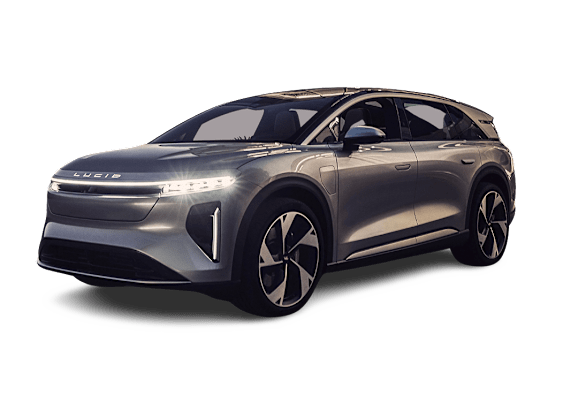
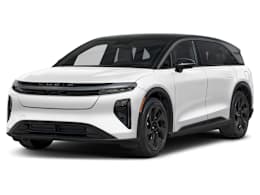
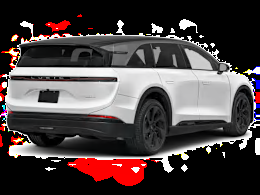
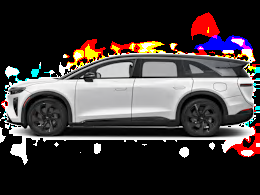
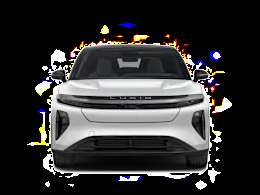
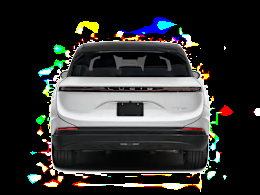
Lucid Motors’ second model, the Gravity SUV, is a showpiece for the electric vehicle startup’s biggest strengths. It has a smooth powertrain that delivers extremely quick and effortless acceleration and a long driving range, all cleverly packaged to maximize space for both cargo and passengers. But, like other EVs, such as the Fisker Ocean and Volvo EX90 SUVs, the Gravity was not quite finished when it went on sale. Besides the several significant glitches our testers experienced, some promised features haven’t been rolled out months after the vehicle’s release.
What the Gravity gets right, though, it knocks out of the park. Its scintillating acceleration is thrilling to experience, while its sharp handling makes it feel like a smaller vehicle than a three-row SUV. Driving range is impressive as well, with the Grand Touring we tested managing 361 miles in our 70-mph highway-range test.
Lucid Gravity at a Glance
- Awesome acceleration and stellar handling make this large, heavy three-row SUV surprisingly fun to drive
- Long driving range and roomy cargo areas are ready to road trip
- Frustrating, unintuitive controls rely too much on large touchscreens
- Frequent glitches, iffy build quality, and promised but undelivered features make it hard to justify the Gravity’s high price
Like Lucid’s first model, the previously-tested Air sedan, the Gravity is a masterclass in clever packaging. This includes a spacious front trunk (or “frunk”) and an adult-friendly third row that doesn’t feel like an afterthought. The rear two rows of seats fold flat, which opened enough space for one tester to haul a new couch home.
Startup-style build-quality issues dampen the experience somewhat, though. The motors that slide the second-row seats fore and aft are slow and noisy. The second-row seats also fold down with a brutal thud when you use the release button in the cargo area and leave the under-seat wiring exposed as you fold the seatbacks up. Some design quirks also got in the way of daily use; taller reviewers had issues hitting their heads on the rear hatch itself, and the extremely thick windshield pillars impede the driver’s outward view.
After we spent months compiling results from more than 50 specific tests and evaluations at Consumer Reports’ 327-acre Auto Test Center in central Connecticut, along with lots of miles behind the wheel on public roads, we experienced numerous recurring issues with the vehicle that made it feel unfinished. Some of these problems, like software glitches that caused blank screens and unresponsive buttons, present real safety concerns. Others, such as cheap-feeling buttons and the unrefined second-row seat motors, are build-quality and design problems that don’t match the Gravity’s $80,000 starting price, much less the six figures we paid for our example.
This is disappointing because, on paper and on the road, the Gravity is a true electric luxury three-row super-SUV. But with all of the issues and shortcomings we experienced, the Gravity’s positive traits aren’t enough to cover for its early-build hiccups. Potential reliability issues give us pause, and therefore we don’t recommend the Gravity at this time. Our advice is to hold off on buying a Gravity until the car is more fully sorted.
We bought a 2026 Lucid Gravity Grand Touring for $111,450—anonymously (in this case from Lucid’s website), as we do with every vehicle we test—for the purpose of this road-test review. Our Gravity was assembled in Casa Grande, Arizona. We also borrowed a slightly higher-optioned Gravity Grand Touring ($122,950 as spec’d) from Lucid, which helped us compare some of the options for this road test evaluation.
Driving experience
Thanks to 828 hp in the Grand Touring model we purchased, there’s more than enough power to scare or delight the whole family. The all-wheel drive from its front and rear electric motors puts all that power to the road effectively, enabling the Gravity to rocket from 0 to 60 mph in 3.6 seconds in Consumer Reports’ tests.
“There pretty much isn’t a two-lane passing zone that this car can’t handle with ease,” said one tester. “There’s also just a pure luxuriousness of having this much instant-on power at your disposal.”
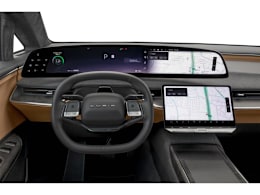
Sharp, confident handling and quick steering help mask the Gravity’s nearly 6,000-pound curb weight. This is a good-sized three-row SUV that’s actually enjoyable to drive on curvy roads. Most of us weren’t fans of the Gravity’s oddly-shaped steering wheel, though. It has flat edges on the top and the bottom, and this non-round shape—while fine at higher-speed driving—feels unnatural when having to make larger steering inputs, such as when parking or turning around.
Ride quality wasn’t up for debate, though; the Gravity’s air suspension system enables a smooth ride over all but the largest bumps, and it does a good job of keeping the vehicle stable and planted when encountering rises and dips in the road.
Like most EVs, the Gravity can use regenerative braking. This slows down the vehicle when you let off of the accelerator pedal while recuperating some of its kinetic energy, which the system then feeds back into the car’s battery. While regen braking can be turned off completely, this results in the driver having to press the brake pedal fairly hard to slow down at speed, as the friction brakes alone feel nearly inadequate for this hefty EV. But it did well in our panic-braking tests, with short stopping distances on our dry surface, though just merely average stops in the wet.
The Gravity’s interior provides decent isolation from wind and road noise, even at higher speeds. However, there is noticeable electric motor whine, which can be a high-pitched nuisance at highway speeds. While it’s less noisy than the Air, it’s more pronounced than in other luxury EVs we’ve tested such as the BMW iX and Mercedes-Benz EQS SUV.
Cabin comfort
The Gravity exemplifies Lucid’s master class of clever packaging. The compact electric powertrain allows for three spacious rows and decent cargo space, in addition to a front trunk (or “frunk”) that’s large enough for two people to sit side-by-side in as a seat. Lucid even sells a frunk-mountable seat cushion for that purpose, but likely more relevant is that we could fit one large suitcase and three backpacks in there. With the second- and third rows folded down, we measured 54.5 cubic feet of cargo volume, making it the most spacious three-row EV interior we’ve measured outside of the Volkswagen ID. Buzz.
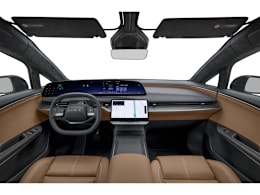
The Lucid’s front seats are firm, but generally comfortable, with ample adjustability. The nicely bolstered buckets got mixed reviews, however, with some testers wanting more underleg support. The second row bench seat delivers generous space on pretty much all fronts, and the padding is comfortable. Due to its flat shape, it doesn’t hold occupants in place all that well. The third row is also roomy enough to fit most adults. Although it lacks enough underleg support, it’s not a terrible place to spend a few hours on a road trip.
Unfortunately, build quality doesn’t quite meet the expectations set by the Gravity’s price tag. While there are plenty of nice materials, such as the soft microsuede and leather seats, padded dashboard, and matte-finish wood trim, other components feel cheap and flimsy, including some of the climate-control switchgear, the short sun visors, and the door pulls. The second-row seats are perhaps the worst offender in the whole interior. The motors that move them fore and aft for third-row passengers to get into and out of the Gravity are painfully slow, and make disconcerting grinding noises.
Controls and usability
Most of the Gravity’s controls are handled on-screen, either through the centrally-located 12.6-inch touchscreen or the wide 34-inch display above it. This upper display spans from the driver’s-side windshield pillar to the center of the car and combines the driver’s instrument screen and an upper infotainment touchscreen into one display.
Our testers found the Gravity’s controls to be unintuitive. Aside from a couple of bottom buttons on each side, the steering wheel controls rely heavily on unlabeled cup-shaped pads that require a frustrating amount of precision to engage. (The left-side pad on our test vehicle often didn’t work at all.)
Frequently used features—such as side mirrors, screen brightness adjustments, windshield wipers, and seat heaters—are only adjustable through the screen, sometimes under multiple layers of menus. This forces the driver to spend too much time looking at the screens instead of the road. We were glad to see some physical controls at least, such as for the temperature, fan speed, and audio volume. The air vents are even manually adjustable (not a given these days), rather than relying on a touchscreen, although you do have to dive into the onscreen menu for more granular controls, such as those for the heated seats or windshield defroster.
Some desirable features we would have liked to test, like the hands-free driving system and Android Auto/Apple CarPlay connectivity, weren’t available with the car at launch, but Lucid plans to release them later through software updates. We also experienced many glitches with the Gravity’s onboard software. All in all, it feels like Lucid didn’t quite finish the car before putting it on sale.
Active safety and driver assistance
Standard active safety and driver assistance features include automatic emergency braking with pedestrian and bicyclist detection, along with automatic emergency braking that operates at highway speeds, blind spot warning, rear cross traffic warning, reverse automatic emergency braking, lane centering assistance, lane departure warning, lane keeping assistance, adaptive cruise control, and automatic high beams.
Three levels of Lucid’s DreamDrive 2 active safety and driver assistance suite are available. Stepping up to the mid-tier DreamDrive 2 Premium adds a blind spot display (which shows you a camera feed in the driver’s instrument screen of the blind spot in the direction you’re turning), adaptive drive beam headlights (which block out sections of the headlights to avoid dazzling oncoming traffic), a 3D surround view monitor, Enhanced Hands-on Drive Assist (which adds lane buffering, lane-change assist, and suggested lane changes), automatic parking in and out, and a see-through camera view. The top-tier DreamDrive2 Pro adds more advanced automatic parking tech, including remote parking capabilities and traffic light detection.
The Gravity comes standard with a rear belt minder, which alerts the driver if a rear passenger unbuckles their seat belt during the trip. But it’s disappointing that Lucid didn’t fit it with a rear occupant alert. These types of systems are designed to remind the driver, based on rear-door logic, to check the rear seat at the end of a trip to help prevent children and pets from being unintentionally left behind in the vehicle.