



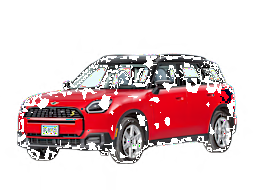
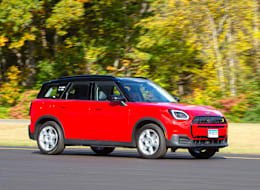
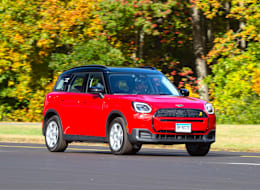
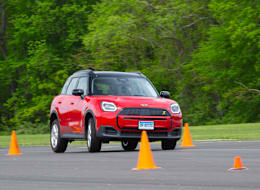
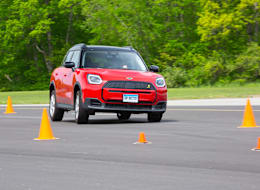
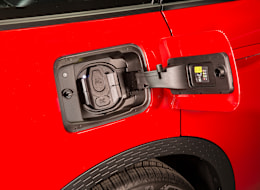
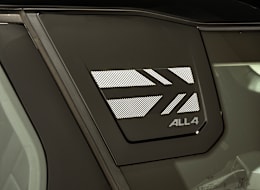
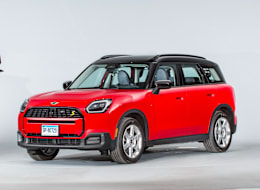
The Mini Countryman SE ALL4 electric compact SUV was launched as part of Mini’s push to offer electric- and gas-powered versions of each vehicle it sells. While the electric model solves the uneven acceleration issues we had with the gas-powered Countryman, it shares its distracting, center-screen-heavy controls and comes with its own EV-specific set of issues, including a driving range that’s shorter than most competitors.
Parked next to each other, it’s difficult to tell the difference between the gas Countryman and the electric one, aside from the SE’s solid grille and green “S” badges on the front and rear, instead of red ones. Makes us wonder why Mini didn’t just give the electric Countryman “SE” badges. Or make it even simpler by just calling it the Countryman EV. That’s what we’re going to do.
Inside, there’s the same pared-down aesthetic and circular infotainment screen featured in every new Mini. But under the nearly-identical sheet metal is a dramatically different powertrain. The Countryman EV uses an electric motor at each axle, which gives it standard all-wheel drive and an ample 308 hp.
After our testing was completed, we weren’t sold on the value of the Countryman EV. While it has some notable advantages over the gas-powered model, including a quicker and smoother powertrain, a more comfortable ride, and a quieter cabin, it doesn’t fare as well when viewed against other EV competitors. Plus, one of the Countryman’s biggest sticking points is its low-for-the-times driving range, which doesn’t even crack the 250-mile mark. For some of our testers, the short range and confusing controls could be dealbreakers.
“The laggy, overly complicated controls and unintuitive center screen really detract from this car,” said a tester. “But looking past that major fault, it’s quick and more comfortable than the gas Countryman.”
“From a powertrain standpoint, the EV is way better than the regular Countryman,” said another tester. “It’s quite quick, the one-pedal driving is simple to turn on and off, and it’s easy to drive smoothly. The EV’s ride is a little better than the regular Countryman, but the handling is notably less sharp, which is disappointing.”
“I’m not sure that converting the Countryman’s platform to an EV is a very good value,” said another tester. “The small battery means you only get in the low 200s for driving range. You could get into a Ford Mustang Mach-E or a Hyundai Ioniq 5 for a similar cost and get more range, and with an as good or better driving experience in some ways.”
We bought a 2025 Mini Countryman SE ALL4 Signature Plus for $47,195—anonymously from an area dealer, as we do with every vehicle we test—for the purpose of this road test review. Our Countryman SE ALL4 was assembled in Leipzig, Germany.
Driving experience
We had plenty of complaints about the gas-powered Countryman’s engine and transmission, which together lurched and hesitated when trying to accelerate from stops and during low-speed driving. A 66.5-kilowatt-hour battery, two electric motors good for 308 hp, and a direct-drive transmission make the Countryman EV a much more pleasant vehicle to drive, delivering smooth power at any speed and offering impressively quick acceleration. It scooted from 0 to 60 mph in just 5 seconds flat in our testing.
Those two electric motors produce a formidable 364 lb.-ft. of torque. Unfortunately, there’s a fair amount of torque steer when you punch the accelerator pedal hard, especially when doing so while turning. You can feel the power going to the front tires as the effect tugs the steering wheel back and forth in your hands.
But the Countryman EV’s biggest driving weakness is how long you can actually drive it. We were only able to eke out 237 miles in our 70-mph highway-range test. While that’s a bit above the Countryman EV’s EPA-rated range of 212 miles, it’s still relatively short at a time when many other all-wheel-drive EV SUVs are closing in on 300 miles, or surpassing that mark.
Like most EVs, the Mini has a regenerative braking system which slows the vehicle when coasting while recouping energy that gets sent back to the battery. When they’re turned up for maximum energy recovery, regenerative brakes can instantly kick in as soon as the driver releases pressure on the accelerator pedal.
Most EVs, including the Countryman, allow drivers to set the level of regenerative braking. Like other EVs, such as from BMW and Mercedes-Benz, the Countryman also has an “Adaptive” regen setting, although we found it unpredictable as to when, why, and how much it would slow the vehicle down when we lifted off the accelerator pedal. Although the Countryman EV’s ride is a bit softer and more forgiving than the gas-powered version, that’s not to say it’s plush. It’s still on the firmer side of things, but the difference is that harder hits feel more muted and less obvious all the time. But while electrifying this plucky compact SUV has made it better in some ways, it’s worse in others. For example, our test car is carrying an extra 832 pounds over the conventional Countryman S we tested, and this added weight takes away some of the nimble nature that Minis are known for. It still handles fairly well, but it doesn’t feel as light and “chuckable” through turns as the regular Countryman.
Braking performance was excellent, with stopping distances on both our dry and wet surfaces that were very similar to the gas Countryman. The brake pedal doesn’t have a great feel, though. It’s somewhat spongy, and the amount of braking force you get can be inconsistent, including some “clamping down” from the regenerative braking as you’re coming to a stop.
The lack of a gasoline-powered engine makes for a reduction in overall cabin noise, and luckily, unlike some EVs, the Countryman isn’t plagued with a noticeable amount of high-pitched whine from the electric motors. Wind noise does get quite pronounced on the highway, though.
Cabin comfort
The interior of the Countryman EV has a funky vibe, but it’s generally a pretty comfortable place to be. Our test car’s interior featured a mix of soft faux-leather with contrasting fabric accents. Unfortunately, many of these accents are in a scratchy textured fabric that we found unpleasant to touch and even more difficult to clean. Fortunately, it’s limited to places you don’t touch as often, like the top of the center console bin, tops of the doors, and across the dashboard.
Since the Countryman doesn’t have an instrument screen directly in front of the driver, this allows you to adjust the thick-rimmed steering wheel to where it’s most comfortable since it won’t get in the way of any vital information. But, frankly, we would have preferred having a conventional setup. A head-up display (HUD) that appears on a tinted clear panel (as opposed to on the windshield, as with most HUDs) somewhat makes up for the lack of an instrument screen by displaying speed information within your direct view, but it’s a poor workaround given that you still need to take your eyes off the road and look at the center infotainment screen for other data, such as the status of the headlights, turn signals, and emergency flashers.
Our test car was equipped with optional power front seats, including four-way lumbar adjustment for the driver. While the front seats are fairly comfortable, the relatively wide side bolsters don’t do a great job holding occupants in place through corners. The rear seat is more spacious than you’d expect in a car this small, and it’s pretty comfortable, too. It has lots of headroom and good foot space underneath the front seats, and the seatback can be reclined.
Controls and usability
The Countryman EV has the same annoying 9.4-inch circular infotainment touchscreen, plastered in the middle of the dashboard, as the regular model. Just about every task requires a multistep process through the screen. It displays everything from the vehicle’s current speed to climate control—albeit with a few EV-specific features added.
The screen is attractive and unique, but we found that it occasionally lags and doesn’t always respond to our presses. It’s one of the least user-friendly interfaces we’ve come across recently. For example, changing the temperature is finicky and requires a precise movement to slide your finger up or down on the red or blue bars above the temperature icon, or you can tap multiple times to use a plus/minus control. Changing the fan speed or other climate settings requires going into another menu, while turning on or adjusting the heated seats and heated steering wheel require two or more onscreen taps on tiny icons.
Trying to use your phone’s interface instead of Mini’s is of little comfort. Bluetooth phone pairing—especially when trying to use Android Auto and Apple CarPlay—occasionally doesn’t work. Sometimes the car just didn’t recognize our phones. Other times it required us to re-pair or delete and re-pair our connection.
Active safety and driver assistance
Standard active safety and driver assistance features include automatic emergency braking with pedestrian and cyclist detection, automatic emergency braking that operates at highway speeds, blind spot warning, rear cross traffic warning, reverse automatic emergency braking, lane centering assistance, lane departure warning, lane keeping assistance, adaptive cruise control, and automatic high beams.
The Countryman EV has both a rear occupant alert system and a belt minder as standard. The former is designed to remind the driver, based on rear-door logic, to check the rear seat when the vehicle is turned off, helping to prevent children and pets from suffering heatstroke or hypothermia if unintentionally left behind in the vehicle. The belt minder alerts the driver if a rear passenger unbuckles their seat belt during the trip.