Your membership has expired

The payment for your account couldn't be processed or you've canceled your account with us.

Re-activate

2027
Mitsubishi Eclipse Sportback EV

EPA Range: 282 miles

Mitsubishi Eclipse Sportback EV First Drive

Summary

Introduction

The 2027 Mitsubishi Eclipse Sportback May Be the Nissan Leaf to Get

Mitsubishi’s new electric vehicle is a nicely equipped, restyled Leaf, and that isn’t necessarily a bad thing

Overview

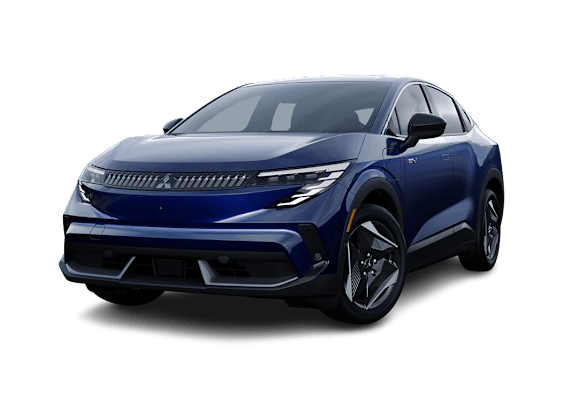
The latest vehicle to be shared between the Nissan and Mitsubishi brands is the Nissan Leaf electric vehicle, which is being gently restyled into the 2027 Mitsubishi Eclipse Sportback. Mitsubishi isn’t shy about this fact, either, touting this cross-corporate-alliance feat of badge engineering as a way to bring an EV back into their lineup for the first time since the humble i-MiEV.

Aside from the confusing reuse of the Eclipse name—which is currently being used for an unrelated gas-powered subcompact SUV (the Eclipse Cross) and was originally used for a two-door sports car (the Eclipse)—it’s hard to see much of a downside. The Leaf is a great value for the money, with a livable range, zippy powertrain, and competent handling. It punches above its price point with some features more expensive EVs omit, like navigation with EV route planning that automatically suggests charging stops, and wireless Apple CarPlay and Android Auto. We expect the Mitsubishi version to be more of the same.

Mitsubishi will sell the Eclipse Sportback in a single trim, and from what we can see so far, it shares many of its features with the mid- and top-trim Leafs, including dual 14.3-inch screens for the driver’s instrument panel and the central infotainment screen, and its powertrain. All Eclipse Sportbacks are front-wheel-drive, with a 214-hp single motor and a 75-kilowatt-hour battery that Mitsubishi claims is good for 282 miles of range.

Only one additional package will be offered: the Technology package. This adds a 10-speaker Bose audio system, a hands-free power liftgate, roof rails for cargo, and an electronically-dimming panoramic glass roof.

Mitsubishi will announce pricing closer to the Eclipse Sportback’s on-sale date later this year, but we expect it to be competitively priced alongside the mid-grade Leaf.

It competes with the Chevrolet Bolt, Hyundai Kona EV, Kia EV3, Nissan Leaf, Subaru Uncharted, and Toyota C-HR

The powertrain is 214-hp, 160-kilowatt electric motor and 75-kilowatt-hour lithium-ion battery; direct drive transmission; and front-wheel drive.

The estimated price range is $32,000-$37,000.

The on sale date is Fall 2026.

Impressions

Outside

There’s a bit of Oldsmobile Eighty-Eight vs. Buick LeSabre going on with the Eclipse Sportback and the Leaf, but just like those older badge-engineered specials, Mitsubishi made sure to give the Eclipse Sportback a unique front and rear fascia to distinguish it. It features a grille-like design between the headlamps that mirrors the grilles found on other Mitsubishis, a more pronounced crease below the vestigial grille, and a more open-feeling lower section. In the rear, black slats on the lower part of the bumper further set the Eclipse Sportback apart from the more pebble-like Leaf.

The Eclipse Sportback features LED headlights and taillights, both with unique lighting patterns that help differentiate them from the Nissan. A welcome animation plays in the headlights and daytime running lights when the car is unlocked. Automatic high beams are standard. The Eclipse Sportback’s taillights have the same smaller-footprint style as the non-top-trim Nissan Leaf, but feature a Mitsubishi-specific T-shaped lighting design and smoked lenses.

The Leaf’s pop-out front door handles (which we’re not especially fans of, given how awkward they are to use if they don’t pop out, such as when they get iced over in winter weather), as well as its awkwardly angled high rear door handles, carry over as well. There’s also a thicker, model-specific chrome trim piece that sets off the C-pillar on the side, with its widest, shiniest spot sitting right behind the rear doors.

All Eclipse Sportbacks ride on funky, chunky tri-spoke 18-inch alloy wheels.

Inside

The interior of the Eclipse Sportback largely mirrors that of the higher Leaf trims, with dual 14.3-inch displays for the driver’s instrument screen and central infotainment touchscreen. Below the infotainment screen is a slick panel of touch-sensitive climate controls. Select controls still have their own physical buttons and knobs on the dashboard, including media seek and volume controls, emergency flashers, the camera, and drive mode settings. The gear selector is a row of PRND buttons near the center of the dashboard. A six-speaker audio system comes standard.

All Eclipse Sportbacks come with black synthetic leather seating featuring perforated and stamped patterns for added pizzazz. Both front and rear passenger seats are heated, and the car’s automatic climate system can also adjust these in response to the overall temperature setting. Like the Leaf, the Eclipse Sportback has a 60/40-split rear bench seat and underfloor storage to provide extra cargo space.

A heated steering wheel comes standard as well. While it shares its flat-bottom shape with the Leaf, the Eclipse Sportback features separate, physical buttons, switches, and knobs that should be easier to use without needing to look down at the wheel.

These aren’t the only conventional controls in the Eclipse Sportback’s interior, as there are easy-to-use stalks for lights and wipers, plus normal physical window switches for all four doors. We were glad to have these on the Leaf as well, given that too many EVs lean too hard into futuristic-looking controls at the expense of usability.

The infotainment system uses a Google-sourced operating system that features Google Maps, Google’s voice assistant, and downloadable apps through the Google Play store. We were particularly impressed by the route-planning capabilities through Google Maps on the Leaf, which automatically factor in charging stops on longer trips. The system factors in which accessories are in use, the vehicle’s speed, projected battery use along the route, and charger status when picking a charging stop. It also cues the car to start preconditioning the battery when a charger is the next stop.

What Drives It

Every Eclipse Sportback is front-wheel-drive, with a single 160-kW electric motor on the front axle that is good for 214 hp and 261 lb-ft. of torque. Powering that motor is a 75-kWh liquid-cooled lithium-ion battery.

Mitsubishi claims the Eclipse Sportback is capable of going 282 miles on a single charge, which is similar to the 288-mile Environmental Protection Agency-estimated range for our purchased Nissan Leaf SV+. We have good reason to believe the Mitsu will live up to that decent range estimate, too. Consumer Reports actually exceeded the Leaf’s EPA range in our 70-mph highway-range test, going 292 miles before its battery was totally depleted.

Four drive modes allow drivers to customize the throttle response, steering feel, and dashboard layout. Paddles behind the wheel allow the driver to adjust the level of regenerative braking as they please. An additional mode, called e-Step, can be enabled via a switch on the dashboard. This offers the maximum amount of regenerative braking the Eclipse Sportback can provide, but still requires drivers to use the brake pedal to come to a full stop.

All Eclipse Sportbacks come with two front-fender-mounted charging ports: on the driver side for slower AC chargers, a J1772-style plug for Level 1 or Level 2 chargers, and on the passenger side a North American Charging Standard-style plug for fast-charging. Mitsubishi claims that the Eclipse Sportback takes approximately 6.5 hours to refill the battery from a 20 percent to an 80 percent state of charge using a 240-volt Level 2 plug, and approximately 11.5 hours to go from 10 percent to 100 percent.

The Eclipse Sportback’s maximum fast-charging speed of 150 kW is significantly slower than the output of today’s top fast-chargers (which can reach up to 400 kW), but this wasn’t a huge setback in our purchased Leaf. Mitsubishi says the Eclipse Sportback can add up to 85 miles of range in 10 minutes and can recharge the battery from a 10 percent to 80 percent state of charge in about 35 minutes. Its NACS plug uses the same charging standard that’s become the industry standard, allowing it to use the chargers in the large Tesla Supercharger network without an adapter. An adapter is included to use CCS-style fast-chargers as well.

Safety and Driver Assistance Systems

The Eclipse Sportback comes standard with a number of safety and driver assistance systems, including automatic emergency braking, forward collision warning, blind spot warning, rear cross traffic warning, reverse automatic emergency braking, lane departure warning, lane keeping assistance, and traffic sign recognition.

Mitsubishi’s standard active driving assistance system also combines adaptive cruise control and lane centering assistance to keep it centered in its lane while maintaining a set speed and distance from the vehicle ahead.

Change Vehicle