
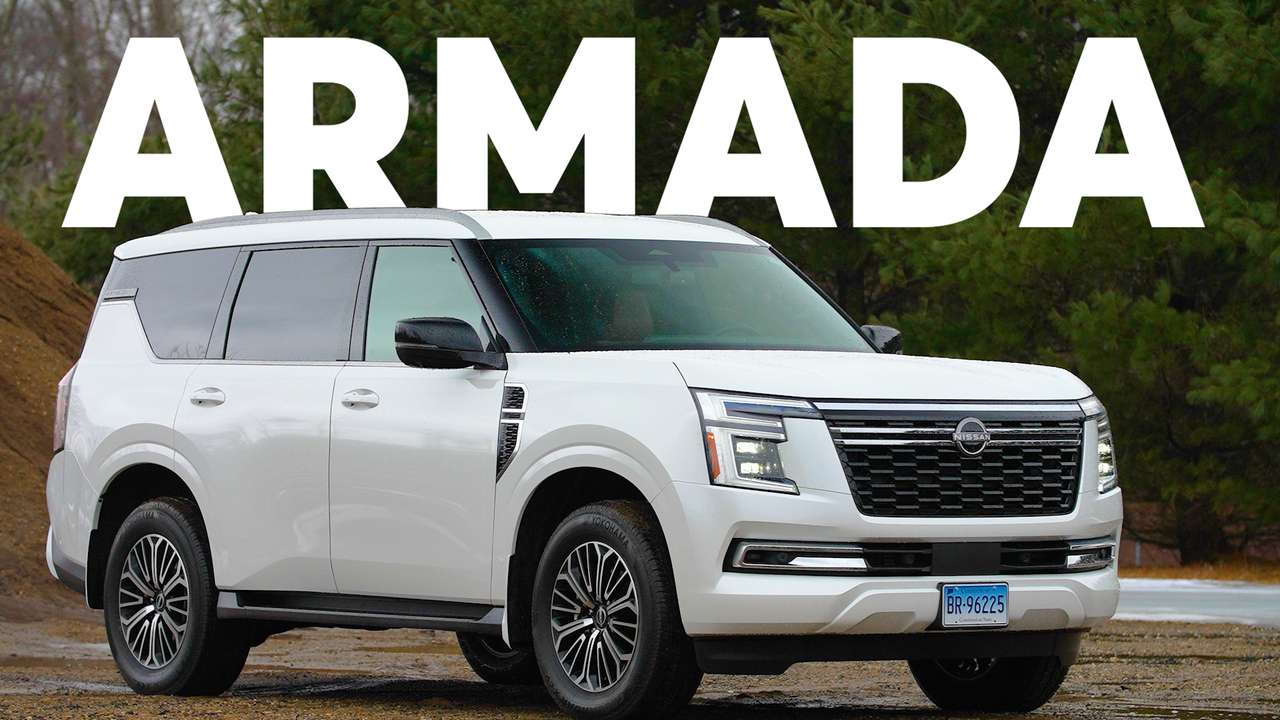


The redesigned Nissan Armada combines premium features, a powerful engine, and a spacious, well-executed interior. Looking like a Land Rover Range Rover alternative, the Armada comes across as more sophisticated than before. It has more standard features than the outgoing model, yet holds the line at not increasing the base price.
All versions use a twin-turbocharged 3.5-liter V6 engine paired with a nine-speed automatic transmission. Total output is 425 hp and 516 lb.-ft. of torque, granting the new Armada an advantage of 25 hp and 103 lb.-ft. compared with the V8 in the outgoing Armada.
When our testing was complete, there was no question: This is a significantly improved vehicle, a point proven by a noticeably higher road-test score. Certain aspects of the new Armada, such as the unintuitiveness of some of its controls and the less-than-stellar ride quality, aren’t anything to brag about. But our testers loved the smooth and brawny powertrain, comfortable front seats, and the near-Infiniti levels of luxury inside the cabin.
What hasn’t changed is the enormity of this massive SUV’s footprint. Some drivers were uneasy piloting such a big vehicle, with one going so far as to say, “I felt a little silly driving this behemoth around and parking it at my apartment complex. It’s so ridiculously tall!”
Others disagreed, with one saying, “I think it drives smaller than it looks. Great side visibility, and the side windows are huge.”
The slick, 425-hp, turbocharged V6 garnered numerous fans for its powerful and refined performance. But although the redesigned Armada’s fuel efficiency is up by 3 mpg compared to the previous version with its 5.6-liter V8, the Armada’s 17 mpg overall won’t exactly have environmentalists cheering.
Believe it or not, a couple of testers even went so far as to suggest that the Armada represents a decent value when compared with well-heeled luxury nameplates—including Nissan’s own upscale spinoff, Infiniti. Said one tester, “The Armada really makes me wonder why anyone would drop $25,000 more to buy an Infiniti QX80. If you’re after a monstrous SUV that gets horrible fuel economy and has some luxury features, this thing gets it done.”
We bought a 2025 Nissan Armada SL 4WD for $75,155—anonymously from an area dealer, as we do with every vehicle we test—for the purpose of this road test review. Our Armada was assembled in Kyushu, Japan.
Driving experience
The standard 3.5-liter twin-turbocharged V6 puts out an impressive 425 hp, and moves this nearly 6,000-pound beast with satisfying authority. It runs through a smooth-shifting nine-speed automatic transmission. Our tested version was equipped with the optional four-wheel drive, but rear-wheel drive comes standard. This combination delivered a 0-to-60-mph dash in a relatively caffeinated 6.3 seconds—slightly quicker than the previous model and right in line for the large SUV class. Fuel economy has also improved, now at 17 mpg overall. That’s a decent upgrade over the previous SUV, which delivered an atrocious 14 mpg overall.
Large SUVs rarely shine in our handling evaluations, and the Armada doesn’t break any new ground here. It exhibits reasonable roll control, helping the Armada keep an even keel through turns. But no one is going to argue that it's particularly agile. The steering has some heft to it, adding to the dull-mannered impression. At low speeds, that heft becomes a nuisance, turning parking lot maneuvers into a workout.
The Armada looks upscale—both inside and out—but the ride is decidedly stiff and at times unruly. The suspension tuning causes uneven pavement ridges to send a shudder through the Armada’s body. At least the big Nissan remains a very quiet land yacht. Road noise is practically nonexistent, and wind noise is well-suppressed. The engine, too, has a pleasing and refined sound.
Braking performance was somewhat of a letdown. Our tests showed competitively short stops on our dry surface, but when we repeated the same tests in the wet, the distances were slightly longer than we’d like to see, although not out of the ordinary among large SUVs.
Cabin comfort
Our tested second-tier SL trim is far from the top-of-the-line Armada model, but we were still impressed by the fit and finish of the cabin, as it’s not far off the similar Infiniti QX80. The cabin is richly padded with a variety of soft-touch materials. Other highlights include some nice textured trim surrounding the window controls, exposed stitching throughout, and the attractive two-tone tan-and-brown seat trim.
The upright and elevated driving position gives a good view of the road over the tall, flat hood. The driver benefits from plenty of headroom, symmetrically-placed armrests, and a lack of right-knee center console intrusion. The front seats are supportive and very comfortable, with one tester even describing them as like La-Z-Boy chairs: wide, upright, and comfortable for long stretches. Some drivers wished that the leading edge of the bottom cushion could be adjusted lower to reduce the under-thigh support, however.
The rear seats (our test vehicle had the optional captain’s chairs, but a three-person bench is also available) offer ample space, good adjustability, and excellent comfort. The third row provides reasonable comfort for the class, but headroom is tight.
Entry into this behemoth is suitable for both those who can stretch right over the running board and those of shorter stature who benefit from the step. The more upscale Armadas, such as the Pro-4X and Platinum Reserve, simplify the task by lowering the vehicle via the air suspension system when parked, utilizing a feature known as "kneel mode." Access is further aided by nice, traditional exterior door handles and beefy interior grab handles for easy entry. Third row access is tight, but not unusually so for the class.
This big, boxy vehicle boasts a ton of rear cargo space. But we were surprised that for such a large vehicle, and one seemingly designed for family voyages, the various nooks and bins for small-item storage are somewhat diminutive or otherwise compromised.
Controls and usability
A large, customizable infotainment touchscreen controls most features inside the Armada. We were happy to find that the main climate controls, including temperature and fan speed, use large physical toggles and buttons that are clearly labeled and well-lit at night.
We like that the volume knob is within easy reach, offering responsive input and clear tactile feedback. The various media, navigation, and phone menus are well organized and easy to use. However, the driver’s instrument screen suffers from a confusing menu structure, and the diagonal thumbwheel on the steering wheel to move around within it requires the dexterity of a magician. Additionally, the monostable turn signal, which returns to its neutral position when activated, proved frustrating to use, as drivers found it difficult to engage consistently.
But the biggest offender, in our opinion, is the electronic gear selector, which features piano-black buttons positioned low on the center console. All of the buttons look the same and have too little tactile differentiation for the driver to use them confidently without looking down and over at them.
Numerous drivers complained about unstable Bluetooth, Android Auto, and Apple CarPlay connections. Some users were unable to pair their phones, while others found the process to be slow.
Active safety and driver assistance
Standard active safety and driver assistance features on the Armada include automatic emergency braking with pedestrian detection, automatic emergency braking that operates at highway speeds, blind spot warning, rear cross traffic warning, reverse automatic emergency braking, lane centering assistance, lane departure warning, lane keeping assistance, adaptive cruise control, and automatic high beams. Trailer blind spot warning is also standard.
Various versions of Nissan’s ProPilot Assist active driving assistance system come standard on the Armada, depending on trim level. The basic setup blends lane centering assistance and adaptive cruise control. The SL, Platinum, and Platinum Reserve trims are equipped with ProPilot Assist 1.1 with Navi-link, which utilizes navigation information to proactively adjust the vehicle's speed for curves and interchanges. ProPilot Assist 2.1 is optional on SL, Platinum, and Platinum Reserve. This top system enables hands-free operation on designated highways, handling acceleration, steering, and braking. You can even change lanes automatically when the driver activates the turn signal or confirms a lane change prompt from the system. It uses an in-car camera to monitor the driver. We like that it clearly communicates when the system is in hands-free vs hands-on mode (blue vs green).
The adaptive cruise control system was slow to reaccelerate and maintain speed, often resulting in jerky acceleration and deceleration in stop-and-go traffic. And the lane centering assistance caused the Armada to frequently “ping-pong” back and forth between the lane lines, and it swung wide through corners.
A rear occupant alert system comes standard on the Armada. It’s designed to remind the driver—based on rear-door logic—to check the rear seat when the Armada is turned off to help prevent children and pets from suffering heatstroke or hypothermia if unintentionally left behind in the vehicle. Unfortunately, the rear occupant alert system doesn’t come factory-enabled (unlike in most vehicles), and some parents may not even realize the Armada has this feature available to them. There’s also a rear belt minder, which alerts the driver if a rear passenger unbuckles their seat belt during the trip.