

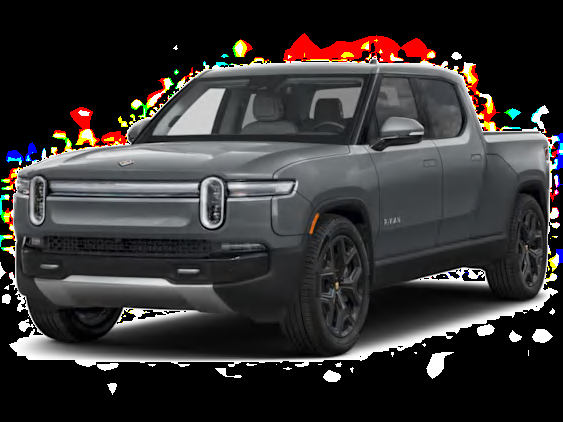
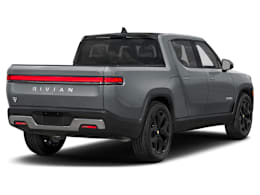
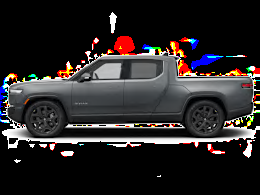
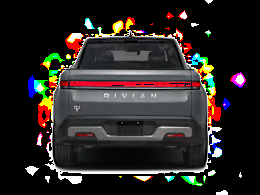
The road test report below is based on our findings with a quad-motor 2022 R1T First Edition, as well as our 2025 R1S Dual Max.
The second-gen R1T is a cutting-edge, all-electric pickup with an impressively wide repertoire of capabilities. This high-horsepower truck can accelerate with the ferociousness of a supercar, claw its way up and over boulders with the tenacity of a Jeep Wrangler, carve through corners better than many trucks, and tow a trailer of up to 11,000 pounds, albeit for a relatively short distance before requiring to be recharged. Slotting in size-wise between a midsized pickup like the Honda Ridgeline and a full-sized Ford F-150, the R1T has a luxurious cabin and features numerous innovations, including a transverse storage tunnel between the cab and bed. All of these positive attributes enabled the R1T to achieve a very high road-test score in our testing.
But all is not perfect. It takes concentration to drive the R1T smoothly thanks to its aggressive regenerative braking system. Then there’s the interior controls: Far too much reliance is placed on the center-dash infotainment touchscreen, including what should be simple tasks such as adjusting the side mirrors and the air vents, which adds to driver distraction. Still, what’s not to like about a luxury pickup truck that can instantly pin you back into your seat when you floor the throttle pedal, as it transfers its prodigious torque to all four wheels at once? The quad-motor, 2022 R1T Launch Edition we tested scorched from 0 to 60 mph in a sports-car-like 3.8 seconds, while our 2025 R1S Dual Max managed the sprint in a respectably quick 4.6. The R1T Dual Max should perform similarly.
The dual-motor R1T with the largest battery (which Rivian calls “Max”) and 22-inch wheels has an EPA-estimated driving range of 420 miles; we saw 358 miles in our own 70-mph highway-range test of the R1S Dual Max, and would expect the R1T to achieve a similar figure. It relies on a huge, 140-kilowatt-hour battery and is capable of DC fast charging at a maximum acceptance rate of 220 kW, which is competitive. Of course, charging such a large battery on a 240-volt connector is a long process that takes around 15 hours from empty. With its 11.5 kW on-board charger, those with a private home charger can benefit from installing the charger on a 48-amp circuit to maximize the charging speed.
Stopping distances are merely average, begging the question of whether the R1T is too speedy for its own good. We also found the regenerative braking system—which slows the vehicle when coasting and sends energy back to recharge the battery—to be abrupt at low speeds.
The R1T’s handling abilities are impressive for any vehicle, let alone a nearly 7,000-pound pickup, thanks to quick steering and very little body roll through corners. The steering effort is a bit light, and doesn’t deliver much feedback to the driver about tire grip or road texture, though. By virtue of its unibody construction, rather than the traditional body-on-frame design of most pickups, along with standard air suspension, the R1T stays steady, composed, and comfortable most of the time out on the road. The firmness of the ride only comes through on bumpier back roads, with some noticeably hard hits punching through into the cabin. The truck handles off-road situations impressively, too; it crawled up our boulder-strewn rock hill with relative ease, thanks to its height-adjustable suspension and effective traction control system.
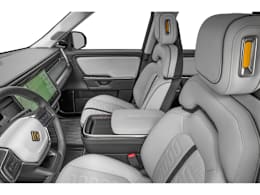
We appreciate the R1T’s spacious driving position, which has an elevated seat height and lots of headroom. The wide front seats provided good comfort and support for some of our drivers. But others found them lumpy, with odd pressure points on the upper portion of the seatback. The rear seat isn’t as roomy as a full-sized truck, but even our taller testers found that they had good headroom and just enough knee room. There’s good foot space under the front seats, and the slightly raised, stadium-style seat delivers ample leg support.
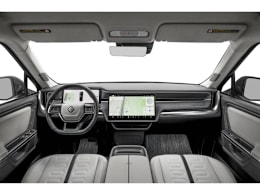
The cabin shows excellent attention to detail and exhibits a premium, high-tech look. We love the metal accents on the doors and seats, and the natural, untreated feel of the wood trim. There are plenty of padded surfaces throughout the interior, including super-soft micro-suede material covering the headliner and windshield pillars.
Plus, the truck is chock full of innovative features. There’s a rechargeable flashlight in the driver’s door; a rechargeable, removable Bluetooth speaker; an air pump in the bed, with a hose that can reach all four tires to air them up; a gear-lock cable in the bed that works with the central locking system; a large front trunk; a transverse gear tunnel between the bed and cab for added storage, and a powered tonneau cover for the bed.
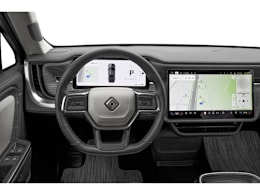
But although the Rivian has many unique features, the company has oddly mimicked Tesla when it comes to the infotainment system and controls, including a lack of traditional, easy-to-use physical controls for the side mirrors, steering-wheel adjustment, and dashboard air vents. Nearly every interior function has to go through the oversized center-dash infotainment screen. At least the activation process of active driving assistance (the combination of ACC and lane centering assistance) has been improved in the updated R1T. Instead of double-tapping the gear selector lever, the motion is now pulling the lever toward the driver. It’s truly a sad state of affairs that we breathed a collective sigh of relief that the R1T at least has a traditional stalk on the steering wheel for the turn signals and windshield wipers, but such is the auto industry’s utter eschewing of physical controls that we never know which button or knob a carmaker is going to take away next. It’s also disappointing that Android Auto and Apple CarPlay are unavailable on the Rivian.
Automatic emergency braking with pedestrian and cyclist detection, automatic emergency braking that operates at highway speeds, blind spot warning, rear cross traffic warning, lane centering assistance, lane departure warning, lane keeping assistance, adaptive cruise control, a direct driver monitoring camera, and automatic high beams all come standard.