Your membership has expired

The payment for your account couldn't be processed or you've canceled your account with us.

Re-activate

2026
Subaru Uncharted

EPA Range: 287 miles

Subaru Uncharted First Drive

Summary

Introduction

2026 Subaru Uncharted Goes Fast but Still Lags Behind

The Uncharted is a smooth, quick electric vehicle, but lacks many of the extra features that make EVs like the Hyundai Ioniq 5 and Nissan Leaf easier to live with

Overview

The new Subaru Uncharted is the all-electric counterpart to the brand’s Crosstrek subcompact SUV, and it should look familiar in many respects. It is essentially a 7-inch-shorter version of the Subaru Solterra, with nearly identical dashboards and powertrain components. The obvious sacrifices made by lopping off length from the Solterra are in back-seat and cargo space, but in our short time with the Uncharted, we’ve noticed that this extensive rework also produced a slightly more pleasant, smoother-riding EV.

Like the Solterra, which was co-developed with Toyota and has a near-twin called the Toyota bZ, the Uncharted has a Toyota counterpart: the all-electric 2026 Toyota C-HR. This extended model family shares a lot between the siblings, which makes spotting the differences a bit tough. All of these EVs ride on Toyota’s e-TNGA platform and are available with the same 338-hp, dual-motor all-wheel-drive powertrain and 74.7-kilowatt-hour battery.

Each vehicle also has dual wireless phone-charging pads beneath a large 14-inch touchscreen at the center of the dashboard. They also share the same 7-inch driver’s information display that sits farther back on the dashboard, nearly where a head-up display would project. There aren’t very many physical controls outside of the steering wheel, which has a pleasingly tactile array of chunky buttons, but there is an unusual twisting gear selector that takes up a ton of center-console real estate.

The devil’s in the details, clearly—and the styling, in case one version speaks to you over the other. Curiously, it’s the Subaru, not its Toyota twin, that offers a base front-wheel-drive version using the 221-hp single-motor powertrain from the bZ. Yes, from Subaru, the brand that’s most synonymous with all-wheel drive. In doing so, this gives Subaru a base model that undercuts the entry-level C-HR’s price by just over $2,000 and has the longest driving range of the duo: an EPA-rated 308 miles.

In addition to the base Premium FWD trim, there are two other trim levels available, the mid-grade Sport and the top-of-the-line GT. Both use the 338-hp dual-motor powertrain and have EPA-rated ranges of 287 and 273 miles, respectively. Pricing ranges from $34,995 for the Premium FWD to $43,795 for the GT, and all models have a $1,450 destination charge.

For our test program, we purchased an Uncharted Sport AWD, which included just three added-cost options: upgraded two-tone exterior paint, all-weather floor liners, and a cargo tray. The total cost came to $42,083.

The final assembly point is Japan.

It competes with the Chevrolet Equinox EV, Nissan Leaf, Toyota C-HR, and the Volkswagen ID.4.

Impressions

What We Like

Powertrain

The Uncharted’s 338-hp dual-motor powertrain is extremely impressive. We’ve come to expect EVs to deliver smooth, instant power, and the Uncharted is no exception. It also delivers a lot of power in a way that’s still easy to drive, without the excessive torque steer we’ve experienced in some less expensive EVs. The Uncharted fears no uphill climb or passing zone.

Ride quality

The defining standout feature of the Uncharted is how smoothly it rides. Often, shorter-wheelbase cars can be jumpy, but the Uncharted isn’t just good for an EV or good for a small SUV—it’s very good overall. It absorbs bumps well and is quiet over impacts. The body also remains well under control when it hits a bump, without becoming bouncy or tossing passengers’ heads around. A bunch of us even preferred it over the Solterra.

Quiet interior

The Uncharted is impressively quiet inside and well insulated from outside noise. “You can hardly, if at all, hear the pedestrian warning sound from inside the cabin, which I very much appreciate as you’re going into and out of that 20 mph threshold,” one tester said. There is little to no whine from the electric motors. Road and wind noise become more noticeable at highway speeds, but even then, it’s no worse than any of the other small EVs we’ve tested.

Handling

While no one’s going to mistake the Uncharted for a sports car, it does a nice job of balancing a comfortable ride with predictable, confident handling. One tester’s take: “When you push it, body roll becomes quite noticeable, but at the same time, the chassis is very responsive to quick changes in throttle or steering inputs mid-corner, which is nice.” The Uncharted’s steering feel is on the lighter side, but it still has a relatively quick ratio and feels natural to use.

Styling

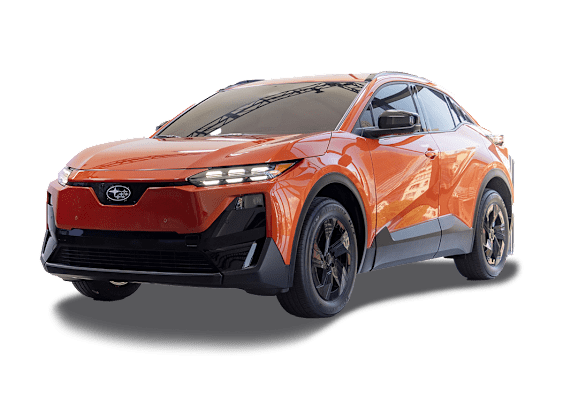
Clearly, this is a personal preference, and not something Consumer Reports scores, but the Uncharted’s trendy fastback design gets a lot of compliments. The two-tone paint looks sharp, and the Subaru’s front-end has a lot more character than the C-HR’s. Many of our testers also felt as if the Uncharted’s proportions looked more balanced than those of its longer counterpart, the Solterra.

This isn’t to say it comes without sacrifices. The rear cargo area is fairly generous in floor space for a small SUV, but is compromised in height due to the roofline angle. Still, that’s to be expected with this body style that’s en vogue at the moment.

North American Charging Standard (NACS) port

The Uncharted at least feels up to date in one important respect: It has a Tesla-style NACS port, the charging standard currently being adopted across the automotive industry. This doesn’t just mean it gets to use a slimmer, easier-to-handle plug; it can also use the more widely available Tesla Supercharger network without an adapter. Now that the automotive industry has agreed upon this standard, public charging stations with NACS plugs will only become easier to find over time.

Fast AC-charging rate

According to Subaru, the Uncharted has a maximum AC-charging acceptance rate of 11 kW, which exceeds the speeds of most Level 2 home chargers on the market. Subaru claims it can recharge the battery to a 100 percent state of charge from its low-charge warning (which comes on at varying low states of charge depending on the outside temperature) in about 6 hours on a 240-volt plug. Combined with a relatively high overall efficiency, the Uncharted will add over 35 miles of range per hour when charging at the full 11kW, which is very competitive.

This is especially helpful in a car that lacks many of the niceties that make public charging easier, and, of course, it’s always cheaper and more convenient to recharge at home than out in public. As faster home chargers become more widely available, the Uncharted is ready to take full advantage of them.

Some physical controls

We hate that we feel the need to give kudos for this, but props to Subie-yota for keeping it pretty normal in here. Our testers appreciated having conventional stalks for the turn signals, headlights, and windshield wipers. The power windows have normal switches, and there are physical knobs for the temperature and audio volume.

Even the front doors have regular pull-out door handles and physical releases inside, which are starting to feel like a rarity in the age of flush and powered handles.

Maneuverability

The Uncharted’s small size doesn’t just help it feel a little more fun on the roads than its larger Solterra iteration, but it makes it very easy to park and maneuver through tight spaces. Forward visibility is great, with narrow pillars and a large, open windshield. An excellent surround view camera that comes on the all-wheel-drive trims also makes it easy to see obstacles you might otherwise miss, and it’s great having a physical button to turn the camera on as needed.

Standard Wireless Android Auto and Apple CarPlay

Not every electric vehicle offers these features, even though many customers prefer a more familiar phone-style interface to the built-in infotainment system.

Price

We can’t complain about another relatively reasonably priced EV, especially at a time when high gas prices are leading more people to consider one. The Uncharted is a pretty compelling option in many respects, and while it may not be for everyone, it’s nice to see another sub-$40,000 option on the market.

What We Don't Like

Poor charging status indicators

The biggest reason the Uncharted feels behind the times at its release is its lack of features that make an EV easier to use. Many EVs have larger, persistent displays that show the car’s state of charge while it’s plugged in and indicate whether it’s actively charging. This way, the driver can at least glance inside the window and tell whether it’s charging as intended or ready to drive. Not so with the Uncharted, which puts this information on its tiny 7-inch driver’s information display, and turns that display off after a period of sitting.

Some EVs also have a clear charging status indicator by the port itself, but the Uncharted has only a solitary, dim green LED above the plug. You’re supposed to be able to tell whether the Uncharted is charging as intended based on whether this light is blinking or solid, but it’s really hard to see on brighter days. Compared to the status indicators on other new EVs, which use multiple colors, larger lights, or even simplified progress bars next to the plug, the Uncharted feels like a finicky vintage EV.

The Uncharted does have a connected mobile app to check its charging progress on your phone, however.

Adapter use

While the NACS port is the right call in the long run, owners need to use an adapter with chargers that still use the CCS plug style, and these can be pretty annoying to use at times. These are especially frustrating with the Uncharted, as it lacks a plug-lock release button next to the charging port. If you accidentally unplug the vehicle without removing the adapter, the adapter sometimes stays locked to the charge port even though no power is flowing through it.

No EV route planning

While many newer EVs account for the vehicle’s current state of charge and include charging stops along longer routes, the Uncharted does not, which feels like an oversight. While you can at least navigate to chargers using the system, it lacks the depth of information on those chargers that other systems have, such as the number of chargers available at a given charging station.

Infotainment system

The Uncharted uses a version of the same slightly laggy Toyota infotainment system as older Solterras, and frankly, it’s time for an update. While it’s nice that there are a few larger tiles and buttons, such as those for the driver assistance and climate control systems, some of the onscreen options are relatively small and lack contrast (most notably, the left menu bar).

The lack of a “home” screen with a split-screen view makes it impossible to see multiple features at a glance, such as maps next to audio. We also had occasional issues with Bluetooth connectivity failing to connect or dropping its connection entirely.

Onscreen climate controls

Using screen-based controls for the most frequently interacted-with features in a car is almost always more distracting than having dedicated physical controls. While it’s good that they’re always visible at the bottom of the infotainment screen, the Uncharted’s controls still require you to look away from the road to make sure you’re pressing the right spot on the screen.

Even the temperature dials—among the few physical climate controls in the Uncharted—were frustrating, as they lacked clear detents to let us know we registered any change, and there was some lag in their response time.

Some automatic climate control features also aren’t clearly labeled or explained in the owner’s manual, either, such as the buried “Settings” menu option that turns the steering wheel and seat heaters on at vehicle start-up whenever the system’s temperature is set to be warmer than the outside temperature.

Lower DC fast charging speeds

While several EVs in this price range, including the just-released Nissan Leaf, have the same 150-kW maximum DC fast charging speed as the Uncharted, this feels slightly behind the times when public fast-chargers are hitting speeds of 350 to 400 kW. Despite this, the Uncharted manages a peak of about 9 miles of range added per minute, due in part to its high overall efficiency. For comparison, a Hyundai Ioniq 5 can hit a peak of about 13 miles of range added per minute. Subaru claims that the Uncharted can go from 10 to 80 percent state of charge in about 28 minutes on a 150-kW public fast charger, which is fairly livable, but a rate of at least 250 kW would be more competitive.

Weak regenerative braking with no one-pedal mode

A common EV feature that many drivers enjoy is using regenerative braking to slow down the car, in turn capturing that kinetic energy and feeding it back to the battery. We found the Uncharted’s regenerative braking settings—all four of them, which are adjustable through convenient paddles on the steering wheel—to be relatively weak compared to other EVs, and nearly nonexistent when the state of charge is over 90 percent. Moreover, the vehicle does not retain the setting you choose when you turn it off and back on. Instead, it reverts to its default level of “1.”

There is no one-pedal driving option, either, where you can use regenerative braking to bring the vehicle to a full stop.

Poor rear visibility

The same dramatically angled, fastback-style roof that garners all sorts of compliments on the Uncharted’s styling makes it a beast to see out the back, particularly when it comes to the thick, angled rear pillars that block the rear three-quarter views on both sides.

The fact that there isn’t the option to equip it with a rear wiper makes it even worse on wet mornings. It takes quite a bit of driving for the rear window to clear off, and drivers might as well be backing up a box truck until then. To the Uncharted’s credit, the surround view camera included on the AWD models is excellent, but this isn’t a true workaround. Cameras can also fog up, get dirty, or fail, and should be viewed as a supplement to out-the-window views, not a replacement.

Tiny driver’s information display

For a vehicle that does such a nice job of including large print on the central infotainment display and big, chunky buttons with large, clear icons on the steering wheel, it all falls apart when it gets to the 7-inch driver’s information display. While the intent is clearly to split the difference between a conventional gauge cluster and a head-up display on the windshield, some testers felt as if it was too far away and too cluttered a design to comfortably understand at a quick glance. The graphics look outdated, and the estimated remaining driving range in the bottom-right corner gets lost in the jumble of icons for active driver assistance systems. Shorter drivers also felt as if its placement higher on the dashboard blocked their view of the road ahead.

Odd-shaped steering wheel

Some testers struggled to find a comfortable steering-wheel position without blocking important information on the driver’s information display. Those who like a lower wheel position had no issues, but others had to lower the wheel further than they preferred to have more information in view.

To Subaru’s credit, they tried to remedy this issue somewhat with a funky, flat-top-and-bottom steering wheel. But our testers were split as to whether this was preferable over the round wheel in our Toyota bZ, which blocks considerably more of the driver’s display, but feels more natural to use. Either way, it’s an uncomfortable compromise, and a solution to a problem that shouldn’t exist.

The steering wheel’s larger-than-usual array of big, chunky controls mirrors those we’ve tested on the Toyota bZ and Subaru Solterra, and frankly, we’re still not huge fans of this cluttered control design. While the relatively large buttons themselves make them easy to tap, they tend to blend into a sea of gray.

Strange gear selector

The Uncharted has a twist-action gear selector that takes up a lot of center-console real estate and offers no usability advantage over a traditional lever or knob. While some of our testers got used to it, at least one noted that it’s easy to accidentally leave it in neutral since neutral only requires pressing down on the knob to select, and park is a separate button to press off of the twist-knob. Between this gear selector and the giant dual charging pads, it forces the cup holders and center-console armrest to sit further back than is ideal, especially for shorter drivers.

Reverse chime

While it is nice to have some audible confirmation that the Uncharted is in reverse, it comes in the form of a repeated “ding-ding-ding-ding” chime that reminds us of the ones found on box trucks, only with a little more class. Unlike on box trucks, the Uncharted’s ding-dings can only be heard on the inside of the vehicle, not the outside. Most of us just found it grating.

Slippery wireless chargers

The Uncharted’s prominent dual wireless device-charging pads are a love-it-or-hate-it feature. Some of us loved them, as users are less likely to forget their phones when they get out of the car. Others felt as if they took up too much of the Uncharted’s precious center console real estate, or didn’t want to see that much of their phones while driving. Your tastes may vary, and we’ll spare you the debate as to whether this in-car shrine to the phone is further proof that we all need to log off.

More universally agreed-upon is that the bottom of these pads is pretty slick, and it allows phones that aren’t in a grippier rubberized case to slide around quite a lot while driving. There is no magnet or clip to hold phones in place, either—just some raised edges that define the ends of the tray.

Cramped rear seat

The rear seats are best left to small children, provided you want to open the door for them every time they get in. That’s because the Uncharted’s awkwardly high exterior door handles sit at a weird diagonal angle that we find unnatural to use. Once you open the door, it’s not much better.

“The door doesn’t open all that wide, so the entryway is tight, also because of the sloping roofline and the lack of knee room,” one tester noted. “So, it’s a bit of a squeeze and a duck and a contort to get in. On the way out, you have to work a bit to get around the rear wheel well.”

Inside, the rear bench sits low to the floor and offers little leg support for adult-size occupants. The drop-down center armrest angles forward in an uncomfortable manner. Headroom is also compromised by the angled roof, legroom is scant, and there isn’t much foot space underneath the front seats. At least the seat itself is soft, and you can recline the seatback slightly.

Compromised rear hatch storage

As with rear-seat headroom, another sacrifice you’ll make for style is in the rear hatch storage area. While it has a decent amount of floor space, the heavily raked roofline leaves you with little vertical cargo area. There’s little advantage in this one over a regular sedan-style trunk.

No glovebox

Important documents will need to be stored in either the center console or the open bin underneath the dual phone chargers, the latter of which has a narrow opening on either side and can be hard to reach into.

No frunk

Some EVs offer a front trunk under the hood, but this is another EV feature the Uncharted skipped. Fortunately, there’s an under-floor storage bin in the rear hatch for small items as well as a nice cargo cover for that area. But the cover lacks a hinge or any means of securing it to the floor.

Poor headlight performance

Nighttime visibility in the Uncharted isn’t great: Our testers felt as though the low beams are aimed too low to be useful. It’s not just us, either—the Insurance Institute for Highway Safety rated the Uncharted’s headlight performance as “poor.”

That lighted emblem

Some of us wished we could turn off the lighted emblem as well to be a little less flashy up front. We would have liked this to be a customizable option.

Too many warnings

When everything’s a warning, nothing actually feels like a warning. The Uncharted’s constant pop-ups, beeps, and persistent icons are nothing short of a design failure that doesn’t adequately prioritize what we actually need to worry about when driving down the road. In addition to the overly paranoid behavior of the driver monitoring system (more on that in the next section), sometimes the Uncharted would ding without us noticing a clear indication as to why it made a noise.

The driver’s information display is also cluttered with icons for whatever driver assists are active, which only makes the information we need to see on that screen harder to find at a glance.

What We'll Keep an Eye On

Range

Our Uncharted’s EPA-rated 287-mile range sounds livable enough, but previous Subie-yota electric SUVs on this platform that we’ve tested have fallen short of the EPA numbers—even more so in cold weather. We’ll do our own range tests once we’ve put more miles on our Uncharted, and will keep a close watch as to whether its range holds up to its spec sheet.

Front seat comfort

Most testers found the front seats just soft enough to be generally comfortable, but some felt they lacked support or adequate bolstering in turns, especially given that the imitation leather upholstery is rather slippery. Some also wanted more adjustability, particularly for the lumbar support location or the bottom cushion. The armrests are also rather thinly padded, and the center console sits further back than some drivers would like. We’ll have to see how comfortable these seats really are for longer road trips.

Voice recognition

Voice controls can be a good way to handle complex tasks (such as entering a navigation destination) without taking your eyes off the road, but they can quickly become frustrating when the vehicle doesn’t understand you, as was the case for some of our testers. We’ll have to see if this improves with subsequent updates.

Driver monitoring system

Driver monitoring systems are typically beneficial, as they remind drivers to keep their eyes on the road ahead. Consumer Reports believes they’re necessary on cars that have advanced driver assistance systems to make sure drivers can’t turn on advanced cruise control and lane centering assistance to text, fall asleep, watch videos, or do other inappropriate, nondriving activities behind the wheel.

The problem is that Subaru’s system is overly paranoid to the point where drivers may become frustrated with it and turn it off. The camera for it sits atop the steering column, and we’ve found that merely resting an arm atop the wheel or raising a cup to take a drink can set it off. That would be one thing, but it also gets set off far too easily beyond that. “You could have your head tilted away and your eyes still looking at the road,” said one tester. “Beeping when using the side mirrors is an issue.”

While its camera location isn’t likely to change, the programming for these systems is frequently updated over time, which is why we’ve noted it in the “keep an eye on” section. As it sits, it’s too hard to tell the difference between it beeping at us for looking at the side mirrors or taking a drink, and it beeping at us because we’re actually looking away from the road for too long.

Child seat fit

The Uncharted’s tiny rear seat is par for the course for a subcompact SUV, and by now, we’ve come to accept that bonking our fully-formed adult heads on these trendy coupelike roofs is an occupational hazard. We see a lot of young parents with affordable small SUVs, though, so it will be interesting to see how manageable it is to fit child seats inside. Fortunately, Consumer Reports has its own set of comprehensive tests on child seat fit, which you can read when we publish our longer road test.

Safety and Driver Assistance Systems

Subaru’s EyeSight suite of active safety and driver-assist features comes standard, and includes automatic emergency braking, blind spot warning, rear cross traffic warning, lane departure warning, front cross-traffic alert, adaptive cruise control, lane centering assistance, automatic lane change assist, and automatic high beams. It also features emergency stop assist, which can safely bring the car to a stop and turn on the hazard lights if the driver becomes unresponsive.

All-wheel-drive models include a surround view camera, Subaru’s DriverFocus distraction mitigation system (which uses sounds and visual warnings to ensure the driver stays alert and is looking at the road), and low-speed hands-free lane centering assistance for driving through a traffic jam.

Change Vehicle