
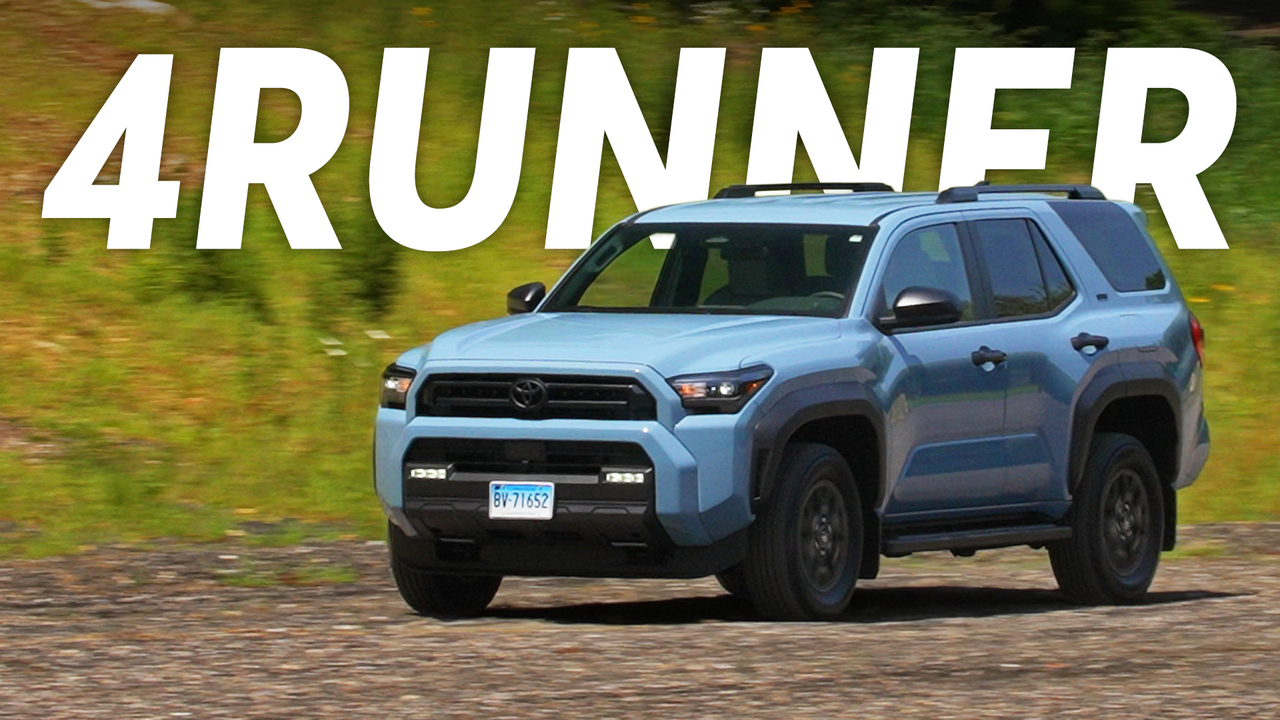
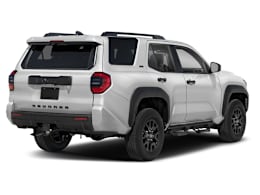
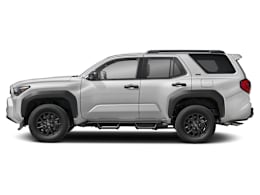
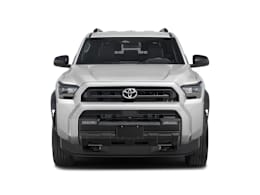
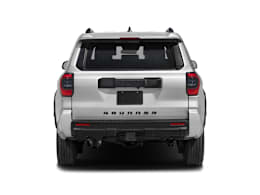
True to its roots, the redesigned Toyota 4Runner is an off-road-capable SUV spun off a platform shared with the latest Tacoma, Land Cruiser, and other body-on-frame Toyota models. Despite being last redesigned for the 2010 model year, the 4Runner has remained relatively popular over the years, serving adventurous drivers who also prize reliability. Light updates over time added tech and safety features, but the 4Runner has long been in need of a full overhaul.
The sixth-generation 4Runner has grown slightly larger and benefits from many of the improvements we experienced in the Tacoma, including easier access, an improved driving position, updated controls, and additional active safety features. It shares its powertrains with the Tacoma, offering a choice of a conventional turbocharged four-cylinder along with a potent turbo-four hybrid. There is a huge range of trims and available equipment, from the SR5 with its basic features up to the relatively luxurious and safari-ready top versions. And, don’t worry, 4Runner faithful: the rear window still rolls down.
After our testing was complete, we found that the 4Runner has been enhanced in some ways, but sadly has gotten worse in others. It remains a rugged, off-road-ready machine that's fun to drive in its own trail-conquering way. Other positives include easy-to-use controls and comfortable front seats.
But from an overall perspective, refinement has slipped, even compared with the outgoing model. The new turbocharged four-cylinder and eight-speed automatic transmission make for a rather crude powertrain, with elevated, uncouth noise levels and rough shifts. Meanwhile, the ride is unsettled, and on-road handling is clumsy. In short, we found it fairly disappointing for a full redesign.
Still, it’s important to note that the 4Runner has a higher road-test score than its two most direct, off-road-oriented midsized SUV competitors: The Ford Bronco and Jeep Wrangler. It also benefits from superior reliability.
With all that in mind, if your priority is everyday comfort and livability, the 4Runner isn’t for you. But if you’re looking for long-term ruggedness and real off-road chops, the 4Runner remains a compelling choice.
“The new 4Runner doesn't do much for me, personally,” said one of our testers. “Between the rough-shifting transmission, noisy engine, truck-like ride, and low handling limits, it's not really all that pleasant to drive. But I can see the appeal, with the bold styling, off-road capability, and (hopefully) robust reliability.”
“For about $45,000 as-tested, you aren't getting many features,” noted another tester. “While some might argue that the 4Runner’s overall lack of refinement is just the nature of the beast of a vehicle like this, buyers really need to know what they’re getting into and be willing to deal with the compromises.”
Even with its shortcomings, several of our staff appreciated the 4Runner for what it is. As one tester commented, “I enjoyed driving it. Not because it’s the best vehicle—in fact, it’s flawed in many ways. But it has character, and there’s something satisfying about driving it. Toyota seems to know that some people actually want a truck-like feel. If you’re looking for something more refined, Toyota builds those vehicles, too. The 4Runner has historically been a more refined choice compared to other truck-based SUVs; while that’s still true in some ways, it’s unfortunate that the powertrain has taken a step back.”
We bought a 2025 Toyota 4Runner SR5 4WD for $44,630—anonymously from an area dealer, as we do with every vehicle we test—for the purpose of this road test review. Our 4Runner was assembled in Tahara, Japan. Besides the model we purchased, Toyota also lent us a 4Runner TRD Pro so we could gain experience with the most aggressive off-road trim, and so that we could sample the hybrid powertrain.
Driving experience
The 4Runner’s base powertrain is a 278-hp, 2.4-liter turbocharged four-cylinder engine paired with an eight-speed automatic transmission. The previous 4Runner used a 4.0-liter V6 with a five-speed automatic. Our testers appreciated that the turbo-four and eight-speed combo got going from a stop without any hesitation, and the transmission responds quickly with a downshift when needed. Passing power is up to the task, with ample grunt when the gas pedal is pressed hard.
Whether it’s because the engine is so loud or due to the rich mid-range torque, the 4Runner feels quicker than it actually is. The 8 seconds that it needed to run from 0 to 60 mph is on the leisurely side for the segment, and it’s actually slightly slower than the outgoing model. But the biggest downside is that refinement has degraded. The engine produces a coarse sound along with a growly exhaust note. Besides that, the transmission delivers far too many rough and bumpy shifts.
Fuel economy has improved, thanks to the turbocharged four-cylinder and the addition of three more gears. The 4Runner managed 21 mpg overall in our testing, which isn’t impressive on its own, but is still 3 mpg better than the Bronco and Wrangler, and tied with the less rugged V6-powered Honda Passport.
Engine noise and wind noise are prevalent inside the 4Runner’s cabin, with lots of wind rustling swirling around. The engine produces a whistly turbo noise that really bothered some people. Engine vibrations can also get pretty noticeable through the steering wheel.
Not surprisingly for a ruggedly built, body-on-frame SUV designed with off-roading in mind, the 4Runner’s handling limits are low. It feels sloppy, with lots of body roll, slow steering, and minimal grip from the tires. The 4Runner’s high center of gravity doesn’t help. Driving with any sort of pace on a twisty road requires lots more steering input than in most vehicles.
While we don’t expect an off-road-capable SUV to have agile handling, there’s less of an excuse for the 4Runner’s ride quality to be so unrefined and unsettled. Hit just about any bump or imperfection, and the 4Runner feels bouncy, with pronounced body shake and jiggling sensations. The bumps don’t come through in a harsh fashion; it’s more that the 4Runner just feels exceedingly “trucky,” as it tosses occupants back and forth in the cabin. What you get for all of these tradeoffs, though, is one of the most capable midsized SUVs you can buy when you venture off the pavement. Rough dirt roads barely faze it, and it has the solid frame and good ground clearance that help it navigate truly tough off-road situations.
Panic-brake stopping distances proved competitively short with other off-road-focused SUVs, though a bit longer than mainstream SUVs. Our testers found the pedal easy to use out on the road, with a firm and linear feel that made it easy to stop where you intended.
Cabin comfort
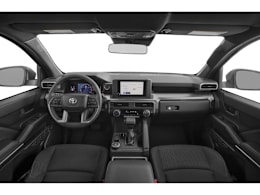
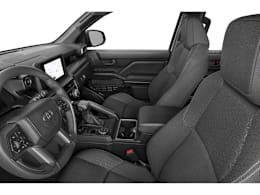
In keeping with the 4Runner’s rugged intentions, the cabin has a burly look. But, similar to other aspects of the vehicle, it’s rougher around the edges than you might expect. It’s almost a cocoon of plastic panels with very few soft-touch trim elements. Even some of the items that look brawny don’t actually feel all that sturdy. For example, the driver's door interior grab handle has some rough edges where your fingers land, and you can see the handle flex as you pull on it.
Most of our testers found the driving position to be pretty decent. It has plenty of headroom, minimal knee interference from the plastic center console, and well-positioned armrests. But the door armrest has hardly any padding. The driver’s seat doesn’t look like much, but we found that it worked well, with comfortable padding and good side bolstering to help hold you in place. Owing to the SR5 trim’s basic nature, the driver’s seat lacks any ability to tilt the leading edge of the bottom cushion to help dial in underleg support, though it does benefit from two-way lumbar adjustment.
The rear seat is a letdown, in both space and comfort. Headroom will be tight for taller passengers, and toe space is squished underneath the front seats. The bottom cushion’s low position results in very little underleg support. At least the seatback has a fair amount of recline adjustment. A third-row seat is optional.
There’s a good amount of cargo room behind the 4Runner’s rear seat—enough to fit six large suitcases and some smaller bags. But maximum volume is compromised by the rear seats’ “tumble” mechanism, which doesn’t enable them to fold flat with the cargo floor, unlike in most SUVs. It also doesn’t help that artifacts from the available third-row model remain, including cup holders and armrests, even though there isn’t an accompanying seat.
Controls and usability
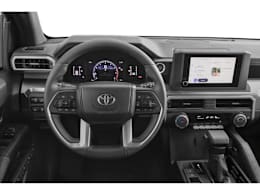
The 4Runner’s interior resembles the Tacoma pickup truck, with an abundance of large, glove-friendly physical knobs and switches, along with a conventional gear selector. Frankly, we found it refreshing, as most new vehicles have a high dependency on touchscreens or capacitive-touch panels. There are controls that are hard to find amid the clutter, like the emergency flashers behind the fan speed dial. And the detents on some dials, like the volume knob, are too subtle or nonexistent, removing some expected feel when turning them.
The 8-inch infotainment touchscreen offers a clear display with a seemingly simple layout, but the lack of a home screen or split-screen ability forces users to switch back and forth between different features. Some difficulties are offset by the easy-to-use steering wheel controls.
The driver’s instrument screen is a menace to navigate through. Not only is it cluttered with tiny icons and text, but the advanced driver assistance systems (ADAS) menu is full of puzzling acronyms.
Active safety and driver assistance
Standard active safety and driver assistance features include automatic emergency braking with pedestrian, bicyclist, and motorcycle detection, along with automatic emergency braking that operates at highway speeds, blind spot warning, rear cross traffic warning, lane centering assistance, lane departure warning, lane keeping assistance, adaptive cruise control, and automatic high beams.
The 4Runner also comes with Toyota’s Proactive Driving Assist (PDA). In some situations, this feature can provide gentle braking and/or steering assistance based on radar and camera information to help with turns, when following behind another vehicle, or reacting to a pedestrian or bicyclist.
A rear occupant alert system comes standard. It’s designed to remind the driver—based on rear-door logic—to check the rear seat when the 4Runner is turned off to help prevent children and pets from suffering heatstroke or hypothermia if unintentionally left behind in the vehicle. There’s also a rear belt minder, which alerts the driver if a rear passenger unbuckles their seat belt during the trip.