Your membership has expired

The payment for your account couldn't be processed or you've canceled your account with us.

Re-activate

2026
Toyota bZ Woodland

EPA Range: 281 miles

Toyota bZ Woodland First Drive

Summary

Introduction

The 2026 Toyota bZ Woodland Is Quick and Quiet

Toyota’s electric SUV targets competitors like the Chevrolet Blazer EV and Tesla Model Y. But it comes with a few compromises.

Overview

  • The bZ Woodland is a twin to the Subaru Trailseeker and longer than the regular Toyota bZ.
  • Rapid acceleration and a comfortable ride are strong points.
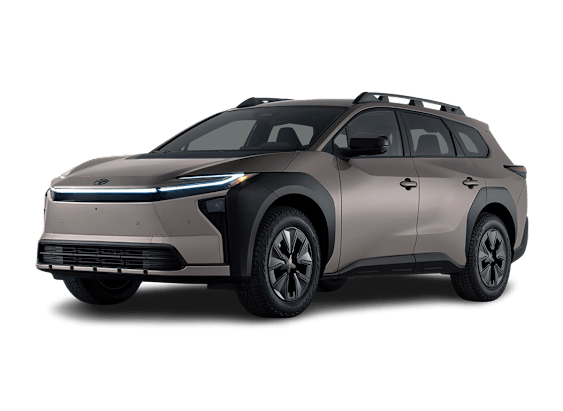
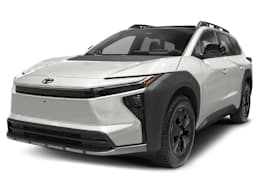
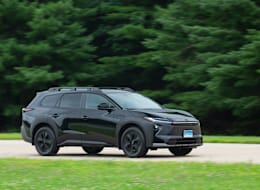
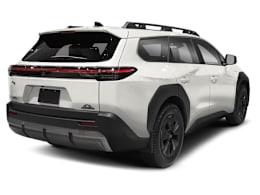
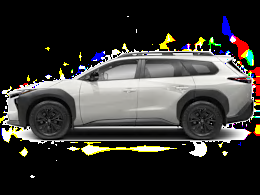
  • The outdoorsy conceit is built on black plastic exterior trim, high ground clearance, standard all-wheel drive, and available all-terrain tires.


The bZ Woodland expands on Toyota’s electric offerings, providing a slightly larger SUV choice to the recently updated bZ (formerly known as the bZ4X).

In the current Toyota electric vehicle hierarchy, it slots above the C-HR and bZ. Think of the trio as small, medium, and large, with the new three-row Highlander positioned as the extra-large electric SUV.

Measuring nearly 6 inches longer than the bZ, the bZ Woodland is more powerful and a little better equipped. These bZs share many features, including a 14-inch infotainment screen and a lengthy roster of standard active safety equipment. The Woodland likewise employs Toyota’s upgraded onboard charging hardware to hasten charge times, and it comes equipped with a Tesla-compatible North American Charging Standard (NACS) charge port.

There are only two versions offered, the Base and Premium. The Base has a solid array of commonly sought features. It comes standard with a heated steering wheel, heated front and rear seats, dual wireless phone chargers, an auto-dimming rearview mirror with Homelink, and a 120-volt outlet in the cargo area. The Premium adds ventilated front seats, front foot and leg heaters, driver’s seat memory function, a digital rearview mirror, a nine-speaker audio system, and a panoramic roof.

We expect most buyers will choose the cheaper Base trim, so that’s what we purchased for testing.

We bought a 2026 Toyota bZ Woodland Base with 375-hp, dual electric motors; 74.7-kWh battery; direct-drive transmission; and all-wheel drive. The base MSRP is $45,300. Adding options such as the Adventure tow package ($1,268), cross bars ($350), mudguards ($165) and a destination fee of $1,595, the total cost came to $48,678.

The final assembly point is Gunma, Japan.

It competes with the Chevrolet Blazer EV, Honda Prologue, Hyundai Ioniq 5, Kia EV6, Subaru Trailseeker, Tesla Model Y, and the Volkswagen ID.4.

Impressions

Driving Experience

Producing 375 hp, the bZ Woodland delivers impressive, silent acceleration. It’s notably quicker than earlier bZ iterations, granting it a surprisingly lively feel. Toyota estimates 0 to 60 mph in about 4.4 seconds—far greater straight-line performance than most conventional SUVs and a match for the results from our Model Y test.

The bZ Woodland has an EPA-rated 281-mile range with all-season tires. If you buy into the outdoorsy conceit and add optional all-terrain tires, the range drops to 261 miles. Expect a hint less if you add the available roof rack cross bars. For contrast, the EPA-rated range on the Long Range Model Y we bought was 327 miles.

On paper, the public charging specs aren’t impressive: The bZ Woodland has a 150 kW maximum DC acceptance rate. (For comparison, the Tesla Model Y has a 250 kW maximum DC acceptance rate. That translates to the bZ Woodland adding 8.7 miles per minute on a Tesla Supercharger, while the Model Y can add 15.2 miles per minute.) Fortunately, home charging uses an effective 11-kilowatt onboard charger. Like most EVs now, the bZ Woodland comes with a North American Charging Standard (NACS) port for access to the Tesla Supercharger network. The bZ Woodland comes with adaptors to allow access to other chargers.

The standard all-wheel drive is augmented by X-Mode, a Subaru-derived system that helps to optimize throttle and braking at very low speeds to improve traction in low-grip conditions. Unless you’re scaling a muddy path or trying to escape a snow bank, this feature is not likely to be used.

We found the bZ Woodland handles similarly to the other related Toyota/Subaru EVs, with quick steering, light effort, and a natural feel. Some helpful steering feedback is transmitted through the small-diameter steering wheel. Body roll is well controlled when pushed, such as during brisk runs on a highway off-ramp.

The ride is composed on most surfaces, though particularly rough roads can make it feel jumpy. Overall, its ride quality may be the best among the other Toyota EVs, likely aided by the bZ’s slight extra weight.

Cabin Comfort

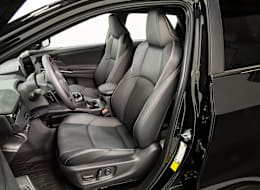
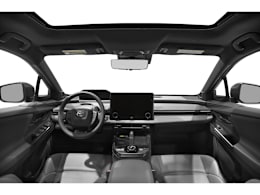
Due to the battery under the floor, the driver’s seat doesn’t lower as much as desired, requiring some ducking to enter. Once inside, the driver’s compartment feels narrow due to a wide center console. Adjusting the steering wheel height can compromise thigh space or the view of the instrument panel, which is positioned at the base of the windshield. This is especially an issue for larger drivers. The driver’s seat has supportive bolsters and soft cushions, making it a comfortable perch.

That center console has a pass-through space under it, designed to hold the rather large owner’s manual. This wouldn’t be an issue if the bZ Woodland had a glove compartment, but it doesn’t.

It takes a bit of bending to access the rear seat, but there’s a large footpath making it easy to step in. Once settled, testers said the mild bolstering resulted in narrow seating positions. There’s plenty of legroom, just as with the bZ. But headroom is scant, and there isn’t space under the front seats to tuck feet. The back of the second-row console has vents, heated-seat controls, and USB charging ports to satisfy rear riders.

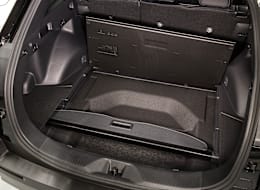
The added length is of greater benefit to the cargo area, which is significantly larger. Under the cargo floor are a tire inflation kit, a trailer receptacle, and a little extra storage. The squared-off shape of the rear hatch means the bZ Woodland can better accommodate large, boxy items than the bZ, which has a more sloped rear shape.

Controls and Usability

The cabin is fairly easy to live with, but there are some quirks. For example, we like the dual wireless charging pads for smartphones, but they do take up a lot of room when storage is rather limited.

The infotainment system looks slick, with its wide screen and illuminated dials, each featuring a clever central temperature display. Despite the bZ Woodland coming to market after the RAV4, it doesn’t have the latest generation Toyota infotainment system introduced on that popular hybrid. Consequently, it lacks some functionality, like having a Home button, and many climate-related functions are handled via the touchscreen rather than physical buttons. Further, the navigation system doesn’t have the same level of electric vehicle support that’s common in competing EVs for routing based on charging needs. If you’re planning a long trip in the Woodland, you may need to use phone apps rather than depend solely on the native features. Our drivers reported problems with pairing both Apple and Android phones, and later, reconnecting.

To its credit, the bZ Woodland has a rear wiper—unlike the bZ.

Safety and Driver Assistance Systems

The bZ Woodland comes with Toyota Safety Sense 3.0, featuring automatic emergency braking with pedestrian detection, lane departure warning, lane keeping assistance, lane centering assistance, adaptive cruise control, and automatic high beams. In addition, it has standard blind spot warning, rear cross traffic warning, and a safe exit assist system, which monitors for passing vehicles before it allows passengers to open the doors when parked on a city street. Overall, the bZ Woodland comes standard with the proven safety technology we recommend. This will help its safety verdict rating.

It includes a five-year trial for connected safety services with an SOS button for emergency assistance, automatic collision notification, and a stolen vehicle locator.

For context, the RAV4 features TSS 4.0, a whole next-generation safety suite.

Change Vehicle