

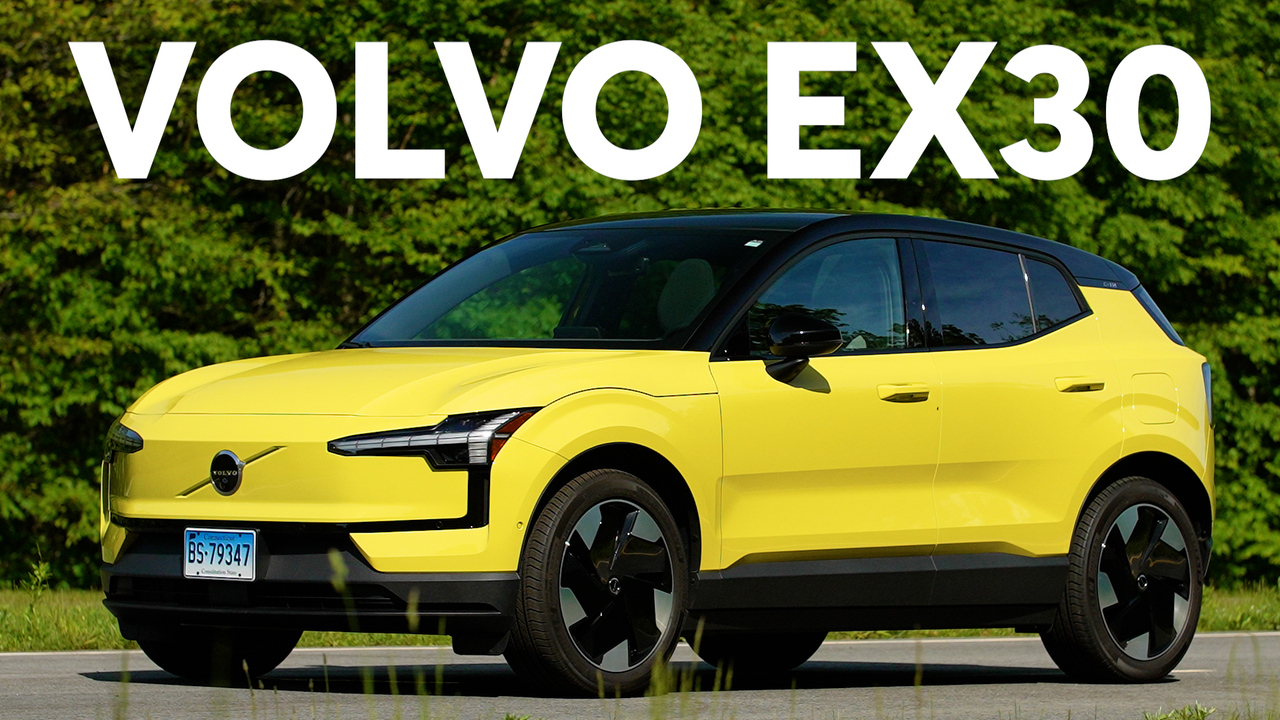

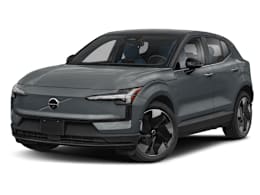
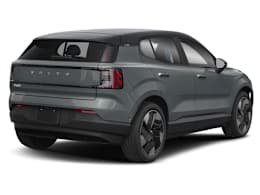
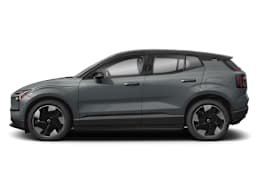
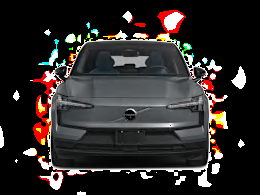
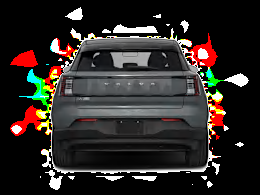
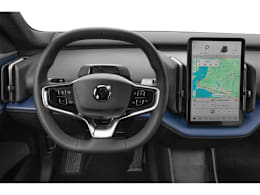
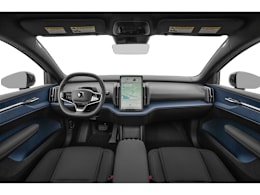
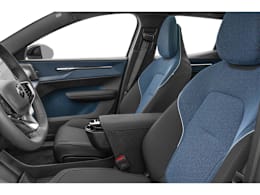
Volvo drivers who trade in for the all-electric EX30 small SUV will feel like they’re visiting a favorite restaurant after a major remodel and menu change: The car still has Volvo hallmarks—fairly comfortable seats, a minimalist interior, tons of safety features, and logos in that signature Volvo font. But the large center screen, instrument-cluster-free driving position, and cloth seats make it clear that this is a new era for the brand.
In total, the EX30 more closely resembles other sub-$50,000 electric vehicles than the SUVs, sedans, and wagons that Volvo is known for. It’s a compact SUV that’s adept at navigating tight parking lots and city streets while keeping the driver comfortable. But that capability comes with a long list of drawbacks that any potential customer should consider. Among them: a tight rear seat, modest cargo space, and unintuitive controls that rely heavily on a center-mounted touchscreen that proved distracting to our testers.
These high- and low-lights are important in context with the EX30’s price, which has changed considerably since Volvo first announced the car. Initially, Volvo advertised the EX30 as costing “under $35,000.” At that price, we could ignore some of the EX30’s shortcomings, a few of which could be deemed reasonable sacrifices necessary to make an electric car affordable. But when the time came to take delivery of our vehicle—over a year after we placed our order in January 2024—the final price was $48,395. Note that a RWD model is now available with a starting MSRP of just over $40,000.
That makes the EX30 we purchased about the price of an average new car, and more expensive than some comparable EVs. “Other than the ride quality and front seat comfort, there is little to like about this car,” said one of our testers. “It's way too expensive for what you get compared to other EVs.
Plus, there are just too many gimmicks that are a detriment to the overall experience, with the controls first and foremost. I also have a hard time looking past the way-too-weak one-pedal driving system, and the poor storage and armrests.”
“It's a true mixed bag for me,” said another tester. “On the one hand, I love the power, small size, maneuverability, and quirky looks. But on the other hand, the controls are pretty awful. Having to adjust settings every time you drive is a nuisance, and the lack of usability as an EV—weak one-pedal mode, no regen adjustment—is a huge miss for Volvo.”
We bought a 2025 Volvo EX30 Ultra Twin Motor AWD for $48,395—anonymously from an area dealer, as we do with every vehicle we test—for the purpose of this road test review. Our EX30 was assembled in Zhangjiakou, China, though Volvo has since moved production to Ghent, Belgium.
Driving experience
Floor the EX30’s accelerator pedal, and prepare to get pinned back in your seat. Two electric motors producing a combined 422 hp make this compact (167 inches long) and comparatively light (4,185 pounds) vehicle pleasantly speedy, even among EVs. We measured a 3.6-second 0-to-60-mph time, nearly a second quicker than the Tesla Model Y Long Range AWD. One of our testers said the EX30 is “the most bang-for-the-buck in terms of pure power and acceleration in the country right now.”
Using lots of forceful acceleration, however, will quickly diminish an already short driving range. From a 100 percent state-of-charge (SOC), the EX30 only managed 245 miles during our 70-mph highway-range test—less than the EPA’s estimate of 253 miles. We’ve recently tested EVs with shorter driving ranges than the EX30, such as the Mini Countryman EV with 237 miles. But there aren’t many. Worse, in day-to-day driving with the EX30, some testers returned ranges closer to 200 miles. For those with easy access to charging, that may be sufficient for errands and commutes. But these days, EV customers can reasonably expect a vehicle that will go close to 300 miles, and the EX30 falls well short of that.
There are other aspects of the EX30 that also don’t live up to current EV standards. Take its “one-pedal driving” mode, which typically enables the driver to speed up and slow down by using just the throttle pedal, without the need to step on the actual brake pedal. In the EX30, the one-pedal driving mode simply isn’t powerful enough. Unlike many other EVs, our drivers had to use the brake pedal to stop where they intended, instead of just modulating deceleration with the throttle pedal.
When using a 240-volt (Level 2) charger at the EX30’s maximum rate of 11 kilowatts, it will add about 36 miles of range per hour. That means it will take just over six hours to charge the 69-kilowatt-hour battery from empty. With a 153-kW maximum charging rate at public DC fast chargers, the EX30 can add about eight miles of range per minute.
Our testers appreciated the EX30’s handling capabilities, which are aided by minimal body roll through corners, although they weren’t fans of its overly light and vague steering. It’s agile, though, achieving a relatively high speed through our avoidance-maneuver test, where it successfully swerved and kept in control at 53 mph—about equal to the Mini Countryman EV. In our dry and wet braking tests, the EX30 stopped quickly with good stability.
Overall, the ride is fairly comfortable, especially in city and suburban driving, which, given its short driving range, is the ideal environment for the EX30. It absorbs small bumps and cracks in the road well, but the cabin isn’t as quiet as other EVs. “There was quite a bit of tire noise over many surfaces,” one tester said. The powertrain, on the other hand, is nearly silent, with only minor electric motor whine during hard acceleration.
Cabin comfort
Inside, the EX30’s interior is stylishly minimalist, similar to other EVs at this price. It comes with unexpectedly nice touches, such as the lined front and rear door pockets and the wrapped steering wheel with glossy trim. But there are some flaws that we expect will annoy some owners. The plastic panels on the lower portion of the doors looks and feels cheap and flimsy, and we noted rough edges on the lower center console bin. Further, the steering wheel buttons don’t have enough tactile feedback to tell you when you’ve pressed them successfully.
Most people will find a spacious driving position, with good headroom and excellent legroom, along with minimal intrusion from the center console. The seat’s posture is pleasantly upright, too. But a few aspects kept some testers from getting truly comfortable. First, the EX30 doesn’t have a driver’s instrument screen behind the steering wheel, so the driver has to look away from the road ahead and check the center screen to see basic information like current speed, and turn signal and cruise control status. Second, the steering wheel doesn’t have much range of adjustment. Even at its lowest position, it was still too high for some testers. Armrests weren’t ideal, either: The door armrest is in the right spot, and nicely padded at the front, but that padding stops toward the rear. Testers said the center armrest’s padding was far too hard.
The front seats are another aspect of the EX30 that received mixed reviews. While some testers found them comfortable and reasonably supportive, and the cloth material does a good job holding occupants in place through corners, others complained that there was too much built-in lumbar support that felt like it was digging into their backs. We came to much more of a consensus on the rear seat, however; it’s cramped and uncomfortable. Headroom was the only positive aspect, with a few inches leftover for average-sized adults. But knee room and foot space under the front seats are very tight. Further, the bottom cushion’s close proximity to the floor means passengers must sit with their knees uncomfortably bent.
Controls and usability
Like the Tesla Model 3 and Model Y, the EX30 has a center-mounted touchscreen to adjust most interior functions—audio volume, air conditioning, mirror position, and more. Most procedures require tapping and swiping through menus, which makes what should be simple tasks difficult. Even opening the glove box requires using the touchscreen.
In theory, systems such as memorized seat and mirror positions and air conditioning that adjusts to a set temperature mean that you shouldn’t need to adjust much. But in reality, drivers will need to use or at least glance at the screen often during a trip. This over-reliance on the screen, even for simple tasks, means that you’re constantly taking your eyes off the road. Ironically, when performing most tasks, the car's driver monitoring system sometimes alerted our drivers that they were not paying sufficient attention to the road.
Changing the temperature or other climate settings is confusingly split across two different menus. Worse, most actions don’t give helpful audio or visual feedback to tell you that you’ve successfully changed something. Fortunately, the EX30 has a traditional turn signal stalk, the gear selector works well enough, and you can adjust the direction of the air vents manually, without having to use the screen like in some vehicles.
The EX30 runs on Android Automotive OS, so features like Google Maps and Google Assistant will be somewhat familiar to Android phone owners. But the car doesn’t have Android Auto functionality, which mirrors a user’s connected Android phone. The car has Apple CarPlay, but we found that it can be unreliable and requires extra steps to start.
Unless you exclusively use your smartphone as a key, owners will need to carry either a slim key card or a button-less key fob (which Volvo refers to as a key tag), the latter with proximity locking/unlocking capabilities which CR testers found occasionally troublesome.
Active safety and driver assistance
Except for the distracting center screen, the EX30 makes good on Volvo’s reputation for prioritizing safety. It comes standard with proven technology that, really, should be in every new car. This includes automatic emergency braking with pedestrian and cyclist detection, automatic emergency braking that operates at highway speeds, blind spot warning, rear cross traffic warning, reverse automatic emergency braking, lane departure warning, and lane keeping assistance. Standard driver assistance features include adaptive cruise control and automatic high beams.
The top Ultra trim of the EX30 is the only way to get Volvo’s active driving assistance system (ADA), called Pilot Assist. It gives the driver the ability to simultaneously use adaptive cruise control (ACC) and lane centering assistance (LCA). In our testing, ACC worked well in stop-and-go traffic, but LCA tended to swing the EX30 wide through curves and would resist the driver's steering inputs.
A rear occupant alert system comes standard, designed to remind the driver to check the rear seat when the EX30 is put into Park, which can help prevent children and pets from suffering heatstroke or hypothermia if unintentionally left behind in the vehicle. The EX30 also has a standard rear belt minder, which alerts the driver if a rear passenger unbuckles their seat belt during the trip.