Best Frying Pans If You Want to Avoid PFAS Chemicals
These pans don't have a traditional nonstick coating, but our tests have found that they still clean up easily

When you shop through retailer links on our site, we may earn affiliate commissions. 100% of the fees we collect are used to support our nonprofit mission. Learn more.

Nonstick frying pans outsell all other types by a considerable margin. They’re easy to use, a cinch to clean, and inexpensive in many cases. But the nonstick coatings don’t last forever. Most nonstick pans have to be replaced every few years and even sooner if they’re scratched.
That’s because a nonstick coating that’s not intact is more likely to flake off into your food, says Breann Chai, who leads cookware testing at Consumer Reports. “If a nonstick pan has any chips or scratches, it should be thrown away and replaced,” she says. That doesn’t just cost money; it also adds to the waste stream.
A more pressing concern may be the components of some nonstick coatings. PFOA, for example—one of the thousands of chemicals that fall into the category of PFAS (per- and polyfluoroalkyl substances) and can be present in nonstick coatings—has been clearly linked to health risks.
And when CR asked 2,158 U.S. adults in a nationally representative survey (PDF) conducted in April 2025 how concerned they were about chemicals such as PFOA, PTFE (Teflon), or simply PFAS in general in nonstick cookware and bakeware, 65 percent said they were at least somewhat concerned.
When CR tested three nonstick pans to see whether consumers could trust claims that the cookware was free of PFOA, we found that one pan made with PTFE actually contained PFOA as well. Consumer Reports no longer displays “PFOA-free” in our ratings of nonstick cookware, but our ratings of nonstick cookware sets and nonstick frying pans do indicate whether a pan is made without PTFE, based on the manufacturer’s claims.
If you’ve decided to swear off nonstick cookware made with these chemicals, there are several good alternatives, including ceramic, stainless steel, cast-iron, and carbon steel pans. Below are some of the top performers from all these categories. To find even more options, explore our comprehensive cookware ratings and recommendations. And CR’s labs also test other tools and appliances for the kitchen.
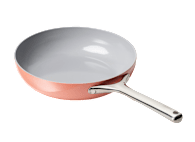
This CR Recommended nonstick pan from Caraway is impressive. In our tests, the surface heats evenly, resulting in no hot spots, and eggs fried without oil slid out one after another with ease. The handle is super-sturdy and stays cool to the touch while you cook. The nonstick coating is ceramic (made without PTFE) and stands up well in our durability test. Another plus: This pan is compatible with induction cooktops.

A pan from the Oxo Mira Stainless Series would be a worthy addition to anyone’s kitchen. While stainless steel pans like this one require some butter or oil to keep food from sticking, we found it very easy to clean. Plus, its cooking evenness is superb. The handle is comfortable and sturdy, and it doesn’t get too hot while you’re cooking. Like all stainless pans, the Mira Series can be used on an induction cooktop.
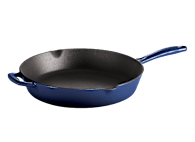
The Tramontina Enameled Cast-Iron Series 1000 frying pan offers great performance at a reasonable price. It also offers the versatility of cast iron, which can be used both on your cooktop and in the oven, even at very high heat. The 12-inch pan we tested does an excellent job of searing steak and also rates highly in our baking test. We also found it very easy to clean, an important quality if you’re looking for an alternative to traditional nonstick cookware. Cast iron can be heavy, though. This pan lands in the middle of all the enameled cast-iron pans we tested at 7.4 pounds.
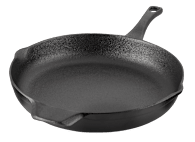
Properly seasoned and maintained, an uncoated cast-iron pan can rival traditional nonstick options when it comes to releasing food without leaving a mess. But if the seasoning process seems daunting, consider the Calphalon Pre-Seasoned Cast Iron pan, which—as its name indicates—comes ready for use. The Calphalon does a great job of searing steak and a very good job of baking cornbread, and it’s very easy to clean.
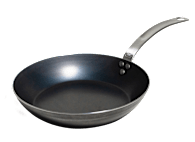
Like uncoated cast-iron pans, carbon steel pans require regular seasoning and reseasoning to maintain their slickness. But they’re extremely versatile, easily moving from stovetop to oven and back again. The Made In Blue Carbon Steel Unseasoned pan is a good example. In our tests, cooking evenness with this pan is very good, as are ease of cleaning and handle sturdiness. Its handle doesn’t get too hot to hold on the stove either. But like other carbon steel pans we’ve tested, this one does a mediocre job of baking cornbread evenly.
 BEST TIME TO BUY:


