Least Durable Nonstick Frying Pans and What to Buy Instead
If you'd rather not have to replace your pan often, there are options that prove more durable than others in CR's lab tests

When you shop through retailer links on our site, we may earn affiliate commissions. 100% of the fees we collect are used to support our nonprofit mission. Learn more.

When a nonstick pan becomes scratched or pitted, it can potentially release pieces of the nonstick coating into your food, which could be detrimental to your health. What’s more, if the coating on your nonstick pan wears away prematurely, you’ll have to replace it sooner than you would a more durable one.
That’s not just a waste of money; it also means your discarded pan is likely headed to a landfill. Depending on the makeup of the coating, that could also mean chemicals like PFAS (per- and polyfluoroalkyl substances, aka forever chemicals) will end up in the soil and remain there indefinitely.
To see how nonstick coatings hold up, Consumer Reports conducts durability tests on all the nonstick frying pans in our ratings, including both those with ceramic nonstick coatings and those with Teflon-like coatings. We test nonstick cookware sets similarly, by putting the frying pan from the set through the same nonstick durability testing that individual frying pans endure. The pans’ durability score is based on tests in which we intentionally wear down the surface, then fry eggs on it to evaluate how well the coating has retained its nonstick properties.
Manufacturers maintain that nonstick coatings are durable when used as recommended. The website of the Cookware and Bakeware Alliance, an industry organization, notes that extreme heat can be damaging to nonsticks and that using low to medium heat will protect nonstick finishes. It adds that "though many non-sticks can withstand the occasional swipe with a metal utensil, the finish will last longer if nylon or wooden utensils are used.”
The good news is that no nonstick frying pan in CR’s ratings landed a bottom-level score in our most recent durability tests; most fall somewhere in the middle. But we’ve also tested plenty of pans that demonstrate excellent durability, making those a safer and longer-lasting choice. (If you’re worried about PFAS in particular, remember there are also many cookware options that don’t contain these chemicals and are still relatively easy to clean.)
How CR Tests for Nonstick Durability
“CR’s nonstick durability test evaluates how well a nonstick coating stands up to continued use and damage from metal utensils,” says Breann Chai, who leads CR’s cookware testing. “We use a custom-built machine to rub the nonstick surface repeatedly with steel wool while the pan is at a high temperature to simulate accelerated use.” The pan’s durability score is based on the number of strokes it can withstand before the coating is worn through, and and on how difficult it is to remove eggs fried without oil on the surface after the test.
Pans receive an excellent score if they withstand all 2,000 strokes without significant damage and release the eggs easily. A fair score means the pan suffered some damage in the scouring test, and the egg sticks to it afterward. None of the frying pans in our current ratings received an outright poor score for nonstick durability, but if one did, it would mean the pan’s nonstick coating completely wore through during the scouring test (in that case, we repeat the test with a second pan) and eggs stuck to the pan after it was scoured.
More Durable Nonstick Options
Below, we list the least durable nonstick frying pans we tested, followed by similarly priced pans that demonstrated excellent durability. For many more durable nonstick pan options, check out our complete frying pan ratings.
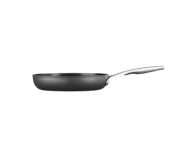
While the Calphalon Premier Hard-Anodized Nonstick performed well in most of our tests, particularly cooking evenness and maintaining a cool handle temperature, the durability of its PTFE coating proved just so-so (though better than its predecessor, the Calphalon Classic).
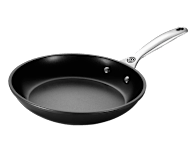
While a bit more expensive than the Calphalon pan above, the 9.5-inch Le Creuset Toughened Nonstick PRO aces our nonstick durability tests and receives a very good score for nonstick food release, meaning it took just a slight nudge to get a fried egg out of the pan in our tests. It’s oven safe to 500° F and can be used on an induction cooktop.
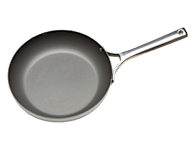
The budget-priced Figmint Nonstick Stainless Steel pan from Target earns a top score for even cooking, and its nonstick coating releases food as well as the best of them, but its middling durability score suggests that slickness might not last long. Its warranty lasts only a year, and its handle sturdiness score, which we assess by applying pressure until it bends or breaks, is middling as well.
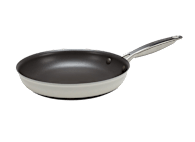
In addition to having an excellent nonstick durability score, the Anolon Achieve Hard Anodized Nonstick pan offers excellent cooking evenness, and its handle stays cool to the touch. When we fry eggs without oil in this pan, they slide off easily, earning it a very good score in that test. The downside is that, like most inexpensive pans, its handle earns just a middling score for sturdiness.
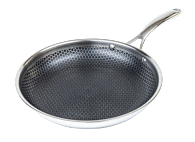
HexClad pans were once heavily advertised, but the somewhat pricey HexClad Hybrid disappointed in our tests with a mediocre nonstick durability score. Its coating is made without PTFE, a plus for those concerned about PFAS. But when we scoured the pan with steel wool, we removed the coating down to the stainless steel beneath, though it still capably released the eggs we cooked on it.
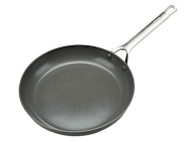
Priced nearly $50 less, the GreenPan Bobby Flay Chef Series Hard Anodized frying pan set received an excellent score for nonstick durability and nonstick food release while matching the HexClad’s top cooking evenness score. Its handle stayed cool while cooking, though it was not exceptionally sturdy.
 BEST TIME TO BUY:


