Media Room
New Report Exposes Instacart’s Hidden Price Games
Investigation by Groundwork Collaborative, Consumer Reports, and More Perfect Union Uncovers Instacart’s Price Experiments Quietly Impacting Grocery Bills, Potentially Costing Families $1,000+ a Year
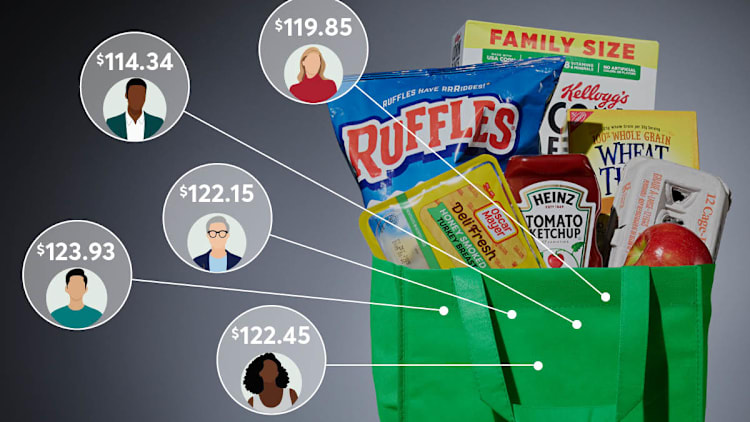
WASHINGTON, D.C. — A new investigation from Groundwork Collaborative, Consumer Reports, and More Perfect Union reveals that Instacart, enabled by the artificial intelligence pricing software Eversight, is running large-scale, hidden price experiments on unsuspecting customers.
The report, “Same Cart, Different Price: Instacart’s Price Experiments Cost Families at Checkout,” analyzes live shopping data from more than 400 Instacart shoppers across four U.S. cities. The findings show many U.S. shoppers who order grocery pickup and delivery through Instacart are unknowingly enrolled in AI-enabled experiments that can charge up to 23% more for the same item ordered from the same store at the same time. The average price variations observed in the study could cost a household of four about $1,200 per year.
Instacart’s algorithmic pricing experiments were found to be occurring through the platform at several of the nation’s biggest grocery retailers, including Albertsons, Costco, Kroger, Safeway, Sprouts Farmers Market, and Target. At a time when food price increases outpace overall inflation and Americans report that the price of groceries is a major cost concern, pricing experiments used by companies like Instacart make the situation worse.
Key Report Findings:
- Nearly three-quarters of grocery items that we tested on Instacart showed different prices to different shoppers. Some items carried up to five different price points simultaneously. For example, people shopping at a Safeway in Washington, D.C., saw a dozen Lucerne eggs listed at five different prices — $3.99, $4.28, $4.59, $4.69, and $4.79.
- On average, the difference between the lowest and highest prices shoppers saw for basics like cereal, pasta, and peanut butter was 13%, with the highest price 23% more than the lowest.
- Researchers found that overall Instacart basket totals varied by an average of about 7% for the exact same items from the exact same locations, at the exact same time. Based on the amount that Instacart says the average household of four spends on groceries in the U.S., that could translate into a cost swing of about $1,200 per year.
“Instacart is quietly running pricing experiments on millions of shoppers during the worst grocery affordability crisis in a generation, and it’s costing households as much as $1200 a year,” said Groundwork Collaborative Executive Director Lindsay Owens. “They have turned the simple act of buying groceries into a high-tech game of pricing roulette. When the same box of Wheat Thins can jump 23% in price because of an algorithm, that’s not innovation or convenience, it’s unfair. It’s time for Instacart to close the lab. Americans shopping for groceries aren’t guinea pigs and shouldn’t have to pay an Instacart tax.”
“This investigation shows how it’s becoming more common for companies to use hidden algorithmic pricing techniques without telling the customer,” said Justin Brookman, director of tech policy at Consumer Reports. “In the case of Instacart, these tactics hurt families who are simply trying to purchase essential groceries. At a time when everyday Americans are struggling with high prices, it is particularly egregious to see corporations secretly conducting individual experiments to see how much a person is willing to pay. Companies must be transparent and upfront with people about pricing, so that they can make informed choices and keep more of their hard-earned money. We encourage the Federal Trade Commission and state attorneys general to investigate Instacart’s pricing tactics.”
On its own website Instacart acknowledges that it runs price tests, that “end shoppers are not aware that they’re in an experiment,” and that when used at scale across a store network, the price change tactics “create an orthogonal array of data points that changes the game.”
In some instances, Instacart kept the sale price of items the same but changed the ‘original’ price, creating the impression of a larger discount.
Instacart claims their price experiments are randomized and “negligible,” but against the backdrop of the fastest increase in food prices since the late 1970s, today’s report shows Instacart’s experiments are yet another way corporate pricing tactics are squeezing American families.
Policy Implications Growing Nationwide
The findings arrive as federal and state lawmakers intensify scrutiny of potentially deceptive corporate pricing schemes including algorithmic and “surveillance” pricing. States including New York, Colorado, California, Georgia, Illinois, and Pennsylvania have introduced or advanced legislation to curb individualized or algorithm-driven price manipulation. At the federal level, Rep. Greg Casar’s (D-TX) Stop AI Price Gouging and Wage Fixing Act would ban the use of personal data to set individualized prices.
The Authors of the Report Warn:
“Fair and honest markets are the bedrock of a healthy economy. As more consumers learn about, and decry, these practices, perhaps companies will change course. But if they do not, policymakers should intervene and require them to change their practices.”
About the Study
The joint investigation by Groundwork Collaborative, Consumer Reports, and More Perfect Union used real-time, controlled shopping tests at Safeway and Target stores in North Canton, Ohio, Saint Paul, Minnesota, Seattle, Washington, and Washington, D.C. A total of 193 high-quality participant submissions were analyzed, with an additional November confirmation test detecting similar pricing patterns at Albertsons, Costco, Kroger, and Sprouts.
Read Full Report Here
Media Contacts
About Consumer Reports
Founded in 1936, CR has a mission to create a fair and just marketplace for all. Widely known for our rigorous research and testing of products and services, we also survey millions of consumers each year, report extensively on marketplace issues, and advocate for consumer rights and protections around safety as well as digital rights, financial fairness, and sustainability. CR is independent and nonprofit.
© 2026 Consumer Reports. The material above is intended for legitimate news entities only; it may not be used for advertising or promotional purposes. Consumer Reports® is an expert, independent, nonprofit organization whose mission is to work side by side with consumers to create a fairer, safer, and healthier world. We accept no advertising and pay for all the products we test. We are not beholden to any commercial interest. Our income is derived from the sale of Consumer Reports® magazine, ConsumerReports.org® and our other publications and information products, services, fees, and noncommercial contributions and grants. Our Ratings and reports are intended solely for the use of our readers. Neither the Ratings nor the reports may be used in advertising or for any other commercial purpose without our prior written permission. Consumer Reports will take all steps open to it to prevent unauthorized commercial use of its content and trademarks.