Why Is Your Electric Bill So High? How to Read the Fine Print.
Energy is pricier than ever. Shrinking your bill starts with understanding the charges, from usage to delivery fees to taxes.


Like many people, I tend to read my electric bill through slatted fingers, glancing at the total just long enough to pay it off. That’s all the more true now that rising rates have ballooned what we owe. We live in a modest one-bedroom apartment, but my partner and I routinely spend hundreds of dollars on electricity each month, and our bill rarely dips into the double digits.
I’m far from alone in experiencing energy sticker shock.
In the last five years, Americans’ residential electric bills have risen by a third, on average, according to data analysis from the climate and energy publication Heatmap—far outpacing the rate of inflation. Many Americans simply can’t keep up. About 1 in every 6 U.S. households is now behind on their utility bills, according to the National Energy Assistance Directors Association.
It doesn’t help that, when reading your bill, it’s difficult to decipher just why you’re paying so much. You’ll probably see a dizzying array of rates and fees, plus an alphabet soup of acronyms for things you don’t remember signing up for. About a third of Americans find it either somewhat or very difficult to read their electric bill, according to a nationally representative survey of 2,003 U.S. adults conducted by Consumer Reports this spring.
“At a time when electric bills are skyrocketing, many Americans are taking a closer look at their bills and finding them to be as complex and opaque as the underlying electricity system they help pay for," says Chris Harto, manager of sustainability advocacy at Consumer Reports.
What Goes Into Your Energy Bill
At its most basic, your bill is for the electricity your household has consumed over a designated billing period—but that’s not all you’re paying for. Your bill also covers a range of expenses for items you can’t control, from infrastructure upgrades to taxes and regional energy-efficiency programs.
Some utilities show their work. That is, they break down all the bill’s calculations and components. Other bills are sparse, displaying the amount due and little else. The specific language and line items will vary widely depending on where you live and your utility provider.
However, a few buckets of charges factor into most bills. Explore this sample bill that CR created, then scroll down for a deeper explanation of what it all means.
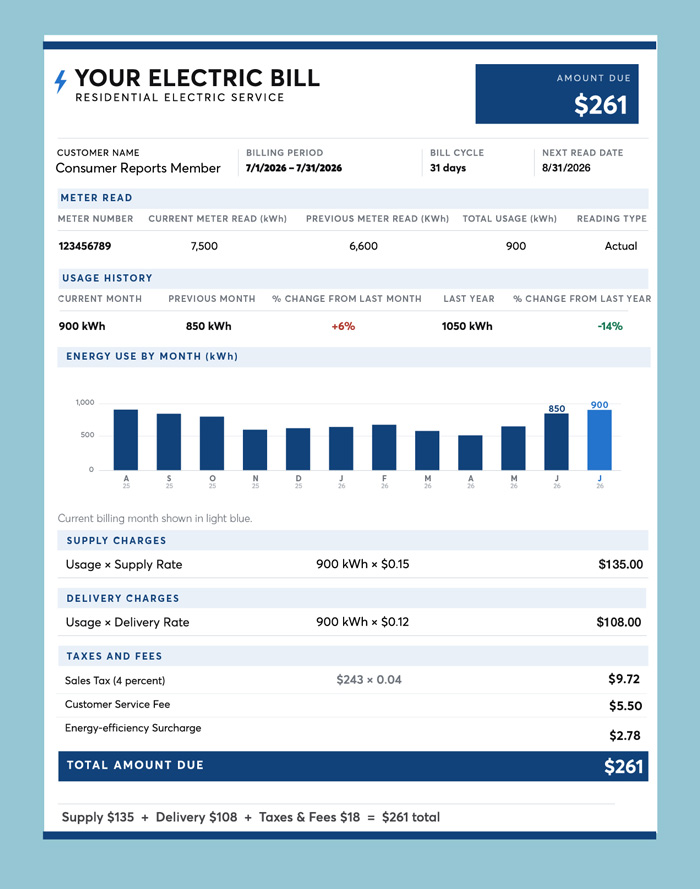
Your monthly payment includes a charge for the electricity you used, plus other fees. Click on the orange circles for a quick explanation, then read on for more detail.
Supply Charges
This is what you’re paying for the electricity itself—the actual power keeping the lights on—and it often makes up the biggest portion of your bill. (This is sometimes called the “generation” or “commodity” charge.) The money you owe gets calculated by multiplying the kilowatt-hours (kWh) you used during the billing cycle by the supply rate. If you use 1,000 kWh and your rate is $0.15 per kWh, your supply charge would be $150.
To get more granular, you can usually see the actual kWh readings from your meter on your bill.
The supply rate isn’t stable. It goes up and down based on fuel prices, regional demand, and other factors. For example, natural gas is the most common fuel source in the country for power generation—and its price is volatile, capable of doubling or tripling in the span of a single year. Utilities can then pass through virtually all that extra cost to customers. Embedded in the rate are other factors, too, such as “capacity charges”—the cost to keep enough generation capacity on standby to cover infrequent periods of high demand.
“Even if you’re doing your part and keeping usage consistent, you could still see pretty significant fluctuations,” says Matt Kasper, deputy director of the nonprofit Energy and Policy Institute.

Source: Consumer Reports Source: Consumer Reports
What if you spot more than one supply rate on your bill? Your utility may implement a pricing system that charges more for usage past a certain kWh threshold during high-demand seasons. You also might be enrolled in a time-of-use plan that charges different rates based on when you use electricity each day. (More on time-of-use below.)
If your home has solar, you can expect to see a breakdown of the energy your panels produced and what your home consumed. If you’re enrolled in a net-metering program, you’ll likely receive an annual “true-up” bill, detailing either an outstanding balance or compensation for the surplus energy your home’s solar panels fed back to the grid.
Delivery Charges
You’d think paying for the electricity itself would be enough, but most utilities also charge you for the cost of delivering that electricity to your home. This covers the maintenance and operation of all the infrastructure—the poles, power lines, meters, technician support, and more—required for 24/7 grid connection. Most utilities charge for delivery by the kilowatt-hour, which puts it partly under your control. However, some portions may be fixed.
Delivery charges are generally less variable and less responsive to market-driven shifts than the supply rate, but they’ve been rising, too. Costly infrastructure upgrades and repairs to the grid, including those required after severe storms or wildfires, typically get passed on to customers through delivery rate increases. These tend to be less closely scrutinized by public utility commissions than supply rates, according to Harto. That’s partly because grid infrastructure and what’s required to maintain it are more of a black box than, say, fuel costs.
“It’s a place where utilities can easily slip in overspending,” says Harto, including the kind of spending designed to benefit utility shareholders, investors, and large commercial customers rather than regular residents. “The industry term is ‘gold-plating.’”
Here, your bill may also differentiate between “transmission” and “delivery” charges. The two charges represent different steps in delivering power to your home, with their own regulatory agencies and rates to match. “Transmission” refers to the transportation of large amounts of electricity across long distances from the place of generation, such as a power plant hundreds of miles away, into the local distribution system owned by your utility. Transmission relies on a system of high-voltage power lines—like our grid system’s super-highways—that’s different from the two-lane roads of the local distribution system that delivers power around your neighborhood.
Join CR to demand an end to excessive rate increases and defend low-cost solutions, like energy-efficiency investments, that make energy more affordable for everyone.
Historical Usage
Most bills display your usage month by month. Here, a bit of sleuthing can help solve the mystery of unusually high bills.
When identifying spikes, start by thinking about heating and cooling, suggests Ivonne Rychwa, who leads utility bill clinics as the outreach director for the customer advocacy group Citizens Utility Board in Illinois. These make up the largest slice of most homes’ energy-use pie. That’s why electricity bills usually go up in the summer from extra AC use, then dip in winter. (That might not apply if your heating system runs on electricity.) What temperature do you set your thermostat? On hot days, do you run additional window AC units? Did you rely on an electric space heater during cold snaps?
“Little things that you may think are harmless, like keeping your thermostat at 72 degrees year-round, are not ideal,” Rychwa says.

Source: Consumer Reports Source: Consumer Reports
Next, consider appliances, particularly older, inefficient ones. Did your kids go back to school, leading to twice as many loads of laundry? Have you checked the temperature settings for your water heater? What about for your pool? Did you get a new refrigerator, but plug in the old, nearly empty one in the garage?
If high usage remains a mystery, a certified home energy auditor can also help make sense of usage trends during an in-person inspection. They can help you prioritize upgrades that pay off, whether that’s installing a heat pump or adding insulation, and in some cases point you toward energy-efficiency rebates that make these projects more affordable.
Taxes, Fees, and Riders
Taxes, fees, and miscellaneous “riders” make up a percentage of every electric bill, though they can appear in a variety of places. Taxes are usually charged as a percentage of your usage—turn off the AC, and your taxes will go down along with your supply charge. Other fees are fixed—that is, they don’t change based on your consumption. For example, some utilities include a static customer service charge for basics like meter reading and billing. It all comes down to how utilities decide to distribute costs.
Other charges also abound on electric bills, under a variety of mysterious names and acronyms. Many of these are riders that fund specific programs or recoup utility costs, but don’t affect standard rates. These can pay for anything from storm-related repairs to bill assistance programs.
Consumer advocates have scrutinized riders because they allow utilities to bypass the typical rate-case process for raising rates, which must be approved by public utility commissions. “They make sense in certain circumstances for costs that are highly variable, but they’re often used now for specific types of capital spending which are very much within the utility’s control,” says Abe Scarr, energy and utilities program director at the Public Interest Research Group.
Some riders are actually good news for consumers.
Energy-efficiency initiatives, for example, may appear on your bill as a line-item charge, but those programs ultimately keep your supply rate down and save money by reducing overall demand and preventing the need for additional power generation—even though your bill won’t list those net savings. “If you get rid of that, now you have to pay for power plants that wouldn’t have been needed,” Harto says.
Frequently Asked Questions About Electric Bills
Can switching electricity suppliers reduce my bill?
If you live in a region with “consumer choice,” you can choose between energy suppliers. (The bill itself will still come from your utility.) While shopping around sounds appealing, it’s difficult for alternative suppliers to beat a utility’s standard offer. Instead, experts say, they often advertise deeply discounted introductory rates that disappear after a brief promotional period, sometimes unannounced. The replacement rate can be higher than your utility’s rate, at which point you might be locked into a plan that includes a hefty cancellation fee. “They can’t compete on price, so they effectively compete by how well they can deceive you,” PIRG’s Scarr says. “For the most part, buyers beware.”
What is "budget billing"?
Some utilities offer voluntary budgeting programs that help smooth out the seasonal ups and downs of your bill and better plan for how much you’ll spend each month. But these aren’t cheaper plans and won’t save you money overall. Instead, utilities simply estimate how much energy you’ll use in the upcoming year based on previous usage, and then split that equally across the year’s 12 billing cycles. If you use more than estimated, you can be stuck with a substantial bill for the difference. (Some utilities revise their estimates during the year to avoid big surprises.) If you use less energy than estimated, you can expect a pleasant refund or credit.
Will a time-of-use plan save money?
Many utilities allow customers to sign up for a “time-of-use” plan, which changes the rate structure. Under these plans, you pay less than the standard rate for electricity you use during off-peak hours, often overnight, and more for your consumption during peak hours, typically midday. (Peak hours vary by utility and season.) These opt-in programs reward you for reducing strain on the grid and can save you money. They’re particularly beneficial for anyone who owns an electric vehicle, which can be charged at a lower rate overnight. But, in general, you have to be conscientious to get the benefit. Run major appliances and handle the bulk of your home’s heating and cooling during off-peak hours. If you don’t change your habits, you run the risk of an even higher bill than before. It’s also worth noting that most time-of-use plans require your utility to install a smart meter, which can more precisely monitor hour-by-hour electricity usage.
What if my electric bill is wrong?
Errors are relatively uncommon, Rychwa says. “In most cases, [a high bill] is related to behavior at home.” But mistakes do happen, caused by a malfunctioning meter or clerical error. There are a few ways to take action. First, save any relevant documentation, like bills, photos of your meter, and records of communication with your utility. You can contact customer service or file a claim directly with your utility, which may re-read your meter. If the issue goes unresolved, you can open a complaint with your state’s public utility commission or connect with consumer advocates, such as your state’s representative from the National Association of State Utility Consumer Advocates. They can help you access additional resources and stay informed of your rights. In some states, consumers are protected against shutoffs due to nonpayment of a disputed balance.
How can I get help paying my bill?
Most utilities offer bill assistance programs and longer-term payment plan options. The federal Low Income Home Energy Assistance Program can help, too. Check for protections in your state regarding power shutoffs. Some states outlaw disconnections for anyone with a verified medical condition or during extreme heat or cold. And know that you’re not alone. Two-thirds of Americans report that rising home energy costs have strained their household’s finances at least a little, according to a nationally representative survey of 2,146 U.S. adults conducted by Consumer Reports in November 2025.
“Americans deserve an electric grid that’s both reliable and affordable,” Harto says. “That’s why Consumer Reports is stepping in to ensure their concerns are heard by utilities, regulators, and legislators.”


