Sign In

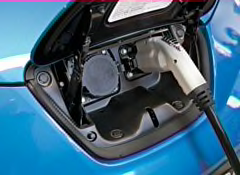
Those who have driven electric cars extol the benefits of never having to stop at a gas station, of driving for pennies per mile, and of no oil changes. With federal and local tax incentives, some electric cars can be comparable in price to a similar conventional car—maybe even less. Counting tax incentives in California and those from the IRS, the Nissan Leaf will cost some buyers only $20,280. And the state allows lone EV drivers access to carpool lanes even after that privilege has expired for hybrid drivers. Even with those benefits, many EV drivers will be early adopters who buy an electric car to make a statement about their environmental consciousness, to reduce foreign oil consumption, or to have the latest technology.
Yes. Tesla, Nissan, and Ford all offer pure electric cars for sale nationwide, the former two in sizeable volumes. So does General Motors with its Chevrolet Volt range-extended electric vehicle, and Ford with its Fusion Energi and C-Max Energi plug-in hybrids.
Automakers are investing in electric cars for a variety of reasons, including consumer demand, meeting new fuel-economy requirements, and zero-emissions mandates from California. Automakers have also found that some buyers want cars that express their social consciousness by symbolizing their reluctance to contribute to importing oil from unstable, unsympathetic regimes, anger over recent gasoline price spikes, and outrage over oil spills. In light of the success of the Toyota Prius with these buyers, electric cars and plug-in hybrids are a logical next step.
Electric cars are up to three times as efficient as gasoline-powered cars. That's primarily because electric motors are 90-percent efficient at converting energy into motion, compared to 30 to 40 percent for conventional cars and hybrids. But considering the energy lost in producing, transmitting, and storing electricity, the real differences are much smaller. But in regions with renewable and clean electric production, electric cars still maintain much of their advantage.
Power is never free. Today, almost half of America's electricity comes from coal, which generates significantly more emissions than other sources. A 2005 joint study by an electric-utility industry organization and the National Resources Defense council estimates that introducing significant numbers of plug-in hybrids with a range of 20 miles of electric driving on American roads would cut global warming pollution by at least 163 million tons annually. Oil dependence is easier to gauge: An estimate by the Federal Highway Administration is a savings of 550 million gallons a year.
What types of electric cars are available?
There are primarily three types:
The Nissan Leaf, Mitsubishi iMiev, Ford Focus Electric, and Tesla Model S are available nationwide, as are plug-in hybrids such as the Chevrolet Volt, Ford Fusion Energi, and Ford C-Max Energi.
Other electric cars, such as the Chevrolet Spark EV, the Fiat 500e, Honda Fit EV, Toyota RAV4 EV, and the upcoming Volkswagen eGolf, are available in limited numbers only in California and select other states to meet state mandates for electric vehicles.
How much do they cost?
Prices range from $23,000 for the slow and unrefined Mitsubishi iMiev to over $100,000 for the sporty and luxurious Tesla Model S, our Top Pick for 2014. Most cost around $30,000. All pure EVs are eligible for a $7,500 federal tax rebate in addition to other state and local tax credits.
Most of the pure electric cars on the way have a range of about 100 miles between charges. Some models, such as the Tesla Model S expected to debut in 2012, will have larger optional batteries that can go up to a claimed 300 miles. Others, such as the Chevrolet Volt and the Fisker Karma will only be able to go short distances (less than 40 miles for the Volt) on electricity, but have gas engines that can carry them farther when the need arises.
How much will it cost to charge?
Electricity rates vary across the country, from a low of 5 cents per kilowatt-hour to a high of more than 29 cents in Hawaii. At our test track in Connecticut, we pay the highest rates in the continental United States at 19 cents per kWh.
The cost to charge an electric car depends on your electric rates and the size of the batteries. For a Chevrolet Volt, which has relatively small battery capacity and doesn't rely on them as its sole energy source, charging takes about 10 kWh. So a full charge would cost between 56 cents and $1.90 a day (or $2.90 in Hawaii), which would take you about 35 miles. A Nissan Leaf would cost between $1.25 and $4.50, which will carry you about 80 miles. Charging a Tesla costs much more: $2.65 to $9, but you can go about 200 miles on that charge.
Overall, you can expect an electric car to cost about 4 cents a mile to charge at national average electric rates. A conventional car that gets 30 mpg would cost about 9 cents a mile to fuel.
There are three levels of chargers:
EVSE stands for Electric Vehicle Supply Equipment. Though not technically a charger, it is the box on the wall (or a post in a parking lot) that you plug an electric car into to recharge it. (Electric cars have appropriate chargers built into them.) The EVSE is the part that most people may call a "charger," because it is an accessory that costs extra. For consumers considering an electric vehicle, a Level II EVSE for the garage should cost between $500 and $900, though prices are coming down fast. Installation can more than double that amount, depending on the configuration of your house.
While hybrid models such as the Chevrolet Volt and plug-in Toyota Prius have a built-in charger that can charge the battery overnight on a standard 110-volt household outlet, pure electric cars will require a separate charger that requires at least a 220-volt, 20-amp circuit. 30 or 40 amp circuits will charge faster. Any electric-car charger has to be on a dedicated circuit. Even plug-in hybrids will be much easier to live with if you have a 220-volt charger, which can cut your charge time in half.
Will electric cars work in the winter?
Using the heater, lights, and wiper (or to a lesser degree the air conditioner in the summer) can use up to half the battery's charge. The batteries also have a little less energy in the winter. At their worst, we found our Nissan Leaf and our Tesla Model S lost about 20 percent of their average range on the coldest winter days.
As batteries wear, their capacity to absorb a charge diminishes. So the range of electric cars will diminish with age. General Motors and Nissan, the first two companies to introduce electric cars in the United States, are providing battery warranties of eight years or 100,000 miles. In California and 15 other states that follow California emissions laws, GM will have to warranty the batteries to 10 years or 150,000 miles.
They have in a couple of widely publicized cases in the Tesla Model S. But they don't explode spontaneously and drivers have had plenty of warning and time to escape.Lithium-ion batteries are a lot less volatile than gasoline. Tesla has addressed the battery-fire concerns with a recall.
For more on saving fuel, see our guide to fuel economy. To learn about electric cars and other alternative technologies, see our guide to alternative fuels.

 Build & Buy Car Buying Service
Save thousands off MSRP with upfront dealer pricing information and a transparent car buying experience.
 Get Ratings on the go and compare
while you shop

