Washers & dryers
Dirty laundry

LUXE LAUNDRIES Kenmore’s Laundry Plus coordinating accessories include a storage bin and a folding surface. But $500 to $560 for just those

add-ons is pricey.
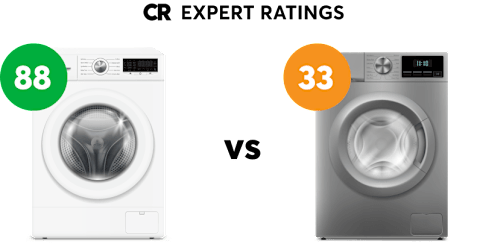
Not so long ago you could count on most washers to get your clothes very clean. Not anymore. Our latest tests found huge performance
differences among machines. Some left our stain-soaked swatches nearly as dirty as they were before washing. For best results,
you’ll have to spend $900 or more.

What happened? As of January, the U.S. Department of Energy has required washers to use 21 percent less energy, a goal we
wholeheartedly support. But our tests have found that traditional top-loaders, those with the familiar center-post agitators,
are having a tough time wringing out those savings without sacrificing cleaning ability, the main reason you buy a washer.
On the other hand, dryer technology hasn’t changed much in the last 10 years. Plus dryers tend to outlast washers. That’s

why we offer buying tips and highlight only dryers that combine performance, value, and reliability instead of showing full
Ratings.
Today most top-loaders only get a good washing score, and some had the lowest scores we’ve seen in years. One washer, with
an overall score of 19 (out of 100) is one of the lowest-scoring washers in this and past reports. Several major manufacturers
are meeting the new energy standard by lowering wash water temperatures. But doing this often lowers the washing performance.
Top-loaders without agitators, often called “high-efficiency” or HE models, work somewhat like front-loaders, filling partially
with water and spinning at very high speeds. While some match front-loaders’ washing ability, our tests have found those HE
washers are less energy- and water-efficient than front-loaders. And Kenmore’s and Whirlpool’s HE washers, a sizable share
of the market, haven’t been as reliable as their regular top-loaders. At $900 to $1,000, HE top-loaders are as expensive as
front-loaders. For all of those reasons, none of our Quick Picks are top-loaders. More news:
More features and style. To soften the blow of higher prices, manufacturers have added special settings such as Bedding and Active Wear, which minimize
sorting. Whirlpool and Kenmore have added coordinating accessories such as storage drawers that fit under or between the washer
and dryer and countertops that fit over them. Also upping the “wow” factor are curved fronts, glass tops, and colors such
as midnight blue, deep red, and champagne. But if you’re on a beer budget, you might balk at the extra $100 to $200 color
adds to cost.
Rough tumbles. Front-loaders have typically been gentle on clothes in past tests, but three models scored only a fair in gentleness. Longer
wash cycles--almost double that of their predecessors--could be the cause.
HOW TO CHOOSE
Consider replacing your washer or dryer when a repair will cost more than half the price of a comparably equipped new appliance.
Our repair data also show that it often doesn’t pay to repair any dryer or top-loading washer that’s more than six years old
or any front-loading washer that’s more than seven years old.
Weigh cost vs. cleaning. Most front-loaders offer superior performance and efficiency. Better moisture extraction on the spin cycle also means shorter
drying times. But at $900 or more, those machines are not for every budget. Bypass high-efficiency top-loaders. They’re as
expensive as front-loaders, but usually not as efficient or reliable. Conventional top-loaders are the least expensive and
have shorter cycle times but are mediocre at washing. To offset their so-so performance, try some of the tips offered in Doing
It Right on the facing page.
Location is critical. As laundries migrate closer to living spaces, noise and vibration matter more. Look for machines with very good scores for
noise, and end-of-cycle signals that can be turned off or down, so as not to disturb the household. Top-loaders tend to make
noise throughout the wash cycle. Front-loaders are quieter overall but make a high-pitched sound and vibrate during spin cycles.
Weigh the features. Auto temperature control balances hot with cold water, giving you consistent water temperatures every time you pick a setting.
Automatic dispensers release detergent, bleach, or fabric softener at the right moment. All front-loaders automatically set
correct water levels. Extra spin cycles don’t extract much additional water. In general you probably don’t need more than
four to five wash cycles, including heavy duty, normal, delicate, and whitest white. A feature that’s nice but not necessary:
a porcelain top, which is more scratch-resistant than a painted one.
Use CR’s efficiency Ratings. The estimated annual energy cost on the yellow EnergyGuide labels can be misleading because it doesn’t take into account
how much water the washer spins out of a load. The wetter the laundry, the more time and money it will take to dry. Though
Energy Star designations are a better measure, our efficiency Ratings are more detailed.
Check warranties. Many manufacturers have shortened warranties in the past 18 months. Most now cover parts and service for only one year from
purchase. Nevertheless, we don’t recommend buying an extended warranty. Our survey data show that major appliances usually
don’t break within three years, and when they do, repairs on average cost about the same as the extended warranty. Check whether
purchasing the appliance on your credit card extends the manufacturer’s warranty.
Skip the matching dryer. You’ll save hundreds by purchasing one of our Quick Picks instead. Remember there’s no need to replace a working dryer. But
if yours is broken, look for a dryer with a moisture sensor. Those automatically shut off the machine when laundry is dry,
so they use less energy and are easier on clothes.