Sign In

A recent recall of toys made of a material that can expand significantly when ingested has revealed a potential health risk that the Consumer Product Safety Commission considers serious enough to warrant a broader investigation.
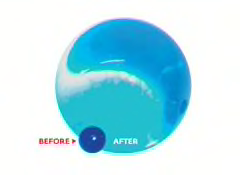
In December 2012, Cleveland-based Dunecraft recalled about 95,000 packages of marble-sized toys that expand in water. That recall came three months after doctors at Texas Children's Hospital reported in the journal Pediatrics that an 8-month-old girl swallowed one of the brightly colored balls from a set of Dunecraft's Water Balz. It had to be surgically removed after it expanded inside her, blocking her small intestine.
The doctors warned that such cases might become more common because superabsorbent polymers such as those used to make the Dunecraft toys are increasingly prevalent not only in other toys but also in widely available household products, such as water-retaining pellets used for gardening or in flower arrangements. Some day-care providers actually use those versions as playthings for babies and preschoolers. In the dry state, the polymer beads are tiny but could pose life-threatening risks.
"If one of these is in the airway and doubles within 2 to 4 hours, a child can go from not breathing well to not breathing at all," says Paul Krakowitz, M.D., a pediatric ear, nose, and throat surgeon and vice chairman of surgical operations at the Cleveland Clinic.
"We view the recall with Dunecraft and the incident involving the 8-month-old girl to be very serious and as a result, CPSC staff are taking a broader look at this product class," said CPSC spokesman Scott Wolfson.
Two cases were recently reported among children in Pakistan, one of whom died as a result. Malaysia banned the sale of such products in August 2011 after hospital reports of seven children needing surgery after ingesting them. Italy has imposed a ban, and New Zealand says they should not be promoted as children's toys or craft products.
"These are colorful and look cute when you watch them expand, but they could have disastrous effects if they are ingested, so any of these superabsorbent polymer products should be kept out of the reach of children or pets," says Oluyinka O. Olutoye, M.D., a pediatric surgeon at Texas Children's Hospital who operated on the baby whose case was reported in Pediatrics.

 Build & Buy Car Buying Service
Save thousands off MSRP with upfront dealer pricing information and a transparent car buying experience.
 Get Ratings on the go and compare
while you shop

