Sign In

Menu
Suggested Searches
Recent Searches
Suggested Searches
Product Ratings
Resources
Chat With AskCR
Resources
All Products A-ZThe payment for your account couldn't be processed or you've canceled your account with us.
Re-activateMy account
Sign In
My account
Sign In

The issue: Labels that tell you where your beef comes from are in danger.
Our take: When you buy imported meat, fish, or fresh vegetables, there's usually a label noting the country of origin—COOL for short—that states where the food was raised and processed.
The labels help consumers make informed choices about their food. If there's an outbreak of food contamination in a certain country, a COOL can help you avoid those products. If you prefer fruit from a specific country, you can identify it.
In December, the World Trade Organization told the Department of Agriculture that it's fine for the U.S. to require retailers to label where meat comes from but that the U.S. rules were too complicated and expensive for other countries to comply with. Now the U.S. must decide whether to change the labeling rules, get rid of them, or leave them as is and risk being penalized by the WTO.
A group of Republican and Democratic senators wrote U.S. regulators in support of preserving the fundamental elements of the COOL. Consumers Union agrees. The U.S. should be able to adjust its rules through regulations without compromising the critical information that consumers want and deserve.

The maker of POM is now required to provide two randomized, controlled, human clinical trials to back up its disease-related claims. The Federal Trade Commission says the producer of POM Wonderful 100% Pomegranate Juice and POMx supplements deceptively advertised the products and could not support claims that they help prevent heart disease and prostate cancer. The company is appealing the decision.
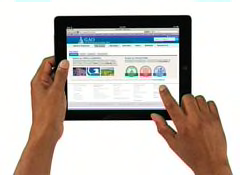
A new "key issues" page on the Government Accountability Office's website makes it easy to find the agency's reports on a range of topics that interest consumers. The titles may not be catchy ("Federal Telework"), but the reports exemplify the GAO's goal of producing "objective, fact-based, nonpartisan, nonideological, fair, and balanced" assessments of what isn't working in government (and sometimes what is).
The GAO's mission is to investigate how our tax dollars are spent. Among the key-issues reports are those about federal help for entrepreneurs (it's scattered across 52 programs, more than half of which aren't evaluated to determine whether they're working), disability compensation benefits for veterans (more than 565,000 claims are in a backlog past the VA's 125-day target), and nuclear waste. (Just what should we be doing with the 2,000 metric tons that are produced every year in the U.S.?)

 Build & Buy Car Buying Service
Save thousands off MSRP with upfront dealer pricing information and a transparent car buying experience.
 Get Ratings on the go and compare
while you shop

