Sign In

Consumer Reports comes down hard on tough-to-open, overwrapped, and underfilled bags, boxes, and containers. But other packaging tactics are even more subtle: attempts to make products look bigger, better, cheaper, or more healthful.
"Consumers are very easily influenced," says Brian Wansink, director of Cornell University's Food and Brand Lab. "When people shop, they're not cool or rational but in a ‘hot' state—stressed, tired, in a hurry."
We asked our Facebook fans about products they had been persuaded to buy because of their look or label. Then we sent our reporter to supermarkets to round up examples.
To avoid being fooled into paying too much, focus on fine print, including ingredient lists and nutrition labels. Ignore pretty packaging, bright colors, and bold lettering. Compare unit prices on shelf tags (per ounce, per quart, or per 100 sheets). And if you like a product but not its marketing, contact the manufacturer. You can air your grievance, and many companies send coupons to customers who call or write.
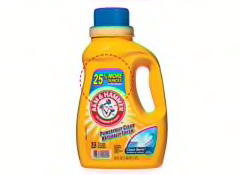
This 50-ounce bottle seems like a bargain because the label screams "25% more ounces." But tiny type below makes a head-scratching comparison: "vs. 40-ounce detergents." Likewise, we found identical 12-ounce bottles of Vicks Nyquil with comparisons so obvious they were silly. The label on one bottle bragged that it contained "50% more (than our 8 oz size)"; the other, that it had "20% more (than the 10 oz size)."
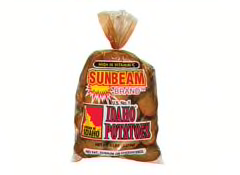
The front of this bag is similar in color to the potatoes and makes them look appealing and pristine. The flip side? It's clear and shows cracks, bruises, and eyes. Another trick: Paint the container a more vibrant version of what's inside. Ketchup bottles are usually clear, but one we found was bright red—sure to catch a shopper's eye.
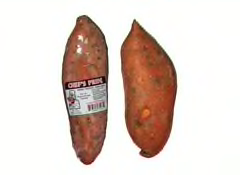
Would you pay three times as much for a single yam just because it had its own label and came in a microwavable wrapper? The Chef's Pride sweet potato with that special treatment cost $1.50. A fatter one we pulled from a bin cost 50 cents.
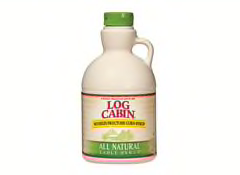
Our tasters have said there's no comparison between maple syrup and pancake syrup. So it's easy to see why Log Cabin, which produces "table syrup"—brown rice syrup, sugar, and water—might use a container that makes it look like the real deal.
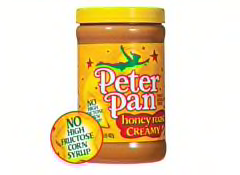
The label on Peter Pan peanut and honey spread notes that the contents are free of high-fructose corn syrup, which consumers might find comforting. It downplays the presence of partially hydrogenated fat, which is definitely not heart-healthy.
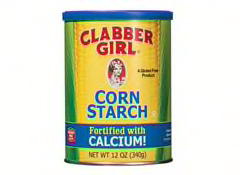
Fortifying cornstarch with calcium offers little benefit, our medical experts say, because it's commonly used in small amounts. A spokeswoman for Clabber Girl told us that "the dietary benefit offers value to our customers."
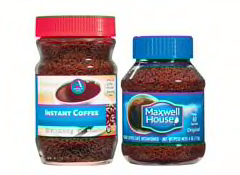
The jar of America's Choice looks larger and costs about $1 less. In fact, the jars contain the same amount of coffee. But cup for cup, Maxwell House is cheaper because it claims to make 60 cups; America's Choice, 30 (using rounded teaspoons). A&P, seller of America's Choice, told us the label was a misprint: 30 should be 50. As of April, we hadn't seen a corrected label.
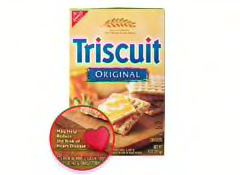
Triscuits are made with whole-grain wheat, and Nabisco notes that diets rich in whole grains and low in saturated fats and cholesterol may help reduce the risk of heart disease. But the Nutrition Facts reveal that a serving (six crackers) has 120 calories, 4 grams of fat, and 180 milligrams of sodium. And how many people stop at six?
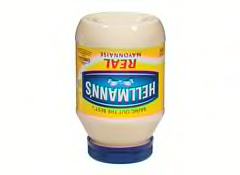
Peanut butter and mayonnaise have been downsized in recent years. Instead of an outright price increase, manufacturers simply give you less for your money. Companies sometimes mask the decrease not by shrinking the jar's dimensions but by indenting the bottom.
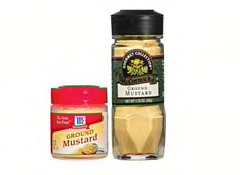
Conventional wisdom suggests that McCormick ground mustard in a fancy glass jar costs more than mustard in plain plastic. Wrong. The smaller mustard, in plastic, is about $81 per pound. The mustard in glass: $48 per pound.
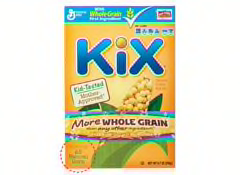
"All natural" often means nothing: The Food and Drug Administration doesn't define or regulate the term except when it refers to meat. Yet in a recent nationally representative survey, the Consumer Reports National Research Center found that half of Americans buy food labeled "natural." Take Kix, made with "all natural corn." General Mills never explains the benefits of the corn or how it differs from the "unnatural" variety. Similarly, "fat free" boasts on corn flakes are stating the obvious. We couldn't find any corn flakes with fat among their ingredients.
A version of this article appeared in the June 2013 issue of Consumer Reports magazine with the headline "Sneaky Packages."

 Build & Buy Car Buying Service
Save thousands off MSRP with upfront dealer pricing information and a transparent car buying experience.
 Get Ratings on the go and compare
while you shop

