Safe Infant Formulas Are Available Through WIC—But Options Are Limited
Should WIC’s state contracting system evolve to allow for more consumer choice?


The Special Supplemental Nutrition Program for Women, Infants, and Children, commonly known as WIC, is a federal program that provides supplemental nutrition and other resources to pregnant women, infants, and children up to age 5. Administered at the state level, WIC provides infant nutrition counseling and EBT cards for parents to buy approved infant formula. According to the Department of Agriculture’s most current data, infants in the WIC program consume an estimated 56 percent of infant formula in the U.S.
When Erika Hardison gave birth at a hospital in Elizabeth, New Jersey, the nurses asked her if she wanted to breastfeed or use formula. “I told them I would like to learn how to breastfeed, but I don’t know how,” she says. “So they gave me some formula, as they tried to help me learn how to express milk and things like that.” Hardison says she struggled with breastfeeding the first month and signed up for WIC. The hospital’s WIC lactation counselor provided her the size and brand of formula, Enfamil only, eligible for coverage in her state. It wasn’t until infant formula samples from various manufacturers came in the mail that Hardison realized how many other baby formula options there were on store shelves.
WIC provides critical nutrition support for infants across the country. But with recent formula recalls and concerns about contaminants in infant formula, parents who rely on WIC may have questions about how the program and the states that administer it decide which brands and types of formula families have access to.
How the Choice of Formula Options Is Made for WIC Families
“Most states use a competitive bidding process to select a primary formula brand,” says Erin Moore, MSN, CPNP, IBCLC, founder of Fed With Love, an infant feeding support consultancy. “Formula companies submit rebate bids offering a discount for each can of formula purchased through WIC. The state awards a contract to one company based largely on those rebates.”
Moore says that “this system allows WIC to stretch its funding and serve more families.” While that rebate structure largely determines which brand is most widely distributed in a given state, she emphasizes that “all formulas provided through WIC must meet federal nutrient and safety standards for infant nutrition.”
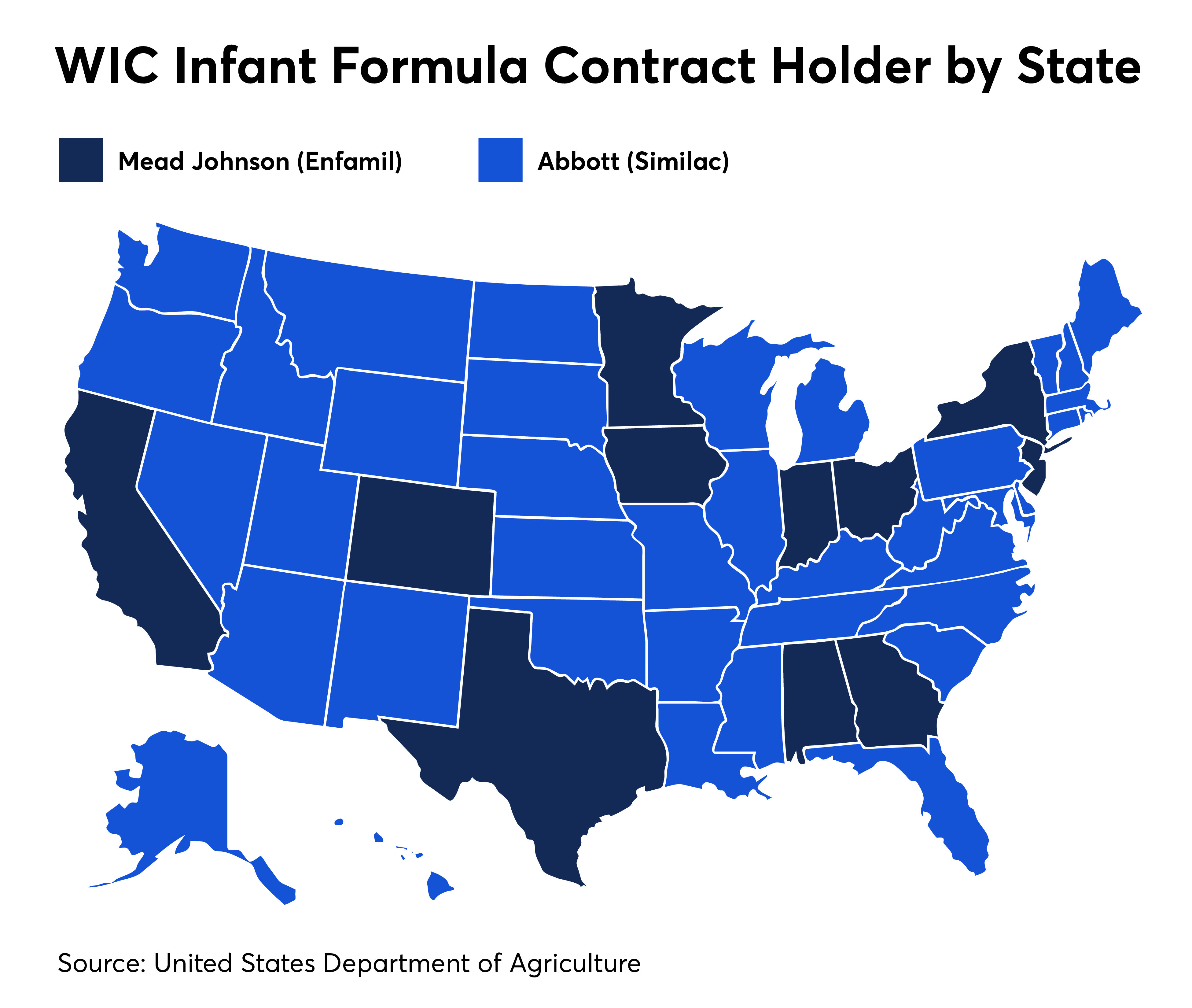
California operates the largest WIC program in the country. The state also boasts one of the highest coverage rates, second to Vermont, with 70 percent of all eligible Californians enrolled in WIC. Arkansas, which has the second-highest infant mortality rate before age 1, has one of the lowest WIC participation rates in the U.S. According to USDA data from 2021, of about 145,000 eligible children ages 1 to 4 in the state, only about 50,700 participate in WIC.
What Lack of Formula Choice Means for Families on WIC
Most state WIC programs use a sole-source contract with a single manufacturer to keep costs down, but that means brand choice is limited for parents. “If a family wants an organic or non-contract brand for non-medical reasons, they usually have to pay out of pocket,” says Dr. Caitlin Goodwin, DNP, APRN, CNM, RN, a certified nurse midwife. “For many families, that makes choosing a specific brand a significant financial burden.”
Parents might have valid reasons for preferring one formula over another. Goodwin says while there are baseline safety measures and formulas legally manufactured and sold in the U.S. must meet federal standards, there are differences. “Parents can trust that these products provide the essential calories and nutrients babies need to grow,” says Goodwin. “The real differences between brands usually come down to ingredient sourcing, manufacturing transparency, and whether the company does extra third-party testing.”
She points to the differences in regulations between the U.S. and the EU. The FDA’s “Closer to Zero” action plan, for example, which aims to reduce heavy metals in baby foods, does not apply to baby formula. “While the U.S. follows the Infant Formula Act, the EU often maintains even stricter limits,” she says. “From a clinical standpoint, the goal should be to move toward more proactive, public testing to better protect infant health and give parents peace of mind.”
Since 2025, Consumer Reports has tested 90 infant formulas for heavy metals, including lead and arsenic, as well as process contaminants. The results were concerning. Many soy, plant-based, and hypoallergenic brands included in the testing had inorganic arsenic levels above our experts’ levels of concern, and we also found that many formulas tested included per- and polyfluoroalkyl substances compounds, synthetic chemicals linked to negative health outcomes. That said, organic formulas tested lower for heavy metals and other contaminants on average than non-organic formulas, and contaminant levels varied between different products under the same brand.
These tests showed that better options for infant formula are available. However, access to these formula options is left up to the states for families using WIC. That means the safer or lower-contaminant products identified in independent testing aren’t necessarily accessible to every WIC household.
“Since babies are still developing their kidney and liver functions, they’re much more vulnerable to toxins like heavy metals,” Goodwin says. Babies from low-income families, the demographic that WIC serves, are even more vulnerable. Children living in poverty are more likely to experience poor health outcomes in the first few years of life.
The two formulas covered by the WIC benefit in most states are Similac Advance and Enfamil Infant formulas. The good news is that both these formulas, in their powdered form, rated among CR’s Top Choices for having low to non-detectable contaminants in our independent tests. The not-as-good news is that no states include organic formula among their standard WIC contract options. Many of the organic infant formulas Consumer Reports has tested rated among our top choices for having lower levels of contaminants, such as lead, inorganic arsenic, and bisphenol A.
A bill in Congress, the INFANT Act of 2025 (H.R. 5759), would change how infant formula companies are selected for the federal WIC program. Instead of awarding a contract to a single manufacturer in each state, the proposal would require states to select two formula makers through competitive bidding. If it passes, the legislation could introduce more manufacturers into the program, reduce the risk to families in the event of manufacturer supply issues, and give WIC families more choice when feeding their babies.


