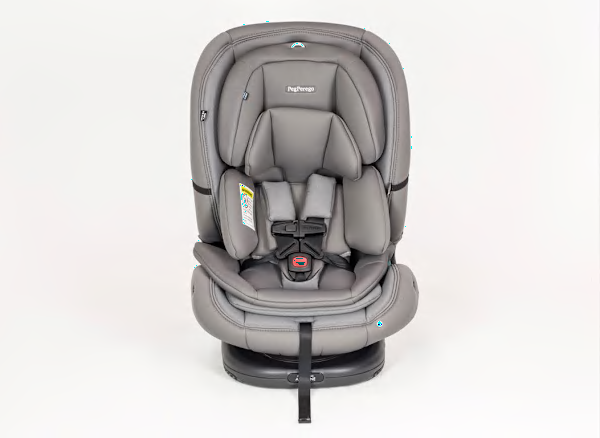
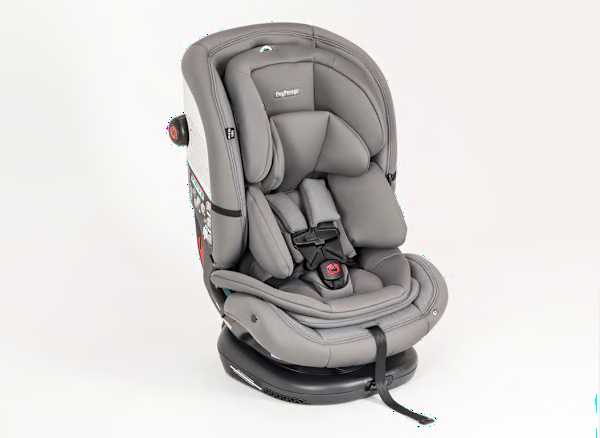
Ease of use: The seat includes several parent-friendly features, such as a no-rethread harness, separate harness storage, and washable seat cover. However, installation can be somewhat tricky.
Fit-to-vehicle LATCH:
Our testers found the LATCH strap needs to be laid out flat first to make sure the connectors are oriented in the correct position to connect to anchors. Threading the LATCH strap through the rear and forward paths means moving lots of cushions and harnesses out of the way first, which can be tricky. The belt guide photos in manual seem to be different than the ones printed on the seat, too, leading to some confusion when installing.
Fit-to-vehicle Belt:
Routing and tensioning the vehicle seat belt can be complicated and tricky to get a secure installation in both rear- and forward-facing installations.
Booster fit:
Our testers found it difficult to adjust the head-shoulder belt guide height in order to get a proper shoulder belt position.
Crash protection:
In CR’s crash testing, the Peg Perego Primo Viaggio All-in-One car seat exhibited a structural issue in which the crotch buckle pulled through the car seat shell in 2 of 2 forward-facing tests with the weighted 6-year-old crash test dummy (62 lb.), installed with the lap and shoulder seatbelt and top tether. This structural failure compromises the seat’s ability to retain the child in a subsequent crash event and warrants a Basic rating for crash protection.
“Peg Perego is committed to designing and manufacturing car seats that meet and exceed all applicable safety standards,” a company spokesperson says. “The Primo Viaggio All in One is engineered to withstand crash forces well beyond those required by federal safety regulations and was evaluated in testing that exceeded the severity of the federal crash test standard. Even under these extreme impact conditions, our analysis confirms that the seat performed its fundamental role by securely containing the child in the seat. As part of our commitment to continuous improvement, we carefully analyze all test data from these high severity evaluations to further advance the safety performance of our products.”
Additional Information
Good to know: All child car seats sold in the United States are required to meet government safety standards.
About our testing: Consumer Reports’ child car seat tests are not designed to test compliance with federal standards. Rather, we evaluate car seat performance under conditions designed by our experts that go beyond the required federal safety standards.
Consumer Reports’ independent car seat crash test program has been carefully designed to simulate the forces encountered during a crash, while replicating some of the real-world factors that might impact a car seat’s performance. Our testing aims to determine which car seats could provide an extra level of safety when compared to other models in the same category.
Basic, Better, or Best: CR rates the child car seats we crash test on a scale of Basic, Better, and Best, based on the additional margin of safety they may provide. Read about how we test car seats to learn more about our crash test protocol.