Recalled Inclined Infant Sleepers Are Still in Use—and Still Dangerous
Data from the American Academy of Pediatrics show infant deaths continue to be linked to inclined sleepers years after they were recalled


In 2019, the Fisher-Price Rock ’n Play and similar inclined sleepers were recalled after Consumer Reports linked them to dozens of infant deaths. But the products remained on the secondhand market—at yard sales, via online marketplaces, and tucked away in closets—unknowingly handed down to friends and family by owners unaware of the danger. In 2023, the recall was reissued after at least eight additional infant deaths were reported.
Now, a new study from the American Academy of Pediatrics underscores the ongoing risk. Researchers found that 158 infant deaths between 2009 and 2023 were linked to inclined sleepers, including at least 50 that occurred after the recall.
The takeaway is unsettling—and sobering. Recalls can reduce risk, but they don’t always eliminate it. Dangerous products can continue to circulate, meaning the risk persists. Here’s what parents need to know to protect their children.
The Inclined Sleeper Recall Helped—But There's More to Be Done
The data tell a complicated story. While the number of infant deaths associated with several inclined infant sleepers declined after the initial Rock ‘n Play recall in 2019, the findings show that the recall reduced risk but didn’t eliminate it. According to the AAP study, in the year following the 2019 recall, sudden unexplained infant deaths associated with inclined sleepers declined from 22 to 14. They remained in that range for the next two years. Deaths from these products dropped to nine in 2023, when the recall was reissued.

Part of the reason for the continuing risk from these products is scale. Inclined sleepers weren’t a niche product. They were everywhere, marketed as solutions for fussy babies and praised for helping infants sleep longer. The Fisher-Price Rock ’n Play recall alone was about 4.7 million inclined sleepers—a figure that doesn’t even account for the many similar products on the market. Many inclined sleepers were sold by trusted brands such as Graco and Evenflo, making it harder for parents to part with them.
“Recalled baby products continue to circulate because they remain in homes long after the initial purchase,” says Lisa Trofe, executive director of the Baby Safety Alliance, adding that these products are often saved, shared, or resold across multiple families. While recalls are issued and managed by the Consumer Product Safety Commission and manufacturers, organizations like the Baby Safety Alliance focus on prevention, working to reduce risks before products reach families and helping parents understand how to identify unsafe items. “A recall depends on reaching the original purchaser," says Trofe. "Once a product moves into the secondhand market, that connection is lost.”
Why Inclined Sleepers Are Unsafe
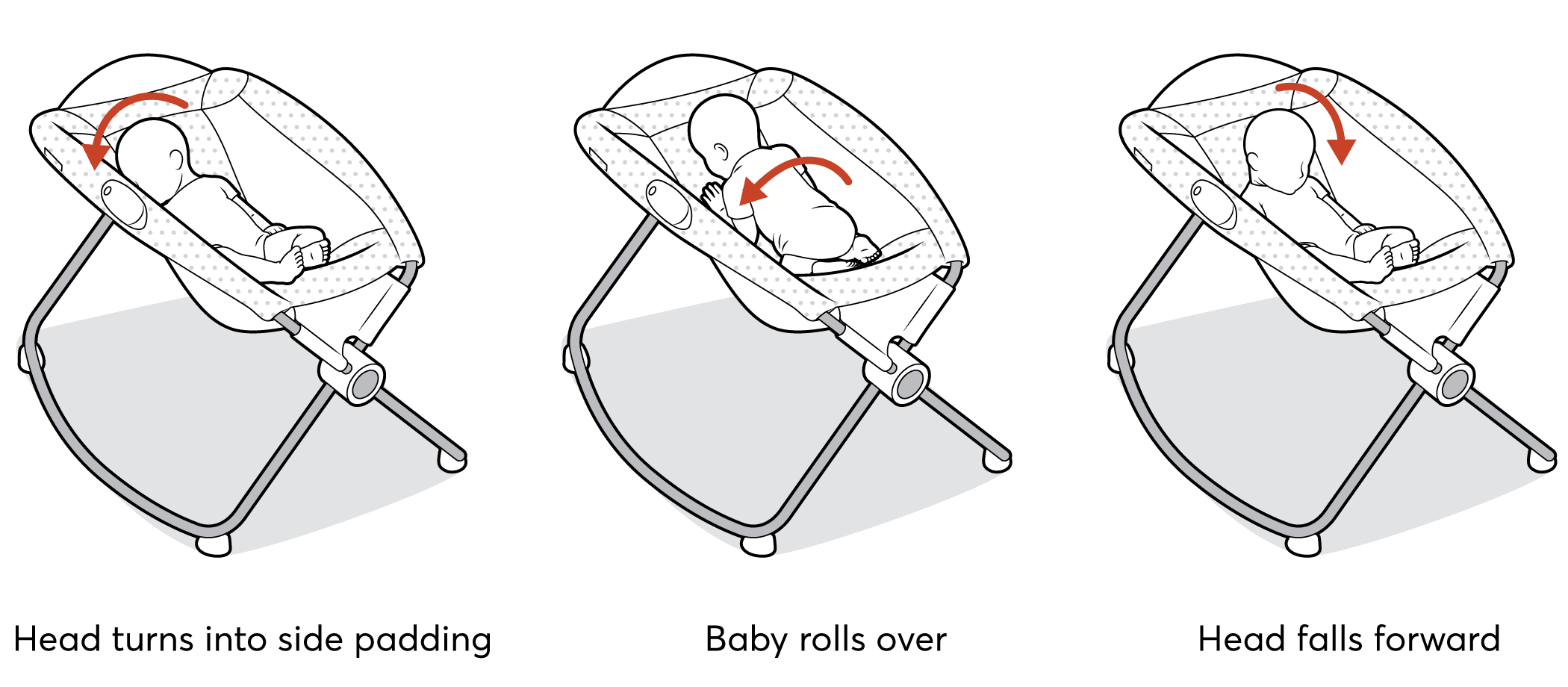
At a glance, inclined sleepers don’t seem dangerous. They look comfortable and supportive, designed to cradle a baby. Unfortunately, that’s part of the problem. The angle that makes them appealing is exactly what makes them unsafe. It can allow a baby’s head to slump forward, blocking airflow and interfering with breathing.
“An inclined position is unsafe because a baby’s head and neck are weak, leaving them at risk for asphyxiation,” says pediatrician Ari Brown, MD, author of the Baby 411 series. "Babies can also potentially roll into dangerous positions or fall out of devices that are on an incline and not designed specifically for sleep."
in Inclined Sleepers
Why Recalled Products Continue to Circulate
“The breakdown happens in the secondhand ecosystem,” Trofe says. “Individual sellers often lack awareness of recall status, and listings are not consistently screened in real time.”
Inclined infant sleep products still show up in neighborhood parent groups, donation centers, and secondhand stores. Even though selling recalled products is illegal, enforcement is uneven, and often reactive rather than proactive. Confusing things further, some inclined sleepers were simply rebranded as swings or loungers, making it difficult to know exactly what you’re buying. As a result, it’s easy for a parent to mistake an unsafe product for a bargain. "It can be dangerously confusing for parents when a manufacturer changes a product’s name but not its unsafe design,” says William Wallace, director of safety advocacy for Consumer Reports. “If a product gets recalled or prohibited, the manufacturer should go out of its way to make a clean break from that product. Consumers should be able to easily distinguish between safe and unsafe options on the market."
Federal regulators say they are trying to close that gap. “The Commission has long recognized the challenge of recalled and hazardous products continuing to circulate in secondary markets,” says Peter Feldman, acting chairman of the CPSC. He adds that efforts have ramped up, including teams dedicated to monitoring online platforms and removing unsafe listings. “In just the first half of fiscal year 2026, the CPSC has issued 82,000 takedown notices,” Feldman says, adding that it’s more than double the prior annual average of 37,000.
But for every listing that’s removed, another can take its place. "It’s a game of whack-a-mole with no end in sight and potentially deadly consequences,” says Oriene Shin, CR’s manager of safety advocacy. “Some online marketplaces have strict requirements for third-party sellers and can revoke their access to the platform if they don’t follow the rules. That’s a much more difficult task on consumer-to-consumer platforms, where sellers typically are just looking to recoup a few bucks from their original purchase, rather than trying to sell products professionally."
That raises a harder question: If the risks are clear, why are parents still using these products?
Why the Risk Doesn’t Always Register
Many inclined sleepers were marketed as a way to soothe babies, ease reflux, or help them sleep longer, all wins for most parents. The products often worked, which is part of what made them so popular—and so hard to let go of.
“I know that parents will try just about anything to help their babies fall or stay asleep," Brown says. Sleep deprivation, coupled with desperation for a solution, can change how parents make decisions. But none of that removes the risks associated with inclined sleepers. “Even if you have the best intentions of staying awake and watching your baby while they sleep, you may doze off,” Brown says. “It’s just not worth the risk.”
The AAP study reinforces that point. Most of the deaths documented occurred at home (86 percent) and while a parent was present (83 percent). In other words, these were ordinary moments, not outliers.
What Gets Lost When Baby Gear Changes Hands
Inclined sleepers are just one example of a broader pattern: Baby gear doesn’t stay in one place. With each handoff, information gets lost, and with it, a product’s safety history.
“Secondhand products carry a higher risk because their history is unknown,” Trofe says. That includes whether a product has been recalled, is missing parts, and if it still meets current safety standards. "Instructions and warning labels are also often missing,” she adds, “which increases the risk of improper assembly or use.”
For parents trying to save money, secondhand gear can feel like a smart, practical choice, and sometimes, it is. But in certain categories, the risks of buying used outweigh the rewards. "If you can afford it, we recommend buying certain types of baby products new—both to avoid known safety risks and to get the benefit of advances in safety technology,” says Wallace.
What Not to Buy Secondhand
Some types of baby gear are riskier to buy used than others, especially items where safety depends on condition, recall status, or evolving standards. That includes:
- Loungers or nursing pillows that don’t meet new safety standards.
- Car seats that may have hidden damage or be expired. CR’s safety experts say the lifespan of most car seats is about six to 10 years. If you’re buying or inheriting a secondhand car seat and the seat’s expiration date is not on the manufacturing label, you can use CR’s interactive decision chart to determine whether it’s still safe to use.
- Older baby gear that may not meet current safety standards—especially strollers, cribs, high chairs, and bassinets, which all must meet specific requirements to be sold in the U.S.
Other items can be reused, but require careful inspection (see below). It’s also important to make sure the product hasn’t been recalled.
How to Check for Recalls and Buy Secondhand Safely
Checking for recalls takes only a few minutes and can prevent serious harm. If you know the brand and model name of the product you’re considering, you can easily look up recall information or safety warnings on CPSC.gov/recalls, or do a simple keyword search.
Even if a product hasn’t been recalled, there is more to consider when buying secondhand baby gear. Trofe recommends a simple checklist:
- Confirm all parts are present and original.
- Look for instructions and warning labels.
- Check for recalls
"When possible, buying new baby products provides the highest level of confidence that the product meets current safety standards and includes all parts, instructions, and labeling," says Trofe. If there is any uncertainty about a product’s condition, history, or compliance, it’s best to avoid using it.
Safe Sleep Basics
For all the complexity around sleep-related baby gear, safe sleep remains simple. “For infants, always stick to the ABC’s for safe sleep, which stipulates babies should sleep Alone, on their Back, in a Crib,” Brown says. That means:
- A flat, firm sleep surface
- No pillows, blankets, crib bumpers, soft bedding, or toys
- No inclined or cushioned products
Inclined or cushioned products not intended for sleep, like car seats, swings, or loungers, can become dangerous if a baby is left to sleep in them. “If a baby is hanging out in one of these products, they may fall asleep and risk asphyxiation, suffocation, or injury,” Brown says. Once a baby appears to be dozing off, experts say it’s best to move them to a safe sleep space.
What Needs to Change
Recalls are only as effective as the systems and people behind them. One problem is that awareness doesn’t always reach secondhand users. "Many parents are focused on cost savings and may not check recall status before making a purchase, and the cycle continues," Trofe says. Recalls move things in the right direction, but only if people recognize the risks. “We will see the most impact when demand for unsafe or recalled products decreases,” says Trofe of the Baby Safety Alliance. “That starts with awareness.” The Baby Safety Alliance conducts public awareness campaigns and, through its verification program, works with manufacturers to promote safer products and clear safety standards.
Online resale platforms also present a challenge. Sites like Facebook Marketplace, eBay, and Mercari don’t catch every potentially hazardous product listing, and product labeling can add to the confusion. "Consumers can do their part by checking for recalls—but they shouldn’t have to go it alone," CR’s Shin says. "These secondhand online marketplaces need to step up now and do everything they can to prevent the sale of unsafe products, including recalled products. With access to today’s technology to help them in this vital task, there is no excuse not to."
Recalled products don’t simply disappear; they keep moving. And as long as they do, the danger moves with them.


