Does an ‘Eco-Friendly’ Diaper Really Exist?
Diapers are inherently tough on the environment. After evaluating 31 of them for safety and sustainability, we found good choices from Coterie, HealthyBaby, Kudos, and Parasol.

When you shop through retailer links on our site, we may earn affiliate commissions. 100% of the fees we collect are used to support our nonprofit mission. Learn more.

We set out to analyze 31 diapers to find our top choices for safety and sustainability. But the truth is, reviewing disposable diapers for those factors was more than a little tricky.
That’s because it probably comes as no surprise that disposable diapers are tough on the environment, just by the nature of their construction. Even the most eco-friendly ones we analyzed contain at least some nonrenewable, petroleum-derived materials that don’t biodegrade. And because the bulk of diapers are made from these materials, once they end up in a landfill, they stick around. Aside from their environmental affect, the plastics in some disposable diapers contain chemicals such as phthalates and VOCs, which have been linked to potential health concerns.
How Are Diapers Constructed?
A typical disposable diaper consists of multiple layers:
Top sheet: This innermost layer provides a soft feel against a baby’s skin.
Acquisition layer: Moving inward, the acquisition layer temporarily holds waste until it can be dispersed into the core absorbent layer.
Core absorbent layer: The diaper core holds and generally locks in liquid, keeping the surface and baby’s skin dry.
Back sheet: The outermost layer of the diaper, also called the outer cover, provides a waterproof barrier to help prevent leaks.
Diapers are made up of more than just these layers of waste-containing materials. Waist closure systems and leg cuffs provide structure to keep the diaper securely fastened, and the various layers are typically bound together using adhesives. Many diapers also contain inks or pigments to enhance the whiteness of materials or to create designs, wetness indicators that alert caregivers to moisture by changing colors, and fragrances to mask odors. Some diaper top sheets also contain added lotions or ointments.
So what materials are used to make all these diaper components? Here’s a guide to the most common materials you might find listed on a diaper package.
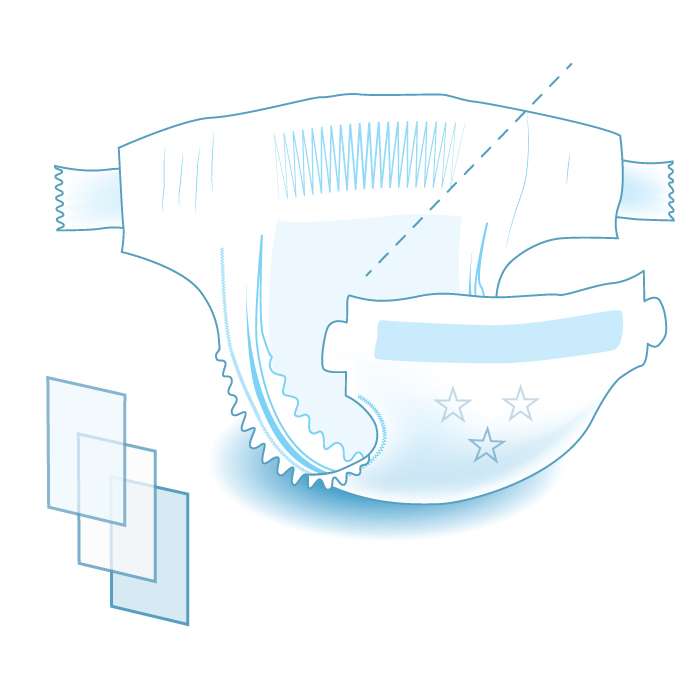
What’s Inside a Diaper? Your Guide to Diaper Materials.
Plastic materials and super absorbent polymers: The bulk of most disposable diapers is simply plastic that goes by different names. Some may be easily recognizable as plastics, but others—like polyester, elastane, and spandex—you might think of as fabric, even though technically they’re a form of plastic as well. Here are some common materials you’ll see on diaper labels:
- Polypropylene (PP)
- Polyethylene (PE)
- Polyester/Polyethylene terephthalate (PET)
- Polylactic acid (PLA)
- Elastane
- Spandex
- Polyolefin
- Sodium polyacrylate
- Sodium acrylate
- Polyacrylic acid
- Superabsorbent polymers (SAPs)
You’ll find these materials throughout the diaper, including, for example, in the top sheet, back sheet, adhesives, elastics, closure systems, and core.
All of the plastics listed above, except polylactic acid, are petroleum-derived, nonrenewable materials. Super absorbent polymers are also plastic, providing extreme absorbency in the core layer. Researchers estimate that they can absorb hundreds of times their weight. Sodium polyacrylate, an acrylic acid polymer, is a common material used, but companies also use sodium acrylate and polyacrylic acid, too. SAPs usually make up about a third of the average weight of a disposable diaper.
One downside of disposable diapers composed primarily of plastics is, of course, the significant environmental impact. Plastics emit greenhouse gases throughout their life cycle, making them inexorably linked to climate change. Plastic doesn’t typically biodegrade, meaning it doesn’t break down in the environment. A consequential amount of it ends up in landfills each year from diapers.
There are also potential health considerations from some plastics. Chemicals called phthalates are used in the manufacturing of many plastics to make them more flexible. They’ve been detected in diapers and may be absorbed through the skin via diapers. Exposure to phthalates has been associated with endocrine disruption, which can result in an increased risk of numerous serious health problems.
Plastics are also a source of VOCs (volatile organic compounds), a diverse group of chemicals linked to many concerns. Specifically, in some diapers, researchers have measured toluene and xylene, which are linked to skin and health problems, as well as other VOCs.
Now just to be clear: We’re not saying that by using disposable diapers you’re a terrible parent, you’re putting your baby’s health at risk, and you’re single-handedly destroying the planet! In discussing the various materials that make up disposable diapers and their potential environmental and health impact, the goal is to give you and caregivers a better understanding of what the materials listed on a diaper package really mean, empowering you to make choices that work for your family. Plastics are, for better or worse, part of everyday life, and your baby’s disposable diaper isn’t their only exposure to them.
Cellulose, wood pulp, and fluff pulp: These materials, used in the diaper’s core absorbent layer, are derived from plants, typically trees, but sometimes bamboo or other plants. The plants are then heavily processed to produce materials with absorbent properties. This process itself has recently become a marketing claim: You might have seen labels reading “Total Chlorine Free (TCF)” or “Elemental Chlorine Free (ECF)” on packages in the diaper aisle. Here’s a brief explainer of what those terms mean.
What Does ECF (Elemental Chlorine Free) or TCF (Total Chlorine Free) Mean on a Diaper Package?
These terms refer to the type of chlorine used as part of the process of creating a diaper’s absorbent pulp core. Here’s how these terms came to be used, and what the difference is.
Before the 1960s, the primary method of bleaching pulp used chlorine in its elemental form. This process generated significant chemical byproducts that were linked to environmental and health concerns. Because of that, some manufacturers have transitioned to different bleaching processes. One is called elemental chlorine free (ECF) and is named to indicate that the process doesn’t use elemental chlorine, as the outdated pre-1960s process did. But to make matters confusing, the process does use a chlorine derivative called chlorine dioxide as the bleaching agent. The other bleaching process, called total chlorine free (TCF), is, as the name suggests, as it sounds. Manufacturers skip chlorine altogether and use alternatives such as oxygen and ozone to bleach materials.
Because these materials are found in the core of a diaper and don’t come into contact with a baby’s skin, the concern with the bleaching process is primarily about its environmental impact. TCF may be a better choice when considering water, chemical, and energy use, and byproducts from manufacturing. Because diapers are made up of about 35 to 50 percent cellulose, wood pulp, and/or fluff pulp, and over 4 million tons of infant and adult diapers are disposed of every year in the U.S., choosing a diaper with a more sustainable manufacturing process might actually have a positive affect on the environment. But TCF might lead to a higher price per box of diapers. In our analysis, we found that companies that marketed their products as using a TCF process were slightly more than one and a half times more expensive per diaper. And the most expensive diaper was almost 5 times as expensive as the least expensive. Cost is important for many families, and choosing a diaper using TCF might not align with your budget. It’s just one consideration when shopping for a more sustainable diaper.
Because the inner core of most diapers is composed of cellulose and pulp derived from trees, they have an impact not just on our landfills but on our forests, too. Look for diapers that are manufactured using sustainably sourced materials to reduce some of this affect.
Cotton: This is sometimes used in the top sheet and back sheet of diapers. Look for cotton that’s labeled certified organic to avoid potential pesticide residue.
Adhesives: Adhesives hold the various layers and components of a diaper together, but you’ll very rarely find the ingredients in them disclosed by diaper companies. Rather, vague terms like “adhesives” or “glue” are usually listed on packaging. Of the products we reviewed, the few that did disclose adhesives listed primarily petroleum-derived adhesives like thermoplastic polymers (which can include polyolefin-based adhesives), hydrocarbon resins, and synthetic rubber. Some products we evaluated, such as Pampers Pure and Freestyle Skin Shield Diapers, also use rosin-based adhesives derived from trees.
Polyurethane: Polyurethane is typically used in two capacities in diapers: in the form of a film that provides a waterproof barrier and/or in the form of a polyurethane elastic that can be used in the leg cuffs or waist closure systems. Polyurethane is a best-in-class waterproofer when compared with other options like PFAS, but the material isn’t biodegradable.
Calcium carbonate: This mineral is manufactured into film form to provide breathability in the back sheet.
Wetness indicators: These are popular features in diapers, but it’s unlikely you’ll see the materials used in them disclosed on the packaging. Of the products we analyzed that had wetness indicators, only two gave any indication of what they were made from. Both listed bromocresol green, a dye that changes colors with pH shifts. One also listed “hydrocarbon resin,” which is a nonspecific umbrella term for petroleum-derived resins—VP/VA copolymer and ethylene/acrylic copolymer—in addition to bromocresol green.
Lotion and ointment: Some products include lotions or ointments added to the top sheet to provide skin conditioning. The most common ingredients we saw were petrolatum and mineral oil (both petroleum-derived ingredients), stearyl alcohol, aloe extract, and other plant extracts.
Fragrance: Due to trade-secret laws, the ingredients that make up fragrance formulations don’t need to be listed on packaging in the U.S. That means formulations might contain hundreds of ingredients but just list umbrella terms like “fragrance” and “parfum” on packaging. Because fragrance ingredients are associated with numerous health effects like allergies, reproductive toxicity, developmental toxicity, and skin sensitization, consumers may be exposed to problematic ingredients without even knowing it. Some diapers contain fragrances to mask odors. None of the three products we reviewed that contained fragrances disclosed the ingredients.
Inks and pigments: Of the 31 diaper products we analyzed, only two companies, Kudos and HealthyBaby, disclosed the inks they used to create diaper designs. The remaining companies listed umbrella terms such as “inks,” “pigments,” and “printing inks.” Some made claims like “made without lead and heavy metals,” “skin safe,” “nontoxic,” and “non-sensitizing,” But it’s impossible to evaluate those claims.
Decoding Diaper Packaging
Diaper packaging keeps parents guessing, and the level of transparency varies wildly. Some companies are committed to product transparency, listing diaper components and ingredients in considerable detail, but many of the packages or websites we analyzed left a lot to be desired. Seven of the 31 diaper ingredients lists we looked at had very little information or none at all about product materials at the time of our analysis, and only two disclosed every or almost every material and component. Most of the remaining companies disclosed some materials, but not all, and many didn’t include how materials were used.
This lack of transparency comes after a New York state law passed in December 2024 and enacted in December 2025 mandated that all diapers sold in the state must include a list of ingredients on packaging, a result of lawmakers observing poor disclosure in the diaper industry. While the law applies only to New York, other states may see the benefits, too, as packaging changes are often nationwide. New diaper ingredient transparency legislation recently introduced in California and supported by Consumer Reports may mean changes to diaper packages in that state as well.
The Most Important Things to Look for in a Disposable Diaper
Materials against a baby’s skin: Diapers touch your baby’s skin in three areas: the top sheet, which is the material that covers the inside of the diaper right against your baby’s bottom; the waistband; and the leg cuffs. When it comes to the waistband and leg cuffs, plastic-based materials are common.
You have a little more control over the top sheet, which also represents more surface area. The best option is an organic cotton or plant-based fiber top sheet, or a conventional cotton top sheet that has been tested for pesticide residue. If that’s not available, plastic materials like polypropylene or polyester that have been tested for chemical residue are the next best thing. Looking for Oeko-Tex certification or EWG verified materials helps ensure that the product has been tested for harmful substances such as pesticides, phthalates, VOCs, and more.
Material disclosure: Look for companies that disclose as many materials as possible and how they’re used in the diaper’s construction. The truth is, you’re unlikely to find diaper companies that disclose inks, wetness indicators, and adhesives, so if you find one that does, give it bonus points. But the bare minimum should be disclosing all other components in the remainder of the diaper: top sheet, back sheet, absorbent core, fragrance, lotion, leg cuffs, and closure system.
Fragrance-free: Fragrance is a component of diapers that’s not technically necessary and adds to chemical exposure. Skip fragranced diapers to avoid unknown chemicals linked to health concerns.
Total Chlorine Free (TCF) processing: To reduce environmental affect, choose diapers made with a TCF process.
Sustainable forestry practices: The absorbent core of diapers is partly made from trees. Support sustainable forestry practices by looking for diapers certified to standards like those set by the Forest Stewardship Council (FSC).
Our Favorite ‘Eco-Friendly’ Diaper Options
We reviewed 31 disposable diapers (focusing on models that received a CR rating of 60 or higher) for processing, plastic composition, top sheet composition, and transparency. While we didn’t find a perfectly eco-friendly disposable diaper, here are our favorite choices, including what we liked and how they could be better for the environment.
Top Choice
Good Choice
Honorable Mentions
Diaper Companies Respond
In a statement to CR, The Center for Baby and Adult Hygiene Products, a trade organization representing diaper manufacturers, said, "Environmental considerations related to diapers are complex and are best understood through a full life cycle perspective. Both disposable and reusable diapering systems have environmental impacts, but they occur at different stages. Reusable diapers typically require repeated washing and drying, contributing to water and energy use, while disposable diapers primarily contribute to solid waste. Life cycle assessments consistently show that no single system is universally superior across all environmental indicators, and outcomes depend on factors such as consumer behavior, energy sources, and washing practices." BAHP also provided a link to its ingredient glossary, a resource for looking up commonly used diaper materials.
We asked BabyCozy to provide a complete list of materials in its Bouncy Soft Baby Diapers, including their functions, because the company listed only two materials on its website. The company shared a more complete ingredients list, including the names of the adhesives it uses, but didn’t provide the purpose of the materials.
Coterie responded to our inquiry to correct a minor error in its materials list. The company didn’t disclose further information about the materials that weren’t disclosed, which include the adhesives and wetness indicator.
Costco, the maker of Kirkland Signature Diapers, chose not to provide further diaper information: “Unfortunately, we will pass on participating in your Diaper Transparency Review and must respectfully decline at this time.”
Kudos confirmed that the ingredients list on its website was complete. While the website doesn’t list the purpose of every material, the company did disclose this information to Consumer Reports, including details about the adhesives, wetness indicators, and pigments.
Procter & Gamble, the makers of Pampers, Luvs, and Bumbum, responded to our inquiry by correcting minor errors in the materials lists. The company didn’t provide further information on materials that weren’t disclosed, including adhesives, pigments, fragrances, and wetness indicators. “Safety is our top priority and every ingredient we use is intentionally selected in collaboration with our dedicated safety and medical experts,” the company said. “All our ingredients have a specific role in delivering the performance consumers expect from our products, and every material has been rigorously tested beyond regulatory compliance to ensure every ingredient’s safety.”
Parasol shared a robust list of materials with Consumer Reports, which aligned with the list on the company’s website. But it didn’t disclose the materials in the diaper’s pigments or wetness indicator.
Pura directed us to the ingredients list on its website. But the names of the adhesives and pigments aren’t disclosed. The company didn’t provide information about the functions of the various materials in its Diapers for Sensitive Skin.
The other companies—Bamboo Nature, Cuties, Earth & Eden, EveryLife, Freestyle, HealthyBaby, Hello Bello, Huggies, Mama Bear, Member’s Mark, Parents Choice, Millie Moon, Rascals, and Up&Up—didn’t respond to our request for information.
Editors’ Note: This story was updated to add additional comment from The Center for Baby and Adult Hygiene Products, a trade organization representing diaper manufacturers.


