
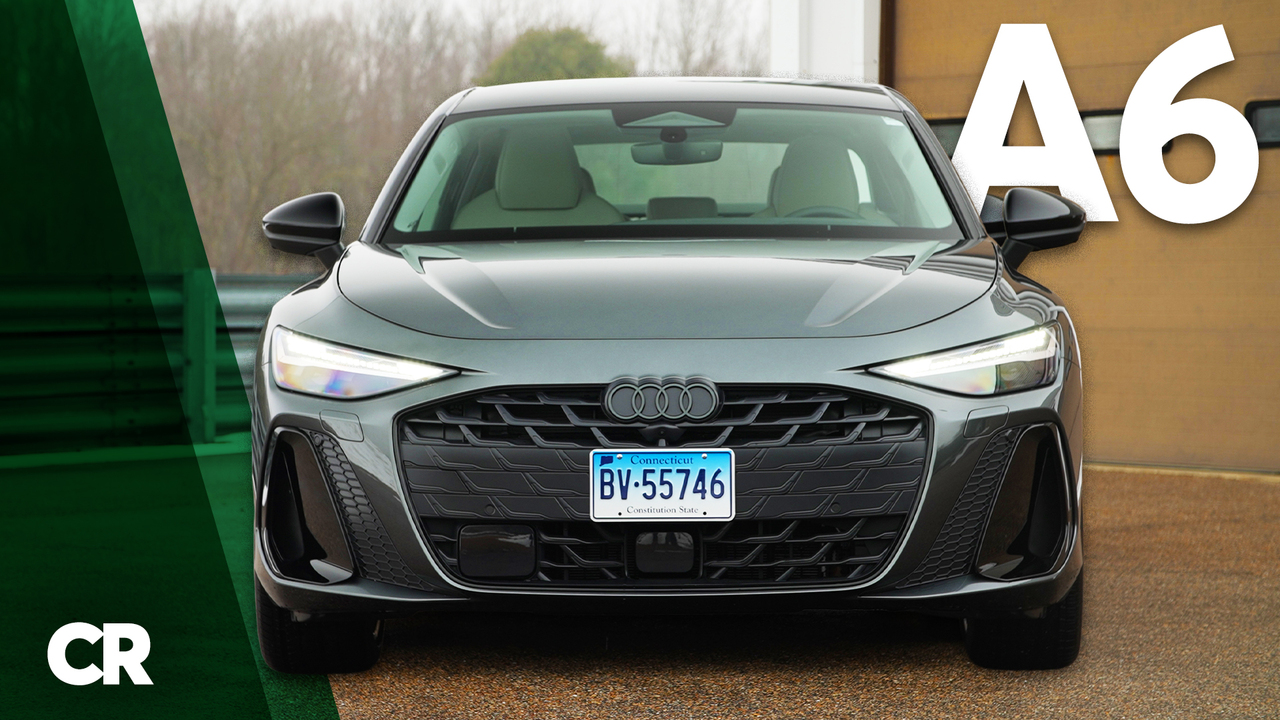


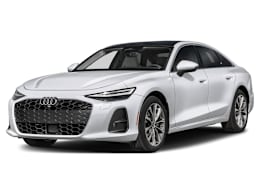
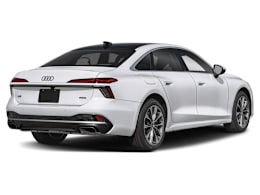
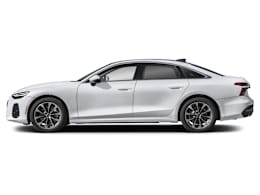
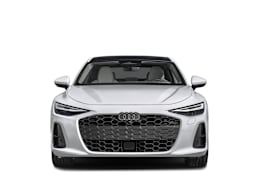
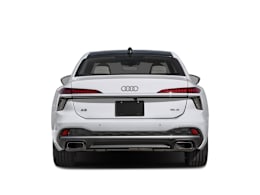
The Audi A6 competes against what automakers call “executive” sedans: cars for people who may regularly carry four adults, are comfortable spending about $70,000, and enjoy driving for its own sake. That final item may be the most important. As a sedan, the A6 delivers handling agility that buyers won’t get with a bulky SUV like Audi’s Q7.
Key Takeaways
- Standard turbocharged V6 is smooth and powerful, but thirsty
- Dual-clutch transmission brings some low-speed hiccups
- Front seats are comfortable and supportive
- Overreliance on touchscreen and capacitive-touch controls brings frustrations
- Ho-hum interior design doesn’t fit the car’s price or prestige
Road Test Review
Unlike the BMW 5 Series and Mercedes-Benz E-Class, the A6 is no longer available with a small, turbocharged four-cylinder engine. Instead, the A6 uses a 362-hp, 3.0-liter turbocharged V6 paired with a seven-speed dual-clutch automatic transmission (DCT) that sends power to all four wheels via Audi’s Quattro all-wheel drive. Despite the extra cylinders, the A6 is only a couple of thousand dollars more than the base price of the four-cylinder 5 Series, and is actually a few thousand dollars less than the four-cylinder E-Class when it’s equipped with all-wheel drive.
After our team of experts spent months compiling results from more than 50 specific tests and evaluations at Consumer Reports’ 327-acre Auto Test Center in central Connecticut, and logging lots of miles behind the wheel of the A6 on public roads, we came to two big conclusions: First, the A6 delivers a high-level driving experience, in large part due to its wonderfully smooth and powerful turbocharged V6. It also has comfortable and supportive front seats, a quiet cabin, and excellent outward visibility. It’s a superb highway cruiser that is equally capable of whipping up the pace on a winding road.
The second conclusion is that the A6 doesn’t feel special enough to stand out among its rival midsized luxury sedans, most notably the 5 Series, Genesis G80, and E-Class. It even struggles to distinguish itself from its smaller, less expensive sibling, the Audi A5.
There was a time when Audi’s strengths were all-wheel drive and stunning interiors that looked and felt a step above others. These days, the A6’s rivals all offer all-wheel drive, while Audi has seemingly lost its way in interior design. Sure, the A6’s cabin is well assembled, but there’s a lot of easy-to-scratch shiny black plastic that comes across as cheap. Further, the user experience is marred by an overreliance on touchscreens and capacitive-touch controls that are frustrating to use.
As such, some testers questioned whether the A6 looks and feels appropriately luxurious for its price. “The 5 Series and E-Class have a presence that the A6 just doesn’t possess,” said one tester. “For almost $73,000 as-tested, this car should feel a little more special.”
Others were more willing to overlook the A6’s understated personality because of how well it drives. “Some of the controls are pretty annoying, and the car’s styling is bland. But the driving experience just flat works—the power, handling, and ride are all really good, and the suspension is compliant even on rough city streets,” said a tester.
For some, those strengths were enough to win them over. “I really like the way this car drives,” said another tester. “It has plenty of power, handles well, and delivers a really good blend of luxury and sportiness.”
We bought a 2026 Audi A6 Premium Plus Quattro for $72,670—anonymously from a local dealer, as we do with every vehicle we test—for this road test review.
Driving experience
The A6 benefits from an increasingly uncommon luxury: a smooth, powerful turbocharged V6. “The engine is glorious. It’s super smooth, yet when appropriate, it delivers rapid acceleration. I’d almost forgotten what a good engine was like amid the trend toward force-fed, small-displacement, wheezy four-cylinders,” said a tester.
In fact, the sweet mill is possibly the most desirable element of the A6—the engine is that good. The abundant low-end torque (406 lb.-ft. from just 1,700 rpm) helps significantly to compensate for the occasional frustrations with the DCT gearbox. Power delivery is smooth, predictable, and potent, with no significant turbo lag. There’s plenty of low-speed grunt for pulling out into moving traffic, while highway passing or on-ramp acceleration is instantaneous. Testers were happy with the transmission’s responsiveness to part-throttle kickdowns, with the powertrain well calibrated to downshift when necessary and avoid it when it wasn't.
Our test numbers back up the extra speed that the two extra cylinders give. The A6 scooted from 0 to 60 mph in just 5.1 seconds, which makes it considerably quicker (by about 1.5 seconds) than its competitors and the smaller A5.
But as wonderful as the engine is, the dual-clutch transmission brings some unfortunate woes. Similar to the A5 and Q5 we previously tested (both equipped with a DCT), there’s some low-speed quirkiness to deal with. For example, the driver might notice that the A6 doesn’t have a natural “creep” behavior that moves the vehicle slowly without pressing the gas pedal when the brake pedal is released at parking-lot speeds, unlike most conventional automatics.
And then there are the occasional, albeit fairly minor, power delays. In certain situations, such as when stepping on the gas pedal to get going again after a rolling stop, the transmission can be slow to engage the correct gear, which results in some hesitation. “The DCT doesn’t ruin the car,” one tester said, “but it certainly doesn’t perform as well as some competitors, such as BMW’s eight-speed automatic.”
It’s also important to point out that owners will literally pay for the A6’s extra power at the gas pump. It only managed 25 mpg overall in our testing—a far cry from the 530i xDrive’s 29 mpg overall, or the E350 4Matic, which got 28 mpg overall. Both were tested with a 2.0-liter turbocharged four-cylinder engine.
Braking performance proved decent, with impressively short stops on our wet surface. Stops on our dry surface were a bit longer than those of most competitors. Out on the road, testers noted that the pedal is firm and responsive, but initial engagement can feel a bit “grabby.” Most of us got used to it, and the pedal delivers excellent confidence when slowing down from higher speeds.
“Solid handling all-around,” was how one tester described the A6’s cornering prowess. Most of us preferred the extra heft and feedback of the A6’s steering vs. the 5 Series. The effort loads up nicely and naturally through corners. Body roll is also very well controlled, and the chassis responds intuitively if the driver changes their steering angle or throttle pressure mid-corner. It did well through our avoidance maneuver exercise, which simulates swerving quickly—with a left, right, left steering sequence—to avoid a vehicle or an obstacle on the road without losing control. It managed a speed of 53 mph, which is just slightly behind the BMW and Mercedes. Our testers found its handling character forgiving at the limits, but it was held back by reduced tire grip and a late onset of the electronic stability control (ESC) system.
If you’ve ever wondered what auto journalists are referring to when they talk about a “taut, European ride,” take a drive in the A6. Its suspension feels slightly firmer than the 5 Series and E-Class, and some hard hits occasionally punch through into the cabin, but it never feels harsh. Overall, the ride is firm but well controlled, and the A6 remains reassuringly planted at higher speeds. It provides the comfort expected of a German luxury sedan while maintaining a fine ride-to-handling balance.
Most luxury sedans have quiet cabins, and the A6 is no exception. Wind noise is very well managed, with hardly any rustling noticeable up to about 75 mph on the highway. The powerful V6 stays in the background during most driving, yet when you rev it up high, it delivers a polished, slightly sporty sound. Some testers wished it delivered a more invigorating note, in fact. Slightly elevated road noise is the A6’s only real demerit, along with noticeable tire impacts over certain road imperfections.
Cabin comfort
There’s no question that the A6’s cabin should feel more special, especially at the price buyers will be paying. The quality of the materials and overall presentation are “fine,” but fine isn’t good enough. There are some cheaper plastics here and there, such as on the doors near the window controls. The center console is adorned with glossy black plastic, a surface that collects dust and fingerprints, and scratches easily. Further driving home our point, there’s an odd juxtaposition between the fancy-looking speaker grilles on the upper portion of the door panels and the boring black plastic ones lower down. At least the door pockets are free of visible mold lines or rough edges and have a grippy rubber base.
Most testers were able to find a comfortable driving position in the A6. There’s plenty of adjustment range between the seat and steering wheel, along with excellent headroom and only a small amount of center console intrusion with the driver’s right knee. The armrests are nicely padded, with the center one height-adjustable. A minor quibble is that the steering wheel can block information on the driver’s instrument screen when it’s adjusted to a lower position. Thin windshield pillars, large glass all-around, and reasonably sized rear roof pillars combine to create an airy cabin that’s fairly easy for the driver to see out of.
Nearly every tester praised the A6’s front sport seats, which isn’t always the case, given our staff’s diverse body shapes and sizes. They’re firm, like most Audi seats, but both the bottom cushion and seatback are well-shaped, with pronounced side bolsters that do an excellent job of holding the driver in place through corners. The four-way lumbar support is nicely positioned and adjusts quickly.
The rear seat isn’t as spacious as you might expect for a midsized luxury sedan, although we found it a little roomier and more comfortable than the 5 Series. Headroom will likely get tight for adults above average height, while knee space and foot room under the front seats are merely okay. The bottom cushion is a bit low, resulting in insufficient thigh support for passengers with longer legs. At least the seat padding is nicely cushioned.
The A6’s trunk is competitively sized. We fit 2 large suitcases, 2 overnight duffel bags, and 6 backpacks behind the upright second row seats. If you need extra cargo space, each rear seat, including the center section, can be folded down for added flexibility.
Controls and usability
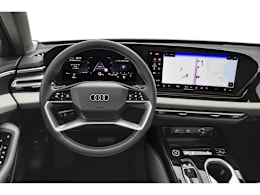
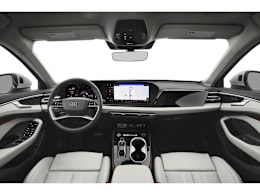
As with the A5 we previously tested, the A6 features two large screens that appear as a single unit: an 11.9-inch driver’s instrument screen and a 14.5-inch infotainment touchscreen, the right side of which curves toward the driver. The infotainment system comes across as initially overwhelming, and this isn’t helped by the fact that the touchscreen suffers from small text and inconsistent menu structures. Compounding matters is that the A6 mostly has capacitive-touch controls, with few physical knobs or buttons. As such, common tasks, like adjusting the climate system, headlights, or media, require extra attention from the driver.
We also aren’t fans of the capacitive-touch buttons on the driver’s door panel, which not only handle the usual suspects—door lock/unlock and mirror controls—but also seat memory, child lock, and headlight controls. There’s little distinction between the buttons on the panel, making them too easy to activate accidentally. This arrangement also pushes the window controls farther back on the armrest, making them awkward to access, particularly for drivers who sit closer to the steering wheel.
Phone projection (Android Auto and Apple CarPlay) is well integrated, and Audi’s built-in infotainment controls remain on the screen, making switching between systems easier. The wireless phone charging pad is the epitome of “it just works.” There’s no need to fiddle with the phone to make sure it lies just so on the grippy surface. Plop it down—even with a drop-proof case—and the phone charges, no adjustments required.
The driver’s instrument screen appears cluttered due to the number of small icons and text present. The two side sections of the screen can be “hidden” to simplify the display, but even then, the bottom section remains somewhat crowded. On the bright side, it’s straightforward to use the steering wheel controls to change the content.
Our Premium Plus test car was equipped with an “augmented reality” head-up display (HUD), which we found clear and easy to read. The HUD can be configured to project speed, navigation, driver-assist, and traffic-sign information (among other features) onto the windshield in front of the driver. Some elements of the HUD are dynamic, such as speed limit signs that “fly in” toward the driver. Several testers found these elements distracting and unnecessary. Luckily, they can be disabled.
Active safety and driver assistance
Standard active safety and driver assistance features include automatic emergency braking with pedestrian and cyclist detection, automatic emergency braking that operates at highway speeds, blind spot warning, rear cross traffic warning, reverse automatic emergency braking, lane departure warning, lane keeping assistance, adaptive cruise control, and automatic high beams.
Audi’s Adaptive Cruise Assist comes on the second-tier Premium Plus trim we tested. It gives the driver the ability to simultaneously use adaptive cruise control and lane centering assistance, with detailed map data and anonymized data collected from other vehicles. It uses radar, cameras, and ultrasonic sensors to maintain the following-gap distance to the vehicle ahead and allows the A6 to accelerate, decelerate, and stay within the travel lane at both city and highway speeds, including in traffic jams. However, the A6 does not have a direct driver monitoring system (DDMS) that alerts the driver if they look away from the road for too long.
We’re happy to see that both a rear belt minder and a rear occupant alert system (with occupant sensing) come standard on the A6. The former alerts the driver if a rear passenger unbuckles their seat belt during the trip. The rear occupant alert end-of-trip reminder system uses rear-door logic to prompt the driver to check the rear seat when they turn the A6 off, helping prevent children and pets from being unintentionally left behind in the vehicle. The occupant-sensing system takes preventive measures a step further. It scans the rear seat for motion if a rear door isn’t opened before the vehicle is locked. If motion is detected, the system will honk the horn and flash the headlights to help get the driver’s attention.