
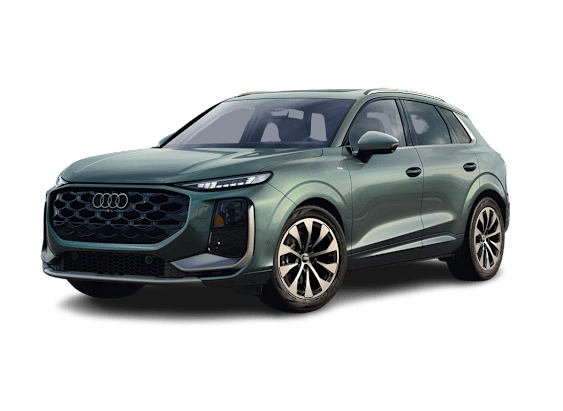
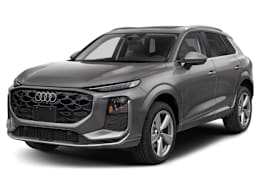
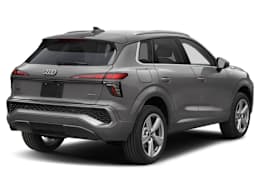
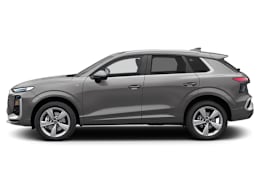
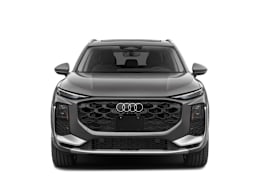
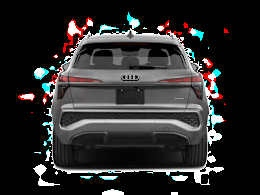
The redesigned, third-generation Audi Q3 doesn’t rock the boat too hard, and sometimes that’s a good thing. Its exterior styling is instantly recognizable as the Q5’s smaller sibling, and it has a city-friendly footprint and a reasonably comfortable ride for a subcompact luxury SUV. It also delivers agile handling, a punchy 255-hp turbocharged four-cylinder engine, and standard all-wheel drive. Unfortunately, Audi has paired the turbo-four engine with a seven-speed dual-clutch automatic transmission (DCT), vs. the conventional eight-speed automatic of the outgoing Q3. The result is some lurchy, power-delayed behavior at low speeds and occasional rough shifts that mar the overall experience.
Key Takeaways
- Strong acceleration makes the Q3 fun to drive, although its dual-clutch transmission lacks smoothness at low speeds
- Suspension strikes a decent balance between nimble handling and ride comfort
- The quiet interior features comfortable seats in both rows
- Conventional door handles and roughly hip-height seats make getting in and out a breeze
- Interior controls rely too heavily on distracting touchscreen menus and a complicated new multi-function control pod that combines turn signals, wipers, and gear selector functions
- The Q3’s luxury-brand price is hard to justify when some well-equipped mainstream SUVs offer more features and a similarly upscale experience
Road Test Review
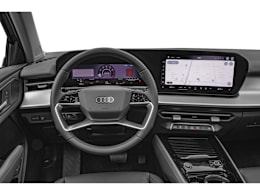
The Q3 debuts Audi’s new “Compact Command Interface,” which is a multifunction control pod behind the steering wheel that incorporates the turn signals, wiper controls, and gear selector. Many testers found it difficult to see these controls due to the pod’s location, while some were frustrated by the stubby turn-signal design and others by the unintuitive wiper controls. The Q3 is also the first Audi to receive the brand’s updated infotainment system, which features slightly simpler menus and larger, higher-contrast tiles.
After we spent months compiling results from more than 50 specific tests and evaluations at Consumer Reports’ Auto Test Center, along with lots of miles behind the wheel on public roads, our testers concluded that the Q3 is a competent small SUV. But like many entry-level luxury vehicles, it’s difficult to justify it over a top-trim mainstream model.
“It's not a bad little vehicle, but it should be a great little vehicle. Instead, it's just okay,” said one of our testers. “The clunky powertrain at low speeds is a problem, though once you get going, it works well, has decent sauce, and the engine is nicely cultured. I can deal with the newfangled turn signal apparatus, but I found the wiper controls problematic.”
“Transmission quirks aside, the Q3 drives pretty well, and I particularly like the way it handles,” said another tester. “However, I drove the Volkswagen Taos right after my time in the Q3, and it delivers similar driving satisfaction without the odd controls.”
That back-to-back comparison underscores the Q3’s value problem: The top trim of the Taos costs thousands of dollars less than the Q3 and includes several features that are added-cost options on the Audi, such as a heated steering wheel, 19-inch alloy wheels, and lane centering assistance. For the Q3’s price, you could even move up in size to a compact SUV that offers many of the same features, like the significantly more fuel-efficient Mazda CX-50 Hybrid.
Still, among subcompact luxury SUVs, the Q3 is a competitive entry. It feels more substantial than the Acura ADX, and it’s roomier and more comfortable than the Lexus UX. The BMW X1 gets better fuel economy, but it has a stiff ride, and some of our testers enjoyed driving the Q3 more.
We bought a 2026 Audi Q3 S line quattro for $48,320—anonymously from an area dealer, as we do with every vehicle we test—for the purpose of this road test review.
Driving experience
The 2.0-liter turbocharged four-cylinder engine is the strong point of the Q3’s powertrain, sending 255 hp and 273 lb.-ft. of torque to all four wheels. It delivers plenty of low-end punch and ample power on the highway, responding readily when merging into traffic or passing other vehicles.
Like most DCTs, the one in the Audi favors an aggressive driving style with a heavier foot on the throttle. But it struggles at lower speeds, for example, when creeping forward in the school drop-off line or in bumper-to-bumper traffic. Some power lag can occur when setting off from a stop, while at other times it launches forward rather abruptly. When looking for more power out on the road, downshifts often don’t come as readily as the driver would expect. On the bright side, the engine delivers strong passing power, and the DCT upshifts quickly and smoothly.
With a 0-to-60-mph time of 6.5 seconds, the Q3 isn’t just 1.3 seconds quicker than the last-gen model, but it’s also one of the quickest entry-level luxury SUVs. At 24 mpg overall in our tests, the Q3’s fuel economy falls a bit short of the X1 at 28 mpg overall and the Mercedes-Benz GLA 250 at 27 mpg. However, unlike most competitors in its class, the Q3 doesn’t require premium fuel.
The Q3’s small size and well-balanced chassis make for a nimble, fun-to-drive little SUV, regardless of whether you’re driving around town or pushing the pace on a curvy backroad. The steering is nicely weighted and does a solid job of letting the driver know how much grip the front tires have. Its 54.5-mph speed through our avoidance maneuver test—where we quickly turn left, right, and left again to simulate avoiding an obstacle on the road—puts it slightly faster than its main competitors.
The Q3 does a nice job balancing its capable handling with a comfortable ride, thanks to a generally absorbent suspension that keeps the body steady and composed. Larger impacts, such as potholes or recessed drainage grates, can firmly punch through, but they never feel too harsh.
In our panic-braking tests at our track, the Q3 took 127 feet on our dry surface and 130 feet on our wet surface to stop from 60 mph, both of which are very competitive among subcompact SUVs. However, on the road, the brake pedal can feel imprecise. When pressing down more gently, the pedal travels unusually far before the vehicle begins to slow. Yet at other times, in particular at parking lot speeds, the pedal can feel grabby.
Cabin comfort
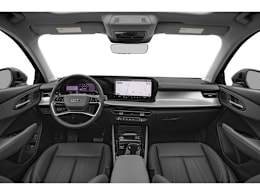
Most of the Q3’s interior panels feel high-quality, but the overall look is fairly boring, especially for a luxury model. There is a fair amount of padded and stitched surfaces, and a large swath of matte wood trim across the dashboard. We really wish the center console wasn’t adorned with glossy black plastic, though, as this material tends to collect dust and fingerprints, and scratches easily. The Q3’s interior is well-isolated from wind and road noise, and the doors shut with a solid clunk rather than the tinny sound found in some mainstream small SUVs.
Thin windshield pillars, a gap between those pillars and the side mirrors, and a straightforward view out the back make for good visibility out of the Q3. Getting into and out of the front seats was easy for most testers, thanks to conventional door handles, an easy step-in height, and wide-opening doors. We found the front seats comfortable, although the mild side bolsters don’t provide much lateral support through turns. We appreciate the wide range of steering wheel and seat adjustments, and the driver benefits from a mostly unobstructed view of the instrument display. There’s also plenty of headroom and a nicely placed and sized left footrest. Unfortunately, the center console intrudes upon the driver’s right knee space, and the armrests are placed awkwardly.
The rear seat is comfortable for the class, with generous head and foot room, a reclinable seatback, good back and underleg support, and the ability to move the seat fore and aft to adjust legroom. The bench is rather flat, though, with minimal bolstering to hold passengers in place through turns.
The rear seatbacks fold down in a 40/20/40 split, making it easier to carry longer items, such as skis, between two passengers. Attachment points for the cargo cover intrude into the storage area, limiting what we could fit with our expandable pipe-frame box to 26 cubic feet—roughly equivalent to the GLA and Volvo XC40. The space behind the upright back seat is comparable to that of other subcompact luxury SUVs. We fit 3 large suitcases, 1 overnight duffel bag, and 4 backpacks.
Controls and usability
Audi didn’t reinvent the steering wheel with the Q3 (thankfully, as unlike many new vehicles, it’s still round), but it certainly reworked what goes behind it. The Q3 debuts Audi’s new “Compact Command Interface,” which is a multifunction control pod behind the steering wheel that incorporates the turn signals, wiper controls, and gear selector. The brushed metal and piano black controls are small, thin, and somewhat slippery, and they are positioned in layers on top of one another. Many testers found it difficult to see these controls due to the pod’s location. We found the wiper controls, which are split between two buttons and an imprecise-feeling dial, particularly unintuitive.
Other controls weren’t a slam-dunk, either, including the hard-to-reach mirror adjustment knob, steering wheel control pads with capacitive-touch centers that are too easy to accidentally engage, and exterior light controls that are on a hard-to-see part of the lower dashboard. Audi’s cruise control stalk has grown larger, but still sits at the bottom left behind the steering wheel. It’s unlit at night, but at least it’s easy to use by feel once you’ve figured it out.
The Q3 is the first Audi to receive the brand’s updated infotainment system, which features slightly simpler menus and larger, higher-contrast tiles. Wireless Apple CarPlay and Android Auto are standard if you prefer a phone-style interface, and persistent icons make it easy to switch back and forth between the car’s functions and the connected phone. Unfortunately, almost all climate controls are on-screen, requiring multiple menu taps or imprecise sliders to perform basic functions like changing fan speed or the airflow mode.
Active safety and driver assistance
Standard active safety and driver assistance features include automatic emergency braking with pedestrian and cyclist detection, automatic emergency braking that operates at highway speeds, blind spot warning, rear cross traffic warning, reverse automatic emergency braking, lane departure warning, lane keeping assistance, adaptive cruise control, and automatic high beams.
Our test car was equipped with the Driver Assistance package, which adds lane centering assistance and gives the driver the ability to simultaneously use that and adaptive cruise control. Together, the two systems can help maintain a gap to the vehicle ahead while keeping the Q3 centered in its lane. In addition, Auto Lane Change can steer the Q3 into an adjacent lane when the driver activates the turn signal, and the system determines the lane is clear.
We’re happy to see that both a rear belt minder and a rear occupant alert system come standard on the Q3. The former alerts the driver if a rear passenger unbuckles their seat belt during the trip. The rear occupant alert end-of-trip reminder system uses rear-door logic to prompt the driver to check the rear seat when they turn the Q3 off, helping prevent children and pets from being unintentionally left behind in the vehicle.