Your membership has expired

The payment for your account couldn't be processed or you've canceled your account with us.

Re-activate

BMW 3 Series First Drive

Road Test Review

Introduction

2027 BMW 3 Series and Electric i3 Sedans Introduce New Look, Bold Tech

Buyers have their choice of four-cylinder or six-cylinder gas engines, or an all-electric powertrain, which is more than Audi and Mercedes-Benz offer

Overview

The BMW 3 Series gets a serious overhaul for 2027. In addition to a new look, inside and out, buyers will be able to choose between gas and electric powertrains.

Along with the iX3 SUV, the all-electric i3 will be the first vehicle to debut an entirely new underlying design, encompassing the electric powertrain, batteries, hardware, software, and pretty much everything else.

While the electric i3 is like a new-construction home, the latest gas-powered 3 Series models are more of an extensive renovation project. Beneath that revamped design, their engines and underlying technology are evolved versions of the current 3 Series models.

Power sources aside, there’s only one thing about the 3 Series that matters: Is it fun to drive? We intend to find out.

That’s why we’ll be purchasing both gas and electric 3 Series models anonymously from local dealerships as soon as they go on sale in early 2027. We’ll put them through more than 50 tests at our test track in Connecticut, and we’ll also live with them the same way that owners do in the real world.

In the meantime, this is what we know so far about the new 3 Series.

it competes with the Alfa Romeo Giulia, Audi A5, Lexus IS, Mercedes-Benz C-Class and CLA.

Powertrains are: 255-hp, 2.0-liter turbocharged four-cylinder engine and rear-wheel drive or all-wheel drive (330 and 330 xDrive); 437-hp, 3.0-liter turbocharged inline six-cylinder engine and all-wheel drive (M350 xDrive); eight-speed automatic transmission; 463-hp dual electric motors, all-wheel drive (i3 50 xDrive)

Price range for the 3 Series is $49,900-$65,900.

It goes on sale in early 2027.

The final assembly points are Munich, Germany (i3) and Dingolfing, Germany (gas).

Impressions

Outside

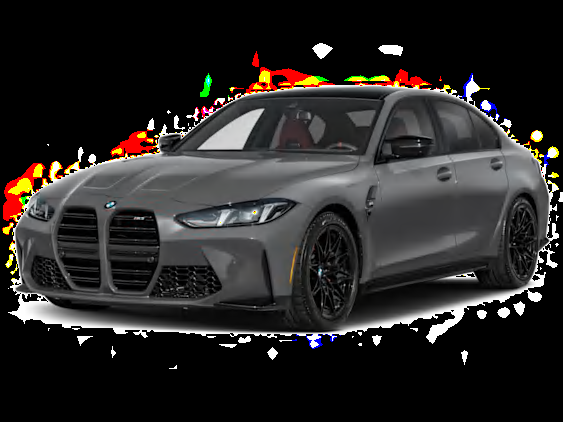
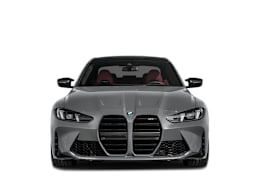
To us, the new 3 Series looks like a mashup of various BMW models, past and present, and it’s impossible to talk about them without using BMW-fan buzzwords. The side silhouette is unmistakably a 3 Series, thanks to the “Hofmeister kink”—a slight angle at the base of the passenger window named after former BMW design chief Wilhelm Hofmeister. Unfortunately, the car has automatically extending flush door handles, which we think are a needlessly complex addition to any vehicle.

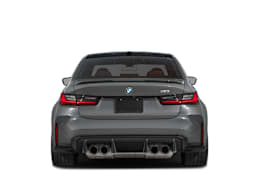
The front has a less-pronounced version of BMW’s “twin kidney” grille, but the angle is similar to the “sharknose” BMWs of the ‘60s and ‘70s, like the legendary 3.0 CSL. From the rear, it shares much of its look with the current BMW 7 Series flagship sedan. Optional lighting packages can display welcome animations on the head and tail lights.

Various M Sport trims add aerodynamic side skirts and diffusers on gas vehicles, and different light signatures on the i3.

Because they use distinct underlying designs, the gas 3 Series and electric i3 have slightly different proportions: The gas car has a tad higher ground clearance, but the roof is a little lower, while the electric car is a little wider and has a longer wheelbase.

Inside

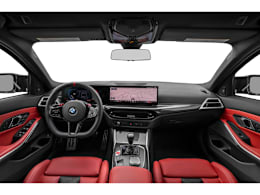
As with the iX3, the 3 Series and i3 have a dashboard that is defined by a 17.9-inch rhombus-shaped central infotainment touchscreen that BMW calls a “free-cut Central Display.” It is canted slightly toward the driver, and it allows for customized menus and widgets based on the driver’s preferences, just like your phone’s home screen. Users can also customize sounds and lights, including interior lighting.

Behind the center-dash infotainment screen is a long, horizontal display at the base of the windshield for BMW’s new Panoramic Vision iDrive system. It’s also a throwback to the wide, thin dashboards of older BMWs, and it isn’t a screen. Rather, it’s a single black printed surface onto which customizable information is projected. It sits closer than where a head-up display would typically appear, although BMW also offers an optional 3D head-up display that can augment navigation with moving arrows and relevant data.

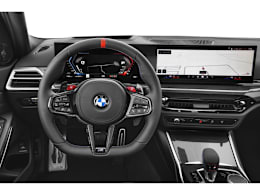
There’s no traditional gauge cluster. Steering wheel controls illuminate only when relevant, and infotainment controls provide haptic feedback. The whole setup looks very touchscreen-heavy, so we’ll be interested to see if it takes drivers’ eyes off the road while in use. BMW says an Amazon Alexa-powered AI voice assistant can also control various functions, including the windows and seats, with natural speech.

A large panoramic sunroof is standard. Options include massaging seats, three-zone climate control, an upgraded sound system with Dolby Atmos, and leather upholstery. BMW hasn’t made any legroom measurements available yet, but the rear seat looks tight. Headroom and elbow room are improved for all occupants.

What Drives It

Dodge, Mini, and Toyota already offer buyers a choice between gas and electric versions of very similar vehicles. Now, it’s BMW’s turn.

At launch, the gas-powered 3 Series comes in two trim levels, both of which have a 48-volt mild hybrid setup and twin-scroll superchargers:

  • At the top of the line is the M350 xDrive, which has a 3.0-liter turbocharged inline six-cylinder gas engine that is good for 437 hp and 428 lb.-ft. of torque, which is a huge bump from the current M340i xDrive’s 386 hp. (Yes, BMW dropped the “i” from its gas-powered vehicles.) It has a conventional eight-speed automatic transmission and all-wheel drive, and BMW says it can accelerate from 0 to 60 mph in 3.9 seconds.
  • The 330 and 330 xDrive are both powered by a 2.0-liter turbocharged four-cylinder engine rated at 255 hp and 295 lb.-ft. of torque, same as the outgoing model. As its name suggests, the 330 xDrive has all-wheel drive, while the 330 is rear-wheel drive. Both can accelerate from 0 to 60 mph in 5.9 seconds, according to BMW.


BMW says it has upgraded the 3 Series’ steering, suspension, and chassis technology for better ride quality and sharper handling. Adaptive suspensions and sport steering are available.

The i3 also has two trim levels: The i3 50 xDrive uses dual electric motors for all-wheel drive. It’s rated at 463 hp and 476 lb.-ft. of torque, and has a BMW-estimated EPA driving range of between 446 and 468 miles between charges. There aren’t any details about the more powerful i3 M60 xDrive, which goes on sale in 2027. The automaker claims 800-volt charging allows drivers to add around 200 miles of range in 10 minutes at a compatible public DC fast charger.

Safety and Driver Assistance Systems

The 3 Series and i3 come standard with blind spot warning (BSW) and rear cross traffic warning (RCTW) with rear automatic emergency braking (RAEB). An exit warning feature can prevent occupants from opening doors in the path of oncoming cyclists. Additional driver and parking assistance functions can be downloaded from the BMW ConnectedDrive Store.

Adaptive cruise control (ACC) with stop and go and lane centering assistance (LCA) can work together as part of BMW’s Driving Assistant Plus feature. The 3 Series also debuts a new feature called Symbiotic Drive. It’s what Consumer Reports and others call “collaborative.” When enabled, it will help maintain the car within lane lines or keep a set speed or distance, but it will not disconnect if the driver adjusts the steering wheel or speed. BMW says the Panoramic View iDrive system will clearly display which driving assistance features are activated.

Change Vehicle