
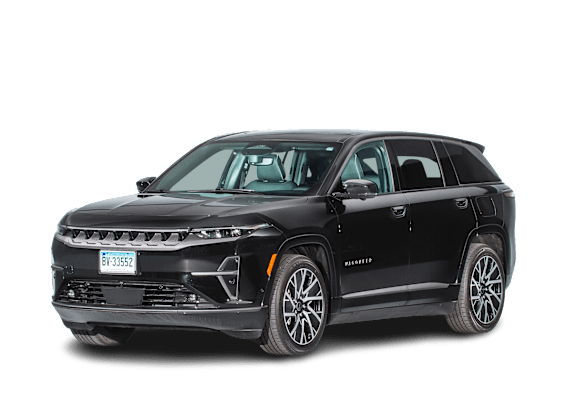
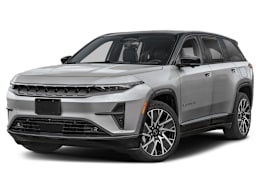
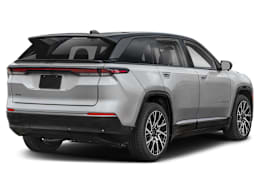
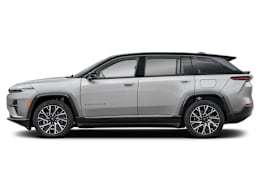
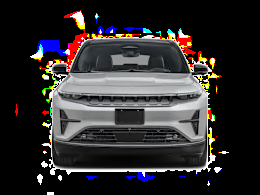
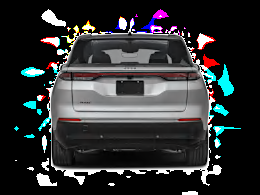
The Wagoneer S is Jeep’s first all-electric vehicle, following the plug-in hybrid electric vehicle (PHEV) versions of the Grand Cherokee and Wrangler. Although it bears a Wagoneer badge, which is also the name of Jeep’s large three-row gas-powered SUV, the S is a two-row SUV that’s much closer in size to the Grand Cherokee.
The specifications sheet includes some impressive numbers, such as a prodigious 500 hp and 524 lb.-ft. of torque. It also has a decent estimated driving range of 294 miles, according to the Environmental Protection Agency (EPA). The Wagoneer S managed 293 miles in our 70-mph highway-range test. All-wheel drive is standard.
But while the idea of an all-electric Jeep looks good on paper, it doesn’t translate into a vehicle we’d actually like to own. Yes, it’s quite quick, has a mostly comfortable ride, and a quiet cabin. But the Wagoneer S’ everyday livability is hampered by its unrefined powertrain, excessive torque steer during hard acceleration, vague steering, a grabby brake pedal, and complicated controls.
As one of our testers said, “I can't think of a single reason to buy this vehicle. For $68,000, you get annoying controls and a convoluted infotainment system, along with throttle tuning that’s as difficult to control as an RC car from Walmart.”
Jeep Wagoneer S at a Glance
- Quite quick for such a hefty vehicle
- Struggles mightily to corral all of its power, exhibiting excessive torque steer
- Comfortable ride and a quiet cabin
- Many of the controls are a nightmare and may be a deal-breaker for some buyers
- Cabin appointments don’t live up to the price
We conduct more than 50 individual tests and evaluations on every vehicle we purchase at Consumer Reports’ 327-acre Auto Test Center in rural central Connecticut. Our testers also log thousands of miles on public roads over several months. After we tallied up the results of the thoroughly underwhelming Wagoneer S, its road-test score proved to be one of the lowest we’ve given to an EV SUV.
The Wagoneer S is behind its competition in nearly every way, without an advantage or clear reason to buy it over any other two-row mainstream EV SUV. And it’s nowhere near the level of most luxury EV SUVs. In short, Jeep is charging way too high of a price for a vehicle that simply doesn’t drive well.
“This vehicle is full of lag, and likely full of regret for buyers,” said a tester. “The accelerator pedal lags when I press it. The infotainment system lags when I touch it. Even the gear selector seems to hang behind as I flip it from Park to Reverse or Drive. Then there’s the power delivery; the torque steer is so bad—I can’t remember the last time I had to fight a car this hard to drive in a straight line.”
Another tester said that the Wagoneer S seems “dead on arrival” compared to its competitors. “It’s a Wagoneer in name only, in an attempt to justify the price. It feels like I could be sitting in the interior of a Grand Cherokee that costs around $50,000." Unquestionably, you can get much better EVs for about $20,000 less.
We bought a 2025 Jeep Wagoneer S Limited 4xe for $67,790—anonymously from an area dealer, as we do with every vehicle we test—for the purpose of this road test review. Our Wagoneer S was assembled in Toluca, Mexico.
Driving experience
It’s not exactly a shocking development that the automaker (Stellantis) known for stuffing Hemi V8s into nearly every product in its portfolio (we’re still waiting for a Hemi in the Chrysler Pacifica minivan) would develop an EV with formidable power. The Limited trim we tested has plenty of oomph thanks to the 500 hp generated by its front and rear electric motors, which give it all-wheel drive. This results in incredibly quick acceleration from the nearly three-ton SUV—the Jeep blasts from 0 to 60 mph in 4 seconds flat, which is quick even among EVs.
But considering tire maker Pirelli’s famous ad line—“Power is nothing without control”—we soon found out that the Wagoneer S’ 500 hp is of little use if it can’t be efficiently (or even adequately) transferred to the road. Power delivery is clunky at low speeds and poorly managed during rapid acceleration. When accelerating from a stop, there’s an initial power lag, and the driver generally reacts by pressing down harder on the throttle pedal. This often causes the SUV to launch ahead with abrupt, brute force, often accompanied by excessive front wheelspin (in spite of its all-wheel drive). We also experienced significant torque steer when accelerating hard in a straight line, as the steering wheel tugged back and forth in our hands.
In normal driving, the Wagoneer S goes through corners just fine. But if you pick up the pace on a curvy road, or take a highway on- or off-ramp with some gusto, the car loses its composure quickly. The steering turns into corners with some quickness, but it suffers from a vague feel. Further, the SUV starts to lean over considerably when it’s driven relatively hard, and it can feel disconcertingly floaty over undulations at higher speeds.
Bump absorption, at least, is quite good. The Wagoneer S’ suspension is adept at filtering out impacts from potholes and drainage grates. “The ride is easily one of my favorite things about this vehicle,” said a tester.
The cabin also stays relatively quiet, thanks to very little high-pitched electric motor whine and well-controlled wind and road noise.
Stopping distances proved disappointingly long, however, especially on our wet surface. Further, most testers didn’t like the feel of the Wagoneer S’ brakes. The pedal delivers a softness out on the road that doesn’t lend confidence, while the brakes can be annoyingly touchy or “grabby” at low speeds, making it difficult to stop smoothly.
Cabin comfort
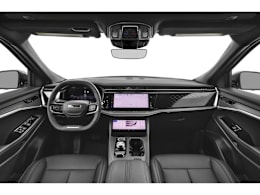
The Wagoneer S’ interior fit and finish was generally assessed as okay, but not quite up to the price Jeep is charging customers. Some strengths that testers mentioned were the nicely lined bins and cubbies, the well-padded door panels and windowsills, the chrome and glossy black trim on the window switches, and the contrasting stitching throughout the cabin. But none of us found that the interior matched the standards expected in a $68,000 vehicle.
The driving position was praised for its headroom and nicely-placed and padded armrests. But several testers found that the wide center console hemmed in their right knee, making them feel cramped. Opinions on the front and rear seats ranged from good to merely acceptable. While the front seats’ padding proved comfortable, some testers found the bottom cushion bolsters too narrow, making them feel more like they were sitting “on” them rather than sitting between them. Another tester said the upper portion of the seatback felt lumpy. Rear-seat passengers benefit from good headroom and ample foot space under the front seats. But the bottom cushion is oddly low to the floor, which results in a lack of underleg support.
The space behind the rear seats is very long, making it great for transporting several bags or larger items. However, due to the rear window's slope, the maximum cargo volume with the rear seats folded down isn’t particularly impressive. Then again, at least the Wagoneer S, like some other EVs, has a front trunk or “frunk,” which can hold two backpacks.
Controls and usability
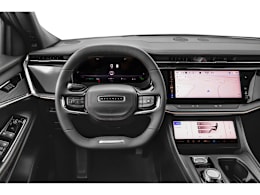
The Wagoneer S carries over many familiar Stellantis interface elements, combining the Uconnect 5 infotainment menu structure with a mix of physical and capacitive-touch controls. Two screens dominate the center dashboard area, with a lower screen dedicated to climate controls that can be pushed upward to reveal a storage cubby. Unfortunately, dense menus with small text and closely spaced buttons require precise inputs. Testers also experienced lag when scrolling through lists or making rapid selections, and the capacitive-touch buttons embedded in the screen frame were often unresponsive, contributing to higher error rates. The sheer number of features and lists within the center screen creates a steep learning curve.
We were frustrated by the lack of EV charging status information when the Wagoneer S was plugged in. We were also annoyed that the only way to adjust the regenerative braking performance is to go into the center screen and toggle between the two available modes.
On a positive note, the driver’s instrument screen presents information in a clean, well-organized layout. And the wireless charger is conveniently located and has an “in use” indicator light that is easy to see from the driver’s seat. The conventional steering wheel buttons are easy to use, and it’s nice that Jeep has a power button to turn the SUV on and off (some EVs don’t).
Active safety and driver assistance
Standard active safety and driver assistance features include automatic emergency braking with pedestrian and cyclist detection, automatic emergency braking that operates at highway speeds, blind spot warning, rear cross traffic warning, reverse automatic emergency braking, lane centering assistance, lane departure warning, lane keeping assistance, adaptive cruise control, and automatic high beams.
We’re happy to see that a rear occupant alert system is standard, but we’re disappointed that a belt minder is not. The former is designed to remind the driver—based on rear-door logic—to check the rear seat when the Wagoneer S is turned off, helping prevent children and pets from being unintentionally left behind in the vehicle. Belt minders alert the driver if a rear passenger unbuckles their seat belt during the trip.