
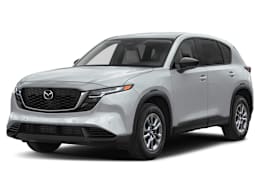
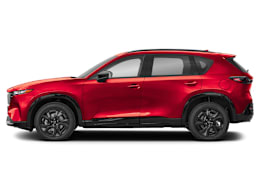

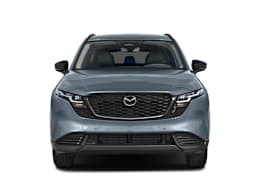
The third-generation Mazda CX-5 is aimed at a broader audience than its predecessor. It’s larger and heavier than before, with most of the growth in the wheelbase, which is 4.5 inches longer. This gives it a roomier, more adult-friendly rear seat. It also has a softer, more comfortable ride, extra tech-forward features, and a larger central display screen. Some of those upgrades may expand its mass-market appeal, but they also come with some downsides.
For example, the CX-5 no longer has the class-leading handling it was once known for. The new model’s interior quality, while average for the class, also isn’t a standout feature anymore. Further, nearly all of the CX-5’s controls have been moved onto a central infotainment screen that’s difficult to use while driving.
“Mazda took some of the defining characteristics of the CX-5, such as its sharp handling and interior quality, and reduced them to the point where the car no longer stands out,” said one tester. “To make it worse, they are jumping on the all-touchscreen trend right as it's beginning to fall out of favor within the industry.”
Mazda CX-5 at a Glance
- The CX-5 trades some of its sporty appeal for a softer ride, but still offers good handling for a small SUV
- Roomier, more adult-friendly rear seat
- Confusing, distracting controls make us long for the last-gen CX-5
- Noisy engine lacks power at highway speeds
- Interior quality is a disappointing downgrade compared to the previous CX-5
After our testers spent months compiling results from more than 50 specific tests and evaluations at Consumer Reports’ 327-acre Auto Test Center in Connecticut, along with many miles behind the wheel on public roads, the new CX-5’s mass-market makeover failed to win us over. As such, we think there’s less of a solid case for choosing the CX-5 over several other, well-rounded small SUVs on sale today.
“I literally recommended to a friend who currently has a Mazda3 to just buy the previous CX-5, rather than go for the new one,” a tester said.
“The good news is that the ride is fairly comfortable. The seats aren’t as rock-hard as those in the CX-50, and it still handles pretty well,” said another tester. “But the elimination of so many physical controls in favor of the big touchscreen is such a step backward in usability that I couldn't focus on the basics of driving because I was constantly fiddling with something on the screen, whether it was the climate or ADAS settings, or what volume the stereo was set to.”
“It feels like a diluted version of the previous model, in both driving dynamics and cabin quality,” said another tester. “The steering isn’t as sharp, the suspension isn’t as taut, and many of the soft-touch interior panels are now hard plastic. At the same time, it's fairly quiet and rides comfortably for the class. While it’s not as fun or engaging to drive as before, it’s likely a better vehicle for more people in some key ways.”
We bought a 2026 Mazda CX-5 2.5 S Preferred for $36,510—anonymously from an area dealer, as we do with every vehicle we test—for the purpose of this road test review. We also borrowed a top-trim CX-5 2.5 S Premium Plus ($41,080 as driven) from Mazda, which helped us compare the available options for this road test. Both CX-5s were assembled in Hiroshima, Japan.
Driving experience
The last-generation CX-5 focused more on driving excitement. The new CX-5 smartly balances above-average handling among its small-SUV peers with a softer, more comfort-oriented suspension. It does a better job of preventing the harshness of hitting a pothole or pavement seam from punching into the cabin than its predecessor. It handles mid-corner bumps nicely, too, keeping the rear of the SUV stable.
Even with the softer ride, the CX-5 still has a more eager and nimble handling feel through corners than most of its competitors. It may have lost a little of Mazda’s traditional sporty character, in part due to a lighter steering effort, but it still has strong grip when diving into a corner. Testers found that it was easy and drama-free to adjust their driving line mid-corner without upsetting the SUV.
Straightline performance clearly wasn’t a priority, though. Mazda kept the 187-hp, 2.5-liter naturally aspirated four-cylinder engine and six-speed automatic transmission from the previous-generation CX-5. (The more powerful turbo engine was dropped, but a Mazda-built hybrid is on the horizon.) It’s not a complete carryover, though; Mazda made a few adjustments, such as tuning the transmission to downshift more quickly in certain situations.
Even so, the power is at best adequate, bordering on insufficient. The engine feels—and sounds—somewhat strained in the new CX-5’s slightly bigger, heavier body when the driver is looking for a burst of acceleration, and this was borne out in our testing. The new CX-5 needed 9 seconds to reach 60 mph from a standstill, almost a half-second slower than the previous model.
On the positive side, the power comes on linearly rather than surging unexpectedly, as with some vehicles. Plus, its fuel economy is on a par with other nonhybrid compact SUVs, with our CX-5 getting 26 mpg overall in Consumer Reports’ tests. Still, between the much more frugal numbers we’ve seen in hybrid SUVs and the occasionally rough upshifts in lower gears, Mazda’s promised hybrid version of the CX-5 can’t come soon enough.
Like its suspension, the CX-5’s brake pedal is a bit softer than the last generation’s, but it remains easy to modulate, delivering fairly predictable, linear braking force. The SUV managed short, consistent stops in our dry emergency braking tests, but stops on our wet surface were on the long side.
Cabin comfort
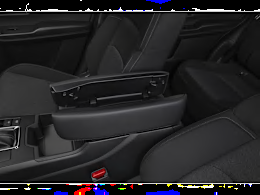
The CX-5’s cabin looks fairly sharp, but the quality of the materials is disappointing. Whereas the previous-generation CX-5’s interior was nearly as nice as those found in luxury models, the new CX-5 has numerous hard plastic and thinly padded surfaces that make it feel merely average in the compact SUV class.
Hop into the front seats, and it’s obvious that Mazda de-sported them, as well, with notably less prominent side bolsters than before. While this makes it easy to slide into and out of the vehicle, the seats don’t hold occupants in place as well through turns. Our testers’ opinions on actual comfort were mixed, with some finding them “fine” and others saying they were too firm.
The power driver’s seat in our 2.5 S Preferred offers a nice range of adjustability, enabling most of our testers to find a comfortable driving position. Even drivers who prefer to tilt the steering wheel down found an unobstructed view of the instrument screen. Forward visibility is pretty airy thanks to the CX-5's slim windshield pillars, but, as with many small SUVs, the thick rear pillars create challenging rear three-quarter blind spots.
Thanks to the CX-5’s longer wheelbase, Mazda was able to give the CX-5 a roomier back seat. There’s more rear legroom than in the previous model, a welcome change for adult passengers. There’s also lots of headroom and good foot space underneath the front seats. While thigh support is adequate, longer-legged passengers will likely wish the seat were higher off the floor.
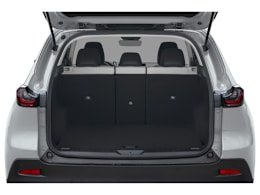
The CX-5 has a spacious cargo area, with an easily accessible floor height, and a power liftgate in our test car. We were able to fit 4 large suitcases and 4 backpacks behind the rear seat. Fold the rear seat down, and we measured 35 cubic feet of space, which is competitive among other small SUVs.
Controls and usability
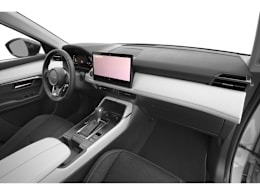
The CX-5 debuts Mazda’s new touchscreen-centric controls, which are a giant step backward—there’s no other way to put it. The automaker removed nearly every physical control, making even common tasks more difficult and distracting than with the last generation’s buttons. All audio and most climate controls have been moved to the touchscreen. There isn’t even a volume knob.
Further, the infotainment system is confusingly laid out, cluttered, and some functions are too small to see at a glance. Many simple tasks, such as adjusting the fan speed, require multiple taps on the screen. The physical steering wheel controls are harder to use as well, with two flat, tilting panels on each side that can be difficult to press with precision without looking down at the wheel.
Not all is lost: there are still some physical controls in the CX-5’s interior, including steering-wheel stalks for safety-related features such as turn signals, headlights, and wipers. Still, buyers who expect this Mazda to be as easy to use as the company’s other models will be disappointed.
Active safety and driver assistance
All CX-5 trims come standard with automatic emergency braking with pedestrian and cyclist detection, blind spot warning, rear cross traffic warning, reverse automatic emergency braking, lane departure warning, lane keeping assistance, adaptive cruise control, and automatic high beams.
The top-trim 2.5 S Premium Plus features a Level 2 active driving assistance system called Cruising and Traffic Support, which adds lane centering assistance. It uses a driver-monitoring camera to determine whether the driver is looking forward and paying attention to the road, and facilitates assisted lane changes when the driver uses the turn signal. The system includes Unresponsive Driver Support, which will bring the car to a stop if the driver does not respond to the monitoring system's prompts.
A rear occupant alert system also comes standard. It’s designed to remind the driver—based on rear-door logic—to check the rear seat when the CX-5 is turned off, helping prevent children and pets from suffering heatstroke or hypothermia if unintentionally left behind in the vehicle. There’s also a rear belt minder that alerts the driver if a rear-seat passenger unbuckles their seat belt during the trip.