
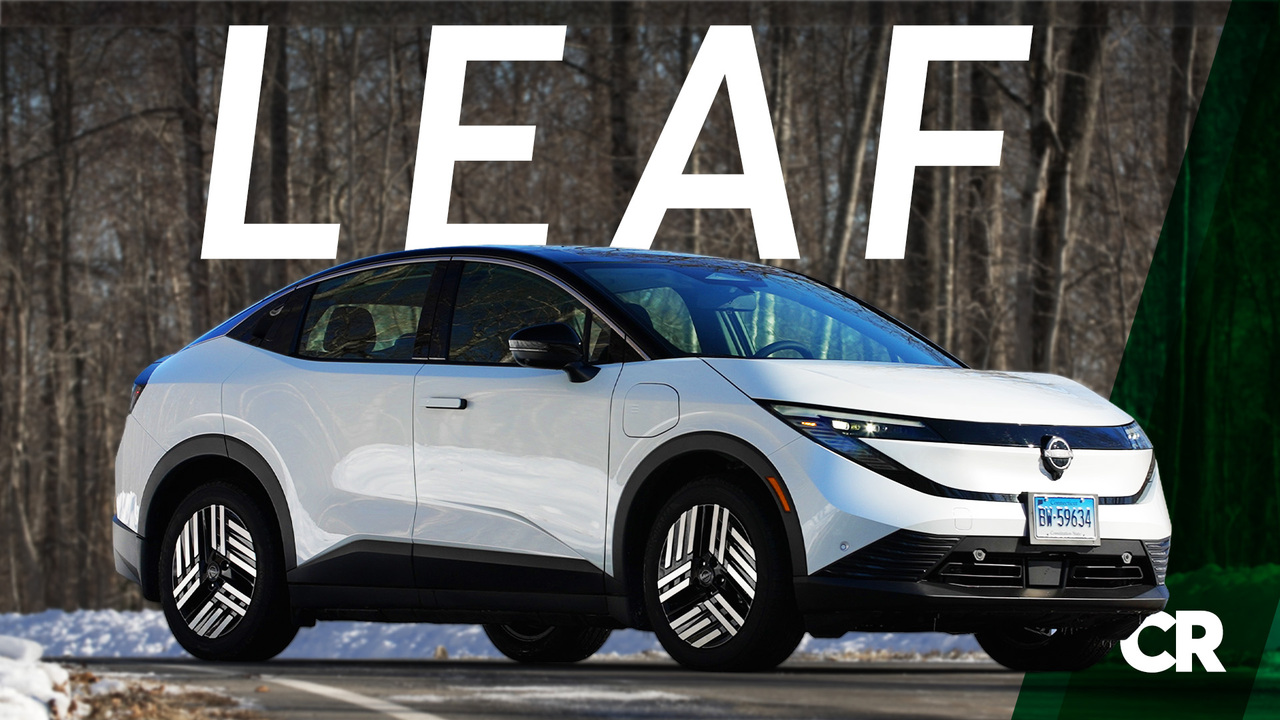


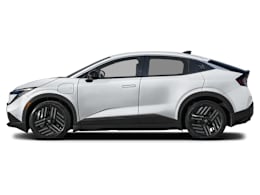

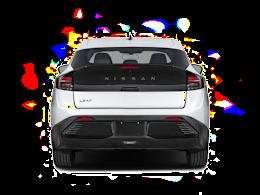
The redesigned Leaf electric vehicle finally has enough driving range to be more than just a commuter car: between 259 and 303 miles, per the EPA, depending on the trim level. Nissan also replaced the Leaf's slow and outdated CHAdeMO plug with convenient dual charging ports. One is a Tesla-style North American Charging System (NACS) port, making it compatible with many more public DC fast chargers. While its 150-kilowatt maximum DC charging speed is far from the fastest out there, that's three times the speed offered by the old Leaf. The other J1772 port is used for AC charging, such as on a home-charging system.
But while Nissan made some notable improvements and fixed many of the previous generation's most glaring issues, in some ways the new Leaf feels like "two steps forward, one step back." That's because Nissan created another glaring problem with the car's much less intuitive controls that are distracting to use while driving.
Nissan Leaf at a Glance
- One of the least expensive new EVs, yet it doesn’t feel like it
- A longer 259-to-303-mile driving range, a more standardized DC fast-charging port, and excellent route-planning features make the Leaf (finally) ready for a road trip
- Confident handling, improved ride quality, and smooth, instant power make the Leaf reasonably fun to drive
- New interior controls rely heavily on touchscreen menus and slick, capacitive-touch panels that are distracting to use while driving
- Braking is a letdown on multiple fronts: both for its soft brake pedal feel and the lack of a true one-pedal driving mode
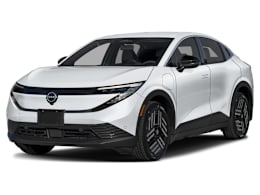
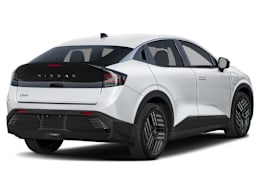
Despite its taller stance, the third-generation Leaf carries nearly identical dimensions to the outgoing car. The exterior features a fastback roofline meant to mimic the current Nissan Z sports car. The 214-hp, front-wheel-drive Leaf can be surprisingly fun to drive, with smooth, instant power, and predictable handling. The ride quality, in particular, is a night-and-day improvement over the previous Leaf, the suspension of which was stiff and caused occupants to feel every bump. Comfortable front seats further bolster the Leaf's appeal for both daily driving and longer trips.
After we spent months compiling results from more than 50 specific tests and evaluations at Consumer Reports’ 327-acre Auto Test Center in central Connecticut, along with lots of miles behind the wheel on public roads, we were left with mixed feelings about the Leaf’s rework. While not every change was for the better, overall, it’s a decent option for those shopping for an inexpensive EV.
“A solid offering for one of the cheapest new EVs for sale,” said one of our testers. “It feels small and somewhat nimble, the powertrain is super smooth, and it’s relatively fun to drive. Even in the more mainstream SV+ trim we tested, it feels like you’re getting a decent amount for your money.”
“This is a pretty easy-to-live-with EV (except for the push-button gear selector and some controls) that has a decent ride/handling mix and a smooth and well-tuned powertrain. The driving range isn't super competitive, but considering the entry price, it's not bad, and the dual charging ports are very convenient,” said another tester.
“I enjoy the strong power, but being front-wheel drive, it overwhelms the tires easily. The front seats are on the narrow side for me, and the too-low and too-hard armrests aren't the best for longer drives,” countered another tester.
We bought a 2026 Nissan Leaf SV+ for $37,760—anonymously from an area dealership, as we do with every vehicle we test—for the purpose of this road-test review. We also borrowed a top-trim Leaf Platinum+ ($41,930 as spec’d) from Nissan, which helped us compare some of the options for this road test evaluation. Both Leafs were assembled in Tochigi, Japan.
Driving experience
While the headline to the new Leaf’s story might be the massive jump in driving range, the car’s generally pleasant character is the most important chapter. The single-motor powertrain is quiet and smooth, and its well-balanced chassis offers predictable, easy-to-control handling.
All 214 hp and 261 lb.-ft. of torque goes to the front wheels, which can cause some wheelspin and torque steer if you step on the accelerator pedal too aggressively, such as when pulling out onto a fast-moving road. Luckily, the car’s traction control system does a good job keeping things from getting too out of line. And, the car is pretty quick, capable of zipping from 0 to 60 mph in 7 seconds in our testing.
Similar to other EVs, the Leaf has a regenerative braking system that slows the vehicle when you release the accelerator pedal, recouping energy that is sent back to the battery. However, unlike many EVs, the Leaf lacks a true “one-pedal driving” mode that lets the driver slow the vehicle significantly by releasing pressure on the accelerator pedal, without needing to touch the brake pedal to come to a stop. In its place is a strange “e-Step” feature that slows the car so forcefully that it’s hard to drive smoothly, yet it’s still not designed to bring the car to a complete halt.
Also not helping matters is that the regular brake pedal feels odd. There’s a significant dead zone when you first step down on it, where the car barely slows down at all. While we got used to it over time, the soft brake pedal doesn’t inspire confidence. Further, the Leaf performed mediocre in our panic-braking tests, both in the dry and the wet.
Our test car has an EPA-estimated 288-mile driving range, a huge improvement over the previous generation Leaf, and a figure that makes it much more competitive within the current EV climate. In our 70-mph highway-range test, the Leaf beat its EPA rating and managed 292 miles before rolling to a stop. When it's time to replenish the 75-kilowatt-hour battery, the Leaf’s 7.2 kW onboard charger adds about 24 miles of range per hour on a Level 2 home-charging system. The maximum acceptance rate at public DC fast chargers has increased from 50 kW to 150. That’s still on the slow side, but it should add about 8 miles of range per minute.
Push the Leaf on a twisty road, and it can be kind of fun to drive. The steering turns in with some quickness, and body roll stays nicely controlled at lower speeds, which makes it feel mildly sporty. We wish there were more steering feel, however, because it’s muted to the point that it’s hard to tell what the front tires are doing.
The new Leaf’s ride quality is a night-and-day difference from the last Leaf, which was stiff and spine-rattling. Now it errs more on the soft but absorbent side, soaking up all but the harshest bumps. It’s not perfect, though, as multiple bumps in a row can cause some front-to-rear pitching sensations, along with floatiness on uneven surfaces.
Cabin comfort
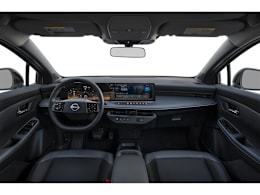
The Leaf’s cabin gives the impression that it’s a more expensive car than it really is, especially in the highest trim level. The Platinum+ model we borrowed from Nissan had an eye-catching two-tone interior with soft surfaces galore, although we noticed a steep increase in hard plastic on our tested Leaf SV+.
The front seats are supportive and well-bolstered without being too aggressive for everyday driving. Unfortunately, some awkward ergonomics can make it difficult to find an ideal driving position. For example, several testers said they felt too high, even with the driver’s seat at its lowest setting. The thinly padded front armrests also proved uncomfortable, and a strange raised floor eats into the front passenger-side footwell. The rear seat has limited knee, foot, and headroom, and the low bottom cushion results in very little underleg support.
The Leaf is small inside, and its trendy sloping roofline epitomizes style over substance. Taller occupants have to duck around it while making a somewhat tall step up into the Leaf, and it eats into passenger headroom and cargo space. Despite this and the lack of a front trunk (or “frunk” for short), the Leaf has a pretty roomy cargo area. Consumer Reports’ testers fit 2 large suitcases, 2 overnight duffel bags, and 2 backpacks behind the rear seat.
Controls and usability
Using the Leaf, for the most part, is a fairly normal-feeling experience. It lacks many of the extra design flourishes and quirks automakers include—often to their detriment— to emphasize that they’re EVs. Hop inside, and it’s more akin to being in a shrunken Nissan Murano than a budget knock-off of a Tesla or Lucid.
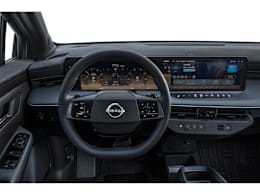
Unfortunately, “normal” in 2026 is still a step back in terms of usability from the previous-generation Leaf’s simple-to-use array of physical buttons and knobs. Nissan moved many of the new car’s basic functions onto capacitive-touch panels and on-screen controls that take the driver’s attention away from the road.
Our tested Leaf SV+ features dual 14.3-inch displays—one for the driver’s instrument screen and one for the center infotainment screen. Even though there’s a lot of room on the screens, some of the text and icons lack the contrast to stand out at a glance from the driver’s seat. There’s also a brief but noticeable amount of lag in the system, which makes an already challenging interface that much more frustrating to live with.
At least the Leaf still has conventional steering-wheel stalks for the turn signals, headlights, and wipers. And the audio volume knob is fairly good-sized and centrally located on the dashboard.
The Leaf’s route-planning guidance is a highlight, designed to make longer trips as easy as possible by integrating charging stops directly into navigation directions based on range estimates. This navigation system is the standout feature of the Leaf’s Google Built-In infotainment system, offering numerous filter options for charging stops, charger availability data, network and speed information, and the ability to set a preferred minimum state of charge for when you arrive at your destination.
Active safety and driver assistance
Standard active safety and driver assistance features on the Leaf include automatic emergency braking with pedestrian detection, automatic emergency braking that operates at highway speeds, blind spot warning, rear cross traffic warning, reverse automatic emergency braking, lane centering assistance, lane departure warning, lane keeping assistance, adaptive cruise control, and automatic high beams. All versions come standard with the ProPilot Assist active driving assistance system, which enables the simultaneous use of adaptive cruise control and lane centering assistance.
A rear occupant alert system comes standard on the Leaf. It’s designed to remind the driver—based on rear-door logic—to check the rear seat when the Leaf is turned off to help prevent children and pets from suffering heatstroke or hypothermia if unintentionally left behind in the vehicle. There’s also a standard rear belt minder, which alerts the driver if a rear passenger unbuckles their seat belt during the trip.