Your membership has expired

The payment for your account couldn't be processed or you've canceled your account with us.

Re-activate

Save products you love, products you own and much more!

Save products icon

Other Membership Benefits:

Savings icon Exclusive Deals for Members Best time to buy icon Best Time to Buy Products Recall tracker icon Recall & Safety Alerts TV screen optimizer icon TV Screen Optimizer and more

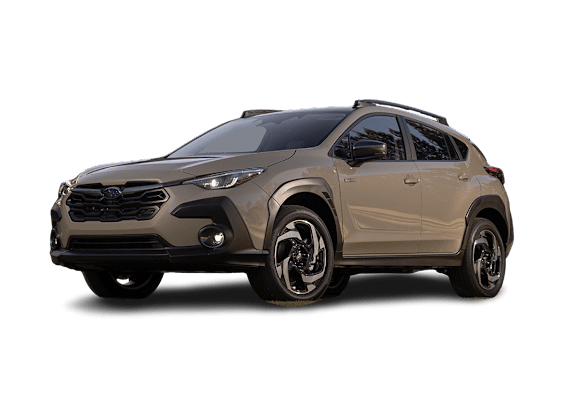
    Subaru Crosstrek Hybrid

    EPA MPG: 36 mpg

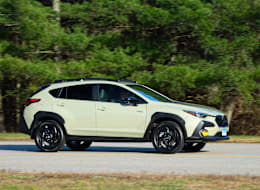
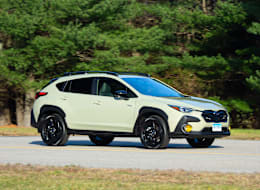
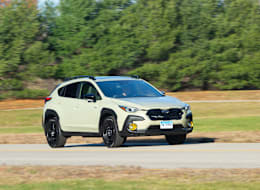
    Subaru Crosstrek Hybrid First Drive

    Summary

    Introduction

    The 2026 Subaru Crosstrek Hybrid Delivers Pricey Improvements

    A hybrid powertrain suits this subcompact Subaru, but you’ll pay for the privilege

    Overview

    Here at Consumer Reports, we’re fans of the Subaru Crosstrek, and we’re also fans of hybrids. You might assume, then, that the arrival of a Subaru Crosstrek Hybrid at our Auto Test Center would be cause for celebration, the CR equivalent of Opening Day, a new GTA release, and a Beyoncé album drop all rolled into one. We’d step away from our spreadsheets, open a bottle of CR’s top-rated dealcoholized sparkling wine, set fire to a copy of last year’s Autos issue, and dance around the skidpad until the sun came up.

    In reality, though, our reaction to the Crosstrek Hybrid was more muted. While the hybrid treatment benefits an already great package, it isn’t quite the slam dunk we had hoped for.

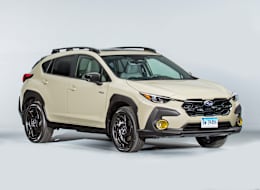
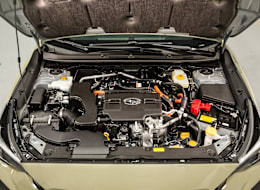
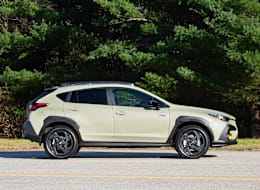
    The new-for-2026 model is Subaru’s second attempt at giving the Crosstrek a hybrid powertrain. The first try was a plug-in hybrid that was discontinued in 2023. That old model had a short all-electric range, negligible fuel economy benefits over the gas-only version, and a small trunk due to its added hardware. The latest Crosstrek has a more conventional non-plug-in setup, combining Subaru’s 2.5-liter flat-four engine with a 1.1-kilowatt-hour battery pack, an electronic continuously variable transmission (eCVT), and a mechanically coupled all-wheel-drive system that, Subaru says, is superior to the systems in other hybrids that only work at low speeds.

    This new technology comes with a significant price premium over the standard nonhybrid Crosstrek, which starts at $26,995, promises 29 mpg, and comes with a 180-hp, 2.5-liter four-cylinder engine as standard equipment—an improvement over last year’s 152-hp 2.0-liter four. With that context in mind, everyone who has seen the $37,378 window sticker of the 2026 Crosstrek Sport Hybrid we bought from a local Subaru dealership has had the same reaction: “That’s a lot of money for a Crosstrek.”

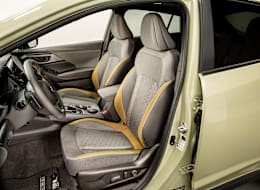
    To be fair, the Hybrid is also a lot of Crosstrek. While the base-model nonhybrid lacks both basic comfort features and key safety technology, the least-expensive Crosstrek Hybrid—which starts at the Sport trim level—comes standard with blind spot warning (BSW), rear cross traffic warning (RCTW), power seats, a moonroof, a digital instrument cluster, upgraded upholstery, and a leather-wrapped steering wheel—features that add thousands to the price of a standard Crosstrek, if they’re available at all. Ours came with nearly $2,000 worth of options and dealer-added accessories, too.

    The EPA rating for the hybrid powertrain is 36 mpg combined, a claim that we’ll put to the test in our own fuel economy evaluations. Its combined 194-hp output is also more powerful and smoother than the nonhybrid.

    Still, buyers with $37,000 to spend on a new car have a lot of choices, and many of them are larger and more efficient than the Crosstrek Hybrid. Even if you’ve also been eagerly waiting for the arrival of a partially electrified subcompact Subaru, we recommend you check out our ratings of other top-performing small SUVs before you make a purchase.

    It competes with the Chevrolet Trailblazer, Ford Bronco Sport, Honda HR-V, Hyundai Kona, Kia Seltos, Mazda CX-30, and Toyota Corolla Cross hybrid.

    The final assembly is  Ota, Japan.

    Impressions

    What We Like

    That smooth hybrid powertrain

    Subarus tend to have an annoying jumpiness when accelerating from a stop. As with the Forester Hybrid we tested, the Crosstrek Hybrid solves that with a smooth, all-electric shove up until around 10 mph, when the gas engine kicks in. “At low speeds, you typically feel the bump as the gas engine comes on, but it’s pretty minor,” said one CR tester. “After that, the engine, eCVT, and electric drive work well together. This is a pretty seamless hybrid.” Testers praised the eCVT for keeping the engine revs nice and low during regular driving without much of a loud “flare” that many hybrids suffer from. There’s a decent power reserve for passing and merging, too, although flooring the accelerator results in some engine noise and a small delay before the car surges forward.

    Ride comfort

    The Crosstrek Hybrid is shockingly good at absorbing bumps, especially in an era where a “Sport” badge usually indicates a stiff suspension and rough ride. Not so in this Subaru: “It soaks up most imperfections nicely, and multiple impacts in a row don’t seem to unsettle the vehicle,” said one tester. “It’s not plush by any means, but it’s quite good,” said another.

    Handling

    As with the nonhybrid, the Crosstrek Hybrid handles responsively and securely. The steering feels natural and delivers feedback about the road surface. Turn-in is predictable, and the car remains composed, even though there’s some body roll in corners.

    The digital gauge cluster

    “Subaru did a good job of adding functionality without making it more complicated,” said one of our infotainment experts. “There are only two buttons that control what you see in the gauge cluster, and they are easy to use.” Depending on your phone, app, and operating system, the screen can integrate with Google, Waze, and Apple Maps.

    Privacy options

    The first time we used the built-in navigation, the screen prompted the user to choose privacy settings and had "do not share data" selected. That “opt-in” approach is the opposite of how most auto manufacturers treat privacy.

    What We Don’t Like

    The hybrid payback period

    The nonhybrid Crosstrek gets an EPA-estimated 29 mpg combined. If the Hybrid achieves its EPA-estimated 36 mpg combined—which is no guarantee—that means someone who pays $3 per gallon and drives 12,000 miles per year will have to own their Crosstrek Hybrid for over 13 years before making up the $3,155 difference between comparably equipped versions of the two vehicles. Of course, that doesn’t account for the societal benefits of the Hybrid’s lower emissions or the individual driver’s benefit of the Hybrid’s quicker acceleration and smoother low-speed operation.

    Some of the same complaints we have about the nonhybrid Crosstrek

    The interior feels like a haphazard mosaic of mostly inexpensive materials, none of which seem to blend harmoniously. A shiny black plastic panel that surrounds the gear selector is sure to attract scratches and fingerprints. If Subaru wants advice on how to make a car interior look good without spending a ton of money, just look at the Mazda CX30 or the Kia K4.

    The center display is cluttered and placed too low, so drivers have to look away from the road for navigation or audio information. It can also be slow to respond when navigating the menus and loading features.

    You’ll have to root through a touchscreen climate control menu with tiny buttons to change anything beyond the temperature or fan speed.

    A little transmission unpleasantness

    The Crosstrek Hybrid’s eCVT does a good job for the most part, but allows the engine to loudly rev unpleasantly high when the driver asks for more power. Other Subarus avoid this with simulated upshifts that make the CVT sound a little more like a traditional geared automatic transmission, which some drivers prefer.

    What We’ll Keep An Eye On

    Fuel Economy

    EPA estimates for the Crosstrek Hybrid are 36 mpg city, highway, and combined. However, according to the on-board fuel economy calculator, only one CR tester so far has been able to crack 30 mpg in real-world driving. And that was on a long highway trip. Most of us are seeing between 26 and 29 mpg, which would be a serious knock against the Crosstrek Hybrid’s value. Because built-in fuel economy displays are notoriously inaccurate and EPA estimates don’t always reflect drivers’ real-world experiences, we perform our own evaluations, splicing a fuel-flow measuring device into the vehicle’s fuel line and driving pre-planned circuits at precise speeds. We’re very interested to see how well the Crosstrek Hybrid does.

    Value

    Subaru doesn’t offer BSW or RCTW as an option on the Base or Sport nonhybrid Crosstrek, so the most analogous nonhybrid model is a Premium with the creatively named “Optional Package.” That model costs $31,660. By comparison, buying the Sport Hybrid version adds a peppier, more efficient powertrain, a digital instrument cluster, upgraded upholstery, and a leather-wrapped steering wheel. All of that costs $34,815 before any of the options or dealer-added accessories that drove the price of ours north of $37,000.

    If you can find one selling for MSRP, a similarly equipped Toyota Corolla Cross would save you thousands of dollars and offer better fuel economy, albeit at the expense of Subaru’s more robust AWD setup. Or you could step up a size class and get a Forester Hybrid, Honda CR-V Hybrid, Hyundai Tucson Hybrid, Kia Sportage Hybrid, or Mazda CX-50 Hybrid for just a little more.

    Hybrid compromises

    Unlike many all-wheel-drive hybrids, which use an electric motor to power the rear wheels when extra traction is needed at low speeds, Subaru’s setup integrates electric motors into the transmission. Engine power is always being sent to all four wheels. This approach makes it more capable on low-traction surfaces at the expense of efficiency. The hybrid and nonhybrid also have the same modest 1,500-pound towing capacity.

    Compared to the nonhybrid Crosstrek, the hybrid’s cargo area is 1.3 cubic feet smaller, and 4.1 cubic feet smaller with the seats folded down, according to Subaru’s measurements. In addition to a slightly raised loading floor, the hybrid also lacks a spare tire. We’ll evaluate the cargo space empirically, but so far, it’s been sufficient. One CR tester found it capacious enough to fit a set of winter tires for his Miata, and another did a pre-Thanksgiving Costco run with no issues.

    Noise

    Although the electric motor takes the edge off some of the gas engine noise, there’s still some there. Road and tire noise are noticeable, wind noise picks up at highway speeds, there’s a background “hum” from the powertrain while cruising, and the engine gets pretty loud during heavy acceleration.

    Active Safety and Driver Assistance

    The Crosstrek Hybrid comes with the latest EyeSight driver assistance features, including automatic emergency braking with pedestrian, bicyclist, and motorcycle detection; automatic emergency braking that operates at highway speeds; lane centering assistance; lane departure warning; lane keeping assistance; adaptive cruise control; and automatic high beams. Also standard are BSW and RCTW. So far, adaptive cruise control has seemed adept, but lane centering assistance has allowed some wandering and ping-ponging between lane lines. We’ll be sure to share the results of our more detailed tests.

    The Crosstrek Hybrid notably includes a driver re-engagement system that can bring the vehicle to a stop if the driver becomes unresponsive to warnings while using adaptive cruise control. Once stopped, Subaru says the Crosstrek will activate the hazard lights, unlock the doors, and place a call to emergency services.

    Change Vehicle