
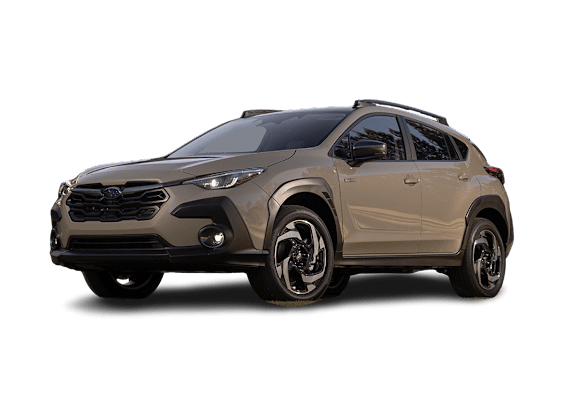

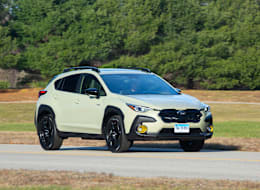

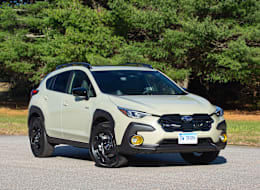
“The third time’s a charm.” At least, that’s how the saying goes. And if a model ever needed some “charm,” it’s the hybrid version of Subaru’s Crosstrek. That’s because the first two Crosstrek Hybrids were largely forgettable. The XV Crosstrek Hybrid for the 2014 model year was a half-hearted attempt that felt rather unrefined, and only got 2 more mpg than the regular Crosstrek. The plug-in hybrid electric vehicle (PHEV) version, sold from 2019 to 2023, had a short all-electric driving range and a significantly reduced cargo area due to the added hybrid hardware.
For this third attempt, Subaru went straight to one of the best in the business—Toyota—for some of the Crosstrek’s hybrid hardware. Smart move. It uses Subaru’s 2.5-liter horizontally-opposed “flat-four” engine, a 1.1-kilowatt-hour battery pack, and an electronic continuously variable transmission (eCVT) sending power to all four wheels via Subaru’s mechanical all-wheel-drive system.
Subaru Crosstrek Hybrid at a Glance
- Subaru finally gets the Crosstrek Hybrid formula right
- Like the Forester Hybrid, Subaru sourced some hybrid hardware from Toyota
- Quicker, with a more fuel-efficient and refined powertrain than the regular model
- Comfortable ride and lively handling
- Value isn’t the Hybrid’s strong suit
After our testers spent months compiling results from more than 50 specific tests and evaluations at Consumer Reports’ 327-acre Auto Test Center, along with lots of miles behind the wheel on public roads, there’s no question that the Crosstrek Hybrid is an improvement over the regular version. For example, the smooth electric shove off the line eliminates the dreaded “Subie-surge” jumpy throttle delivery that the regular Crosstrek suffers from, making the Hybrid easier to drive at low speeds. Add to that the improved fuel economy, plus the Crosstrek’s comfortable ride and fine handling, and this is a winning combination, earning a notably higher road-test score than the conventional version—not to mention its subcompact SUV competition.
While the Hybrid delivers a superior driving experience, its higher starting price—and the fact that it’s only offered in pricier trims—undercuts its value. This means it will take owners many, many years to recoup the cost of the hybrid system.
But, to be fair, the Hybrid is a lot of Crosstrek. While the base-model nonhybrid lacks some key comfort and active safety features, the Crosstrek Sport Hybrid comes standard with blind spot warning, rear cross traffic warning, a power driver’s seat with two-way lumbar support, a sunroof, a digital driver’s instrument screen, upgraded cloth upholstery, and a leather-wrapped steering wheel—features that add thousands to the price of a standard Crosstrek, if they’re available at all.
“This is an easy car to live with,” said one of our testers. “It’s reasonably comfortable, and it definitely drives better than the regular Crosstrek, although the Hybrid’s gas engine can get quite noisy. A potential problem for Subaru, and buyers, is the huge price gap between the base gas-only Crosstrek and the base Hybrid, because it starts at a higher trim level.”
“To me, the Crosstrek Hybrid doesn’t make that much sense,” said another tester. “You can spend just a little more money and get the Forester Hybrid, which offers more space, more comfort, and, in my opinion, is a better vehicle overall. The Crosstrek is like a medium-sized soft drink. It might be the amount of drink you want and need, but it’s not the best value.”
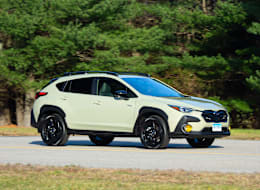
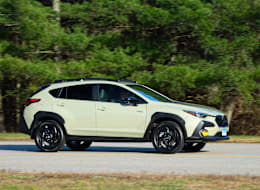
We bought a 2026 Subaru Crosstrek Sport Hybrid for $37,378—anonymously from an area dealer, as we do with every vehicle we test—for the purpose of this road test review. Our Crosstrek Hybrid was assembled in Ota, Gunma, Japan.
Driving experience
Some Subaru models, including the Crosstrek, tend to exhibit an annoying jumpiness when accelerating from a stop, making it difficult to drive smoothly. The Crosstrek Hybrid solves this by providing a silky, all-electric shove until around 5 to 18 mph (depending on throttle input), when the gas engine kicks in. This makes for a considerably more palatable powertrain.
At low speeds, you typically feel a bump as the gas engine turns on, but it’s pretty minor. After that, the engine, electric drive, and electronic continuously variable transmission (eCVT) make for a seamless experience. There’s decent power in reserve for passing and merging, but the eCVT allows the engine to rev unpleasantly high (which gets unpleasantly loud) when the driver asks for more power.
With a 0-to-60-mph time of 8.3 seconds, the Hybrid is about a half-second quicker than the regular Crosstrek. Likely much more important for most buyers, it’s also more fuel-efficient, at 35 mpg overall in our testing. That’s a 6-mpg gain over the regular model we tested with the now-standard 2.5-liter four-cylinder engine. That’s not as big a fuel-economy gain as we see with some hybrids, likely in part due to its all-wheel-drive system. Many hybrid SUVs use a dedicated electric motor to power the rear wheels, while the Crosstrek Hybrid uses a mechanically coupled all-wheel-drive system that sends power to all four wheels at all times for superior capability in low-traction environments.
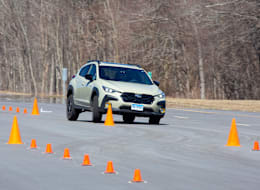
Ride quality remains a standout Crosstrek feature. The suspension isolates the cabin from harsh road imperfections with a level of composure rarely seen in the subcompact SUV segment. Like the regular model, the Crosstrek Hybrid handles responsively and securely. Turn-in is predictable, and the car remains composed, even though there’s some body roll in corners. Further, it achieved a truly impressive 59 mph during our avoidance-maneuver test.
Panic-brake stopping distances proved longer than the conventional Crosstrek—an issue we’ve encountered with many hybrids over the years. On the bright side, pedal feel is pretty normal (not always the case with hybrids), with just a bit of softness and a hint of grabbiness as you’re coming to a stop.
Cabin comfort
The Crosstrek’s cabin is fairly basic and unlikely to dazzle your passengers. But there are some nice touches here and there, such as the carbon-look trim on the lower dash, the glossy-tipped window controls, and the padded upper dashboard.
The interior is roomy, and in Subaru SUV tradition, it is easy to get into and out of. The cabin’s generous glass area, slim roof pillars, and elevated seating position afford good outward visibility most of the way around the vehicle.
We like that the Sport Hybrid trim comes standard with a power driver’s seat with adjustable lumbar support. Most testers found the front seats comfortable, with support that held up well on longer drives. We found the driving position good in some ways, such as the plentiful headroom and a decent view out over the hood, but the plastic center console tends to hem in the driver’s right knee, and some taller testers felt like they were sitting up too high.
The rear seat is comfortable with good leg support and nicely placed armrests. Headroom will be tight for taller passengers, but there’s ample foot space underneath the front seats. We were able to fit 2 large suitcases, 2 overnight duffel bags, and 2 backpacks behind the Crosstrek Hybrid’s upright rear seat. But thanks to its slightly higher cargo floor than the regular Crosstrek (due to the hybrid battery pack), the Hybrid lost 1 cubic foot of maximum cargo space in our measurements.
Controls and usability
As with most aspects of the Crosstrek Hybrid, the controls' layout isn’t flashy but is largely user-friendly. We especially like that Subaru continues to include physical volume and tuning knobs. All Hybrid trims feature an 11.6-inch portrait-oriented infotainment touchscreen. It’s simple and well-organized, but it can respond slowly to inputs.
Most of the Crosstrek Hybrid’s climate controls are housed at the bottom of the center screen. As such, the only truly easy aspects of the climate system are the large, physical temperature buttons for the driver and front passenger, the front and rear defroster buttons, and the heated-seat rocker switches located on the center console. We don’t like that you have to wade further into the climate menu to change the airflow mode or switch to the “Auto” climate function.
The Hybrid replaces the analog gauges found in the regular Crosstrek with a new 12.3-inch digital driver’s instrument screen, giving it a more modern feel. It has a simple layout, and the information is easy to read while driving. The Hybrid also gets Subaru’s latest built-in navigation system, and wireless Android Auto and Apple CarPlay come standard.
Active safety and driver assistance
Standard active safety and driver assistance features on the Crosstrek Hybrid include automatic emergency braking with pedestrian, bicyclist, and motorcycle detection, along with automatic emergency braking that operates at highway speeds, blind spot warning, rear cross traffic warning, reverse automatic emergency braking, lane centering assistance, lane departure warning, lane keeping assistance, adaptive cruise control, and automatic high beams.
A rear occupant alert system comes standard and is designed to remind the driver—based on rear-door logic—to check the rear seat when they turn the Crosstrek off, helping prevent children and pets from being unintentionally left behind in the vehicle. There’s also a rear belt minder, which alerts the driver if a rear passenger unbuckles their seat belt during the trip.