
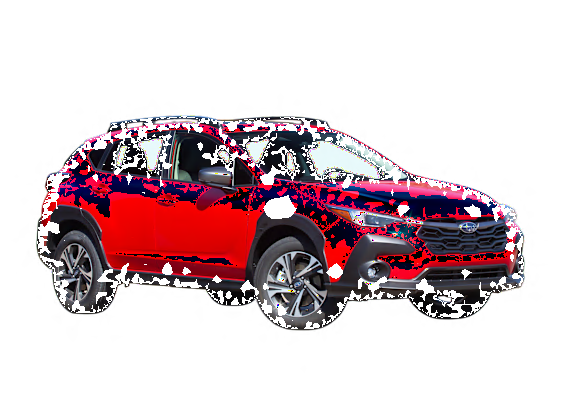

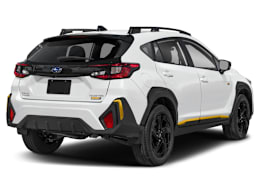
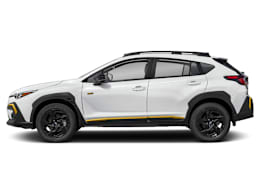

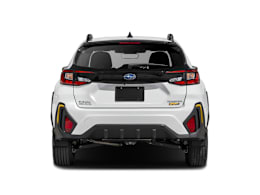

The Subaru Crosstrek has long been one of the top-rated subcompact SUVs in Consumer Reports’ testing. Basically a raised ride-height version of the Impreza hatchback with an aura of off-road ability, the Crosstrek is an easy vehicle to live with thanks to its comfortable ride, responsive handling, good fuel economy, standard all-wheel drive, and mostly simple controls.
The one aspect we’ve routinely complained about is the rather tepid acceleration from its previously standard 2.0-liter four-cylinder engine. For 2026, Subaru addressed this by making the formerly optional 2.5-liter four-cylinder now the standard engine. With an extra 28 hp, we still wouldn’t categorize the Crosstrek as “quick,” but the 180-hp mill certainly makes it feel less slow. There is also a new Crosstrek Hybrid with 194 hp that's quicker and more fuel-efficient, but also more expensive.
Subaru Crosstrek at a Glance
- A 180-hp, 2.5-liter four-cylinder engine is now standard
- The larger engine makes the Crosstrek quicker, and the powertrain feels less stressed
- Comfortable ride and lively handling
- Excellent outward visibility and mostly straightforward controls
- Infotainment system continues to suffer from noticeable lag
We conduct more than 50 individual tests and evaluations on every vehicle we purchase at Consumer Reports’ 327-acre Auto Test Center in rural central Connecticut. Our testers also log thousands of miles on public roads over several months. After we tallied up the results, the Crosstrek’s road-test score increased slightly, due in part to its quicker acceleration and a slightly quieter cabin, further solidifying its spot at the top of the subcompact SUV class.
But that’s not to say this little Subaru is perfect. While we appreciate the slight increase in output, this isn’t a powertrain transformation as we found with the Crosstrek Hybrid (which we also tested). The engine still doesn't feel like it has much oomph left in reserve, and it sounds like it's working overtime when you need strong acceleration.
“The big news for 2026 is that the 2.5-liter engine is now standard, and the base 2.0-liter is gone. The 2.5 is the engine that the Crosstrek should have had from the start,” surmised one of our testers. “In some ways, I actually prefer this regular Crosstrek over the Crosstrek Hybrid because it's simpler, not to mention that it's cheaper. You also don't get the excess noises and slightly unrefined nature of the hybrid system.”
“I found the Crosstrek very easy to live with,” said another tester. “It handles well out on the road, while its small size and good outward visibility make it easy to drive in traffic, or for navigating around parking lots. Simple controls make it a pleasant experience as well.”
“An easy car to use, for sure. But in terms of powertrain drivability, I think the Crosstrek Hybrid is the better choice, although you’re going to have to pay more to get it,” countered another tester.
We bought a 2026 Subaru Crosstrek Sport for $32,819—anonymously from an area dealer, as we do with every vehicle we test—for the purpose of this road test review. Our Crosstrek was assembled in Lafayette, Indiana.
Driving experience
The last Crosstrek we tested with the 152-hp, 2.0-liter four-cylinder engine was, well, downright pokey, as evidenced by its 10.1-second 0-to-60-mph “sprint.” Or, more like a jog. The now-standard 2.5-liter four-cylinder delivers 180 hp, which makes the Crosstrek feel more spunky. It drops the 0-to-60-mph run down to 8.8 seconds, which is class-competitive. Even though the 2.5-liter is slightly stronger down low and in the midrange, it still feels underpowered when you need a burst of speed on the highway or when trying to get around slower traffic in a two-lane passing zone.
The Crosstrek’s annoying off-the-line abrupt throttle delivery has been toned down with the larger engine, although it’s still present, meaning that if you hit the gas pedal with any real intention from a stop, the car lurches forward in a jumpy fashion. When you aren’t in a hurry and driving more casually, the Crosstrek works just fine. The continuously variable transmission (CVT) delivers a generally smooth around-town performance. As before, the CVT mimics the operation of a conventional automatic transmission by simulating upshifts to help keep the engine revs from skyrocketing when climbing hills or accelerating. These “shifts” aren’t a cure-all, and there are still times when the engine noise gets quite loud.
Maybe the best news is that, despite the extra power, the Crosstrek managed the same fuel economy as it did with the smaller engine—29 mpg overall in our testing.
The Crosstrek delivers confident, well-balanced handling with naturally weighted steering and controlled body roll. It handles everyday driving with ease, while its small size and airy outward visibility make it a cinch to maneuver into tight parking spaces. It also stays secure and predictable when picking up the pace. The Sport trim we tested reached a truly impressive 58 mph during our avoidance-maneuver exercise.
But it’s the Crosstrek’s composed and absorbent ride that might impress buyers the most, with a suspension that soaks up bumps so well that occupants at times will barely notice typically jarring things like recessed manhole covers. Of note, we found that the Crosstrek Hybrid provides an even slightly better ride, still.
With its decent ground clearance, permanently engaged all-wheel drive, and available dual-function X-Mode (which has settings to optimize traction for, say, deep snow, dirt, and mud), the Crosstrek is one of the few in the subcompact SUV class that can actually be taken off the beaten path for some light off-road excursions, such as a sand dune or a muddy trail.
Cabin comfort
The Crosstrek’s cabin is fairly basic and unlikely to dazzle your passengers. But there are some nice touches here and there, such as the carbon-look trim on the lower dash, the glossy-tipped window controls, and the padded upper dashboard.
The interior is roomy, and in Subaru SUV tradition, it is easy to get into and out of. The cabin’s generous glass area, slim front and side roof pillars, and elevated seating position afford excellent outward visibility most of the way around the vehicle.
Most testers found the manually-adjustable front seats in the Sport trim reasonably comfortable, with support that held up well on longer drives. But several testers wished they could have adjusted the leading edge of the bottom cushion up and down to better dial underleg support in and out. We found the driving position good in some ways, such as the plentiful headroom and a decent view out over the hood, but the plastic center console tends to hem in the driver’s right knee. Some taller testers also felt they were sitting too high.
The rear seat is comfortable with good leg support and nicely placed armrests. Headroom will be tight for taller passengers, but there’s ample foot space underneath the front seats. We were able to fit 2 large suitcases, 2 overnight duffel bags, and 2 backpacks in the cargo area behind the Crosstrek’s upright rear seat.
Controls and usability
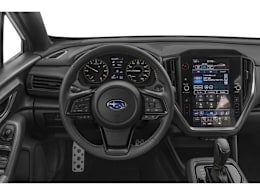
As with most aspects of the Crosstrek, the controls' layout isn’t flashy but is largely user-friendly. We especially like that Subaru continues to include physical volume and tuning knobs. The 11.6-inch portrait-oriented infotainment touchscreen in the Sport is simple and well-organized, but it can respond slowly to inputs.
Most of the Crosstrek’s climate controls are at the bottom of the center screen. As such, the only truly easy aspects of the climate system are the large, physical temperature buttons for the driver and front passenger, the front and rear defroster buttons, and the heated-seat rocker switches located on the center console. We don’t like that you have to wade further into the climate menu to change the airflow mode or switch to the “Auto” climate function.
Active safety and driver assistance
Standard active safety and driver assistance features on the Crosstrek include automatic emergency braking with pedestrian, bicyclist, and motorcycle detection, along with automatic emergency braking that operates at highway speeds, lane centering assistance, lane departure warning, lane keeping assistance, adaptive cruise control, and automatic high beams. It’s disappointing that blind spot warning and rear cross traffic warning only come standard on the top Limited and Wilderness trims. They are optional on the second-tier Premium but unavailable on the Base model and the third-tier Sport.
A rear occupant alert system comes standard and is designed to remind the driver—based on rear-door logic—to check the rear seat when they turn the Crosstrek off, helping to prevent children and pets from being unintentionally left behind in the vehicle. There’s also a rear belt minder, which alerts the driver if a rear passenger unbuckles their seat belt during the trip.