
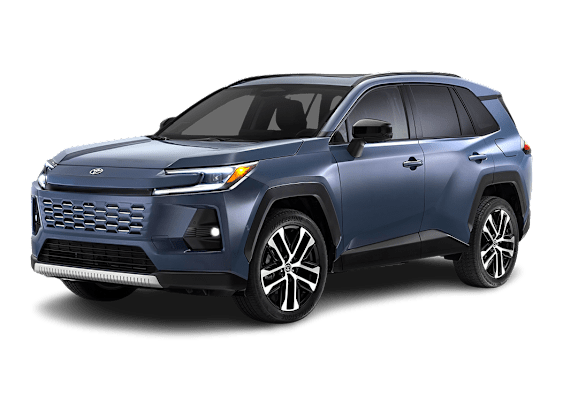

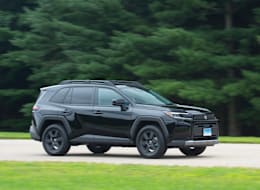
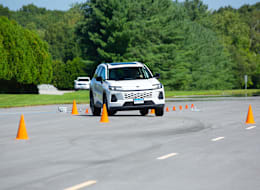
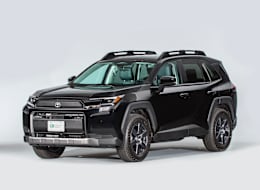
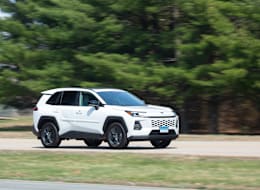
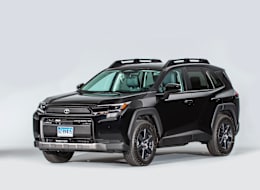
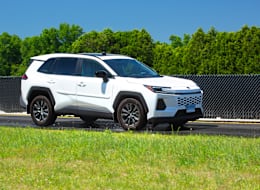
The latest RAV4 marks a smart evolution for the industry's most popular compact SUV, shifting to an entirely electrified lineup with exclusively hybrid and plug-in hybrid (PHEV) options. By ditching the traditional nonhybrid four-cylinder engine in favor of Toyota's fifth-generation hybrid architecture, the RAV4 sees a notable power boost and improved fuel economy.
We could go on about the hybrid RAV4’s immediate electric torque off the line, seamless power delivery, and rapid 0-to-60-mph time of 7.7 seconds, but we’d rather obsess about its excellent 40-mpg overall fuel economy (up from 37 mpg in the last RAV4 Hybrid). Combined with its 46 mpg on the highway, the RAV4 delivers a robust 600-plus-mile cruising range.
The redesigned RAV4 also brings improvements to ride comfort, shorter stopping distances, new trim levels, and upgraded convenience and active safety features. The updated cabin layout represents a big improvement over previous models, integrating a modernized touchscreen with logical physical buttons and better-than-average built-in voice controls.
However, the interior in our tested third-tier (out of six available trims) XLE Premium is underwhelming, with tons of hard plastics, limited soft-touch surfaces, and a general ambience of sad malaise. Its thinly padded armrests and intrusive center console, with a hard plastic edge that rubs directly against the driver’s right knee, made the driving position a literal sore spot for many testers.
Toyota RAV4 at a Glance
- Impressive fuel economy and a long history of top-notch reliability
- Comfortable ride paired with competent handling
- Short stopping distances with a natural-feeling brake pedal
- Driving position is marred by an intrusive center console and uncomfortable armrests
- The XLE Premium’s cabin feels cut-rate
- Testers reported inconsistent Bluetooth connectivity, often requiring multiple attempts to re-pair a phone
We conduct more than 50 individual tests and evaluations on every vehicle we purchase at Consumer Reports’ 327-acre Auto Test Center in rural central Connecticut. Our testers also log thousands of miles on public roads over several months. After we tallied the results, the RAV4 earned an impressive road-test score and remains an exceptionally practical SUV that prioritizes solid utility and superb fuel savings over premium comfort.
As in the past, the RAV4 maintains a strong position among competing hybrid models, such as the Honda CR-V, Hyundai Tucson, Kia Sportage, Mazda CX-50, and Subaru Forester. Truthfully, you can’t go wrong with any of these choices.
As one of our testers said, “Overall, it feels like Toyota hit the nail on the head with the new RAV4. It’s practical, usable, and desirable, but with some key upgrades that keep it competitive. It's not the flashiest option out there, but it doesn't feel phoned-in or derivative. The fact that they went hybrid-only, I think, is essentially a no-brainer at this point.”
“This is a nice RAV4, and really, it’s the way it should have been all along,” said another tester. “It's quieter and rides better, has fairly comfortable front seats, mostly normal controls, strong power, and, of course, it’s also very efficient. It's not perfect; the eCVT still lacks simulated upshifts, and sustained high revs at times only further accentuate the engine's vibrations through the steering wheel, even if they are slightly tamed. I thought the balance between a good ride and solid handling, in particular, is pretty decent.”
We bought a 2026 Toyota RAV4 XLE Premium AWD for $43,238—anonymously, as we do with every vehicle we test—for the purpose of this road-test review. Our RAV4 was assembled in Woodstock, Ontario, Canada.
We also borrowed a 2026 RAV4 Woodland from Toyota to experience this more off-road-oriented trim as part of our road test evaluation.
Driving experience
The RAV4 AWD’s 236-hp, hybrid-infused 2.5-liter four-cylinder engine delivers smooth, responsive, and confidence-inspiring power with strong electric torque off the line. Toyota has been refining and improving its hybrid powertrains for decades, and it shows. Its gas engine and two electric motors work seamlessly together the majority of the time. Issues really only crop up if the driver steps hard on the accelerator pedal. Revs jump up quickly, bringing a coarse engine note, and you feel some minor vibrations coming through the steering wheel. Full-throttle acceleration makes for a rather unpleasant experience.
The electronic continuously variable transmission (eCVT) mostly cooperates, but drivers yearned for simulated upshifts—as some other automakers do, such as Honda with its hybrids—which would help reduce the occasional high-RPM engine flaring or “rubberbanding” situations, where the revs seem discordant with the actual acceleration.
Toyota rarely tunes its suspension systems to cater to enthusiast drivers, which is the case for the new RAV4. The steering is quick enough, but its artificial, numb feel limits driver confidence. Still, it delivers predictable, confidence-inspiring routine handling that prioritizes everyday comfort over sporty dynamics. The suspension adroitly absorbs bumps, delivering a mostly calm ride with minimal side-to-side jostling of occupants. Braking performance was excellent, exhibiting short stopping distances on both dry and wet surfaces, and the pedal delivers a natural, predictable feel.
Aside from the racket that comes with stepping hard on the accelerator pedal, the powertrain remains fairly quiet when driven sedately, especially when operating on electric power at lower speeds. There’s noticeable road and tire noise, but neither gets objectionable. Wind noise stays mostly subdued during regular driving, but as in most vehicles, it becomes more pronounced at highway speeds.
Cabin comfort
Apparently, Toyota put most of its development money into the mechanical bits of the RAV4, leaving the interior designers to fight for scraps. The cabin has a rugged, truck-like design with bold shapes, but too much hard plastic. Given our tested XLE Premium's price, we would have expected more soft-touch materials. Buyers will need to step up to the top-shelf Limited model for any semblance of pampering.
Aspects of the RAV4’s driving position are also surprisingly underwhelming. For example, the plastic center console crowds the driver's right knee. Both the door and center armrests are woefully underpadded, which can make longer drives uncomfortable. The dual-opening center armrest neatly doubles as a small storage tray, though its usefulness seems somewhat limited.
The front seats proved reasonably comfortable for most testers, but a few wished that these flat, firm thrones had more lateral support. On the bright side, their width should accommodate a variety of body types. The rear seat offers good headroom, although foot room is a bit tight beneath the front seats, and underleg support is only average.
We appreciate the RAV4's utility, as the cabin offers several open storage options for front-seat passengers to stash items like phones, keys, and wallets.
The RAV4’s cargo hold can manage a reasonable amount of luggage. We fit 4 large suitcases, 1 overnight duffel bag, and 5 backpacks behind the RAV4’s rear seat. Fold the rear seats down, and there’s 35 cubic feet of space. While that’s decent for a small SUV, the CR-V, Forester, and Tucson all have a bit more room.
Controls and usability
Toyota's latest infotainment touchscreen is easier to use than before, thanks to a dedicated home screen, customizable widgets, and the relocation of some settings from the driver’s instrument screen to the center display. However, basic climate functions such as fan speed and airflow mode rely on the touchscreen, rather than physical knobs or buttons. We also experienced intermittent device reconnection issues with Android Auto and Apple CarPlay.
The driver’s instrument screen is clear and easy to read, with several selectable views that emphasize items such as efficiency, navigation (which also works with some phone projection apps in addition to Toyota’s built-in navigation), and advanced driver assistance systems (ADAS). However, the setup offers too many display options for the driver to choose from, making it difficult to find even basic information.
A wireless phone charging pad isn’t standard on lower trims, but it comes on the third-tier XLE Premium we tested. Potential buyers should choose their RAV4 trim carefully if a feature like this is important.
Active safety and driver assistance
The new RAV4 is the first Toyota model to come with the Toyota Safety Sense 4.0 suite of active safety and driver assistance features. It’s a significant step forward over the TSS 2.5 in the previous model, with a smoother lane centering assistance system and more graceful acceleration and deceleration from the adaptive cruise control system.
Standard active safety and driver assistance features include automatic emergency braking with pedestrian, cyclist, and motorcycle detection, along with automatic emergency braking that operates at highway speeds, blind spot warning, rear cross traffic warning, reverse automatic emergency braking, lane centering assistance, lane departure warning, lane keeping assistance, adaptive cruise control, and automatic high beams.
A rear occupant alert system is standard. It’s designed to remind the driver—based on rear-door logic—to check the rear seat when the RAV4 is turned off, helping prevent children and pets from suffering heatstroke or hypothermia if unintentionally left behind in the vehicle. There’s also a rear belt minder that alerts the driver if a rear-seat passenger unbuckles their seat belt during the trip.
Finally, the RAV4 comes with a Safe Exit Alert system that monitors for vehicles and cyclists approaching from behind when parked on a city street, and only allows passengers to open the doors when it's safe to do so.