Your membership has expired

The payment for your account couldn't be processed or you've canceled your account with us.

Re-activate

Save products you love, products you own and much more!

Save products icon

Other Membership Benefits:

Savings icon Exclusive Deals for Members Best time to buy icon Best Time to Buy Products Recall tracker icon Recall & Safety Alerts TV screen optimizer icon TV Screen Optimizer and more

    Fund Focus: International bond funds

    Bonds of developed and emerging markets can diversify your portfolio and boost its returns

    Published: June 2014

    Find Ratings

    The U.S. Treasury may be the world's largest bond issuer, but it's not the only one. Two types of bond funds primarily invest in government (or sovereign) debt around the world, although some also purchase corporate bonds. Those international bond funds, which own debt from developed markets such as Western Europe and Japan and emerging markets such as Indonesia and Turkey, have attracted ever more money in the past five years while the Federal Reserve does all it can to keep interest rates low here at home. In 2013 alone, world bond funds attracted more than $23 billion in new money, according to Morningstar. And emerging markets bond funds, a relatively new fund class, have grown from almost nothing 10 years ago to $70 billion today.

    In many cases, aside from the usual risks that come with investing in bonds—namely, interest-rate risk and credit risk—investors may need to be mindful of exchange rates. If the bond issued by the government is denominated in local currency, as most world bond debt is, an investor's return would also be affected by changes in the value of that currency relative to the U.S. dollar.

    Emerging markets bonds took a blow in 2013 because of political uncertainties and worries about the impact the Federal Reserve's decision to stop buying bonds could have on the economies of emerging markets. But market observers are still optimistic about those bonds, pointing out that many emerging markets governments have a good fiscal base. Unlike the U.S., which is still running a deficit of 2 percent of gross domestic product, many emerging markets, such as South Korea, Taiwan, and Thailand, have budget surpluses, an indication of credit­worthiness even if their economies were to slow.

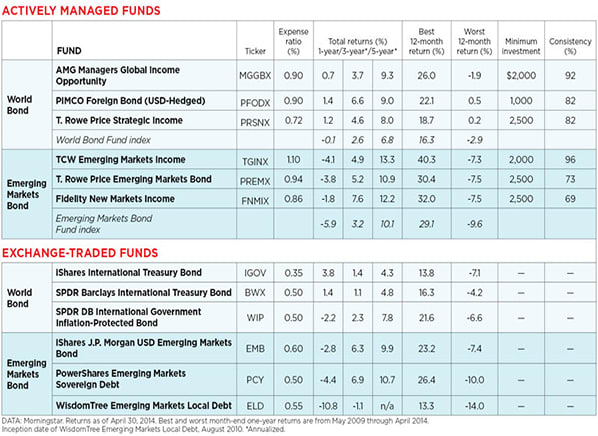
    Below, we list the three most consistently outperforming no-load actively managed funds over the past five years for world bond funds and emerging markets bond funds. We also list the three largest exchange-traded funds for each category, which are slightly cheaper than their actively managed counterparts. Volatility should be apparent by looking at the returns below. Returns aren't as steady as they are in the domestic bond market, and losses, like those that emerging markets bond funds experienced last year, can be significant. 

    Editor's Note:

    This article also appeared in the July 2014 issue of Consumer Reports Money Adviser.


    E-mail Newsletters

    FREE e-mail Newsletters!
    Choose from cars, safety, health, and more!
    Already signed-up?
    Manage your newsletters here too.

    Money News

    Cars

    Cars Build & Buy Car Buying Service
    Save thousands off MSRP with upfront dealer pricing information and a transparent car buying experience.

    See your savings

    Mobile

    Mobile Get Ratings on the go and compare
    while you shop

    Learn more