Sign In

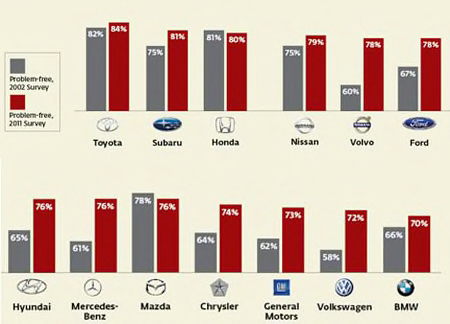
Buying a used car becomes less of a gamble with every passing year. Even the least reliable carmakers are gaining ground on the perennial reliability leaders, Toyota and Honda. Volvo has made the most dramatic improvement over the past decade, but almost all automakers have improved their products in recent years.
Those conclusions are based on a comparison of problem-free three-year-old models in our 2002 and 2011 Annual Auto Surveys.
For each automaker, we calculated the percentage of its product output for which owners did not report any serious problems with their cars during the 12 months covered by each survey.
We chose three-year-old models because that's the point at which most vehicles come off warranty and the owner begins to assume the cost of ongoing repairs. By age three, most models also have the steepest part of depreciation behind them, so used-car buyers will find that's a good age on which to focus.
If you owned a three-year-old Volkswagen in 2002, your chances of having no problems that year were less than 60 percent, and your odds were only slightly better if you owned a Volvo, Mercedes-Benz, or GM model. You would have been much better off with a top Japanese brand: More than 80 percent of the Toyotas and Hondas, and about three-quarters of the Mazdas, Nissans, and Subarus were trouble-free.
Three-year-old Toyotas and Hondas have been the most consistently reliable in our past surveys. But nowadays three-year-old models made by them aren't much more reliable than those of a decade ago. Meanwhile, the rest of the industry has improved a lot overall, with the biggest improvement coming from Volvo, which rose from 60 percent trouble-free to 78 percent, one point higher than the 2011 survey average.
In our latest survey, the lowest-ranking automaker was BMW, with about 70 percent of its cars being trouble-free. But that figure is better than the survey average in 2002, which was 68 percent.
Although newer automotive technologies have reduced some problems, they've sometimes created fresh ones. Audio systems now include GPS navigation, communications systems, and touch-screen displays, and such complex systems have more problems than a basic radio has. Notable are the MyFord Touch and MyLincoln Touch infotainment systems, for which many 2011 Ford Edge and Lincoln MKX owners reported problems.
Some troubles arise at certain stages of a model's life span. But there are other problems that are persistent, showing up in our survey year after year. For example, almost one in five owners of the 2009 Toyota Tacoma rear-wheel-drive, four-cylinder pickup reported a serious problem with the radio, and in last year's survey almost one in four Tacoma owners reported the problem.
Another example is the 2004 Volkswagen Touareg, a vehicle with many problems. The SUV's tire-pressure monitoring system, which has been cited year after year, was prominent among those gripes. In the 2011 survey alone, more than one in three owners complained about it.
Some newer cars develop problems at rates we shouldn't see for many years. A quarter of owners of the supercharged 2010 Audi A6 had a water-pump problem. And 15 percent to 20 percent of some 2008 to 2010 BMW 135i, 335i, and 535i turbocharged models had a fuel-pump problem.
Premature brake wear was cited as a problem for a third of owners of the 2009 Dodge Journey SUV and 2008 Chrysler Town & Country and Dodge Grand Caravan minivans, 15 to 20 times the rate for all cars of the same age. Twenty to 25 percent of 2008 Honda Accord and 2009 Acura TSX owners also reported premature brake wear.
One of the most problematic models in the survey was the 2003 Kia Sedona minivan. Over three-quarters of its owners cited a serious problem last year, with many related to the climate-control system, the steering and suspension, the sliding doors, and the paint and trim.
Used cars are holding up better. Though the most reliable brands have stayed steady over time, others are improving, with their models having fewer problems than same-age models of a decade ago.
For each of 13 automakers, we averaged the percentage of their models that were trouble-free during their third year on the road, starting with those that were three years old in 2002 (2000 models) and ending with cars that were age three (2009 models) at the time of our 2011 survey.
The numbers come from our Annual Auto Surveys, in which subscribers tell us about their serious auto problems. Automakers are listed based on their percentage of problem-free vehicles in the 2011 survey, highest to lowest.
All cars develop more problems as they get older, so the trick is to find those that will age more gracefully. Here we track extremes from the 2007 model year: five models that started out with few problems and stayed reliable as they turned five years old, and several models that started out with a few more problems and then got much worse over time. The numbers here represent problems per 100 vehicles at age one and at age five. This suggests that if reliability is a priority, a safe bet is choosing a model from the most reliable brands.
| HALE AND HEARTY | ||
|---|---|---|
| 2007 Models | Problems per 100 cars | |
| Age 1 | Age 5 | |
| Toyota Prius | 6 | 26 |
| Acura TSX | 7 | 30 |
| Honda Fit | 7 | 24 |
| Toyota Highlander | 8 | 20 |
| Honda CR-V | 8 | 24 |
| SHOWING THEIR AGE | ||
|---|---|---|
| 2007 Models | Problems per 100 cars | |
| Age 1 | Age 5 | |
| Mini Cooper S hatchback | 9 | 113 |
| GMC Acadia/ Saturn Outlook (AWD) |
15 | 106 |
| BMW X5 (6-cyl.) | 15 | 120 |
| Audi Q7 | 17 | 91 |
| Chrysler Town & Country/ Dodge Grand Caravan |
17 | 100 |
Below are the notable models from each of the 2001 to 2010 model years, based on problems per 100 vehicles. The most-reliable lists are in descending order. The least-reliable models are listed with the worst first.
Best |
Worst |
|---|---|
2002 |
|
| Toyota Tacoma (4-cyl., 2WD) | Kia Sedona |
| Toyota Tundra (V8, 2WD) |
Volkswagen Jetta Sedan (turbo) |
| Lexus LS |
Buick Rendezvous |
2003 |
|
| Toyota Tundra (V6) |
Ford Thunderbird |
| Toyota Tacoma (2WD) | Kia Sedona |
| Lexus LS | Lincoln Navigator |
2004 |
|
| Lexus ES | Volkswagen New Beetle Convertible |
| Toyota Tacoma |
Chevrolet Blazer |
| Toyota Camry (4-cyl.) |
Volkswagen Touareg |
2005 |
|
| Toyota Tundra (V6) |
Volkswagen New Beetle Convertible |
| Lexus GS | Chevrolet Uplander/ |
| Honda Civic Coupe & Hatchback |
Pontiac Montana/ |
| Saturn Relay | |
| Chrysler Town & Country/ | |
| Dodge Grand Caravan | |
2006 |
|
| Toyota Tundra (V6) |
Nissan Quest |
| Toyota Highlander (V6) |
Volkswagen Passat (4-cyl.) |
| Lexus ES |
Mercedes-Benz R-Class |
2007 |
|
| Toyota Highlander |
Pontiac G6 Coupe & Convertible |
| Toyota FJ Cruiser |
BMW X5 (6-cyl.) |
| Toyota Yaris Hatchback |
Mini Cooper Hatchback S |
2008 |
|
| Toyota Yaris Hatchback | Chevrolet Uplander |
| Lexus RX Hybrid | Chrysler Town & Country/ |
| Honda CR-V |
Dodge Grand Caravan |
| Chevrolet Tahoe Hybrid/ | |
| GMC Yukon Hybrid | |
2009 |
|
| Toyota Yaris Sedan |
Dodge Journey |
| Honda CR-V |
Volkswagen Routan |
| Honda Element |
Jaguar XF |
2010 |
|
| Scion xD |
Jaguar XF |
| Lexus ES | Audi A6 (3.0T) |
| Honda Accord Crosstour |
Audi Q5 (V6) |
2011 |
|
| Honda Civic Coupe | Jaguar XJ |
| Ford Fusion (V6, AWD)/ |
Lincoln MKX (FWD) |
| Mercury Milan (V6, AWD) |
Ford Edge (AWD) |
| Lexus CT 200h | |
This table lists the 17 trouble spots in Consumer Reports' 2011 Annual Auto Survey and identifies the model for which there are the most reported problems in that trouble spot, and the specific problem areas. Vehicles spanned from model years 2002 to 2011. Older vehicles naturally have more problems, but we see these leading troublemakers weren't always the oldest. Trouble spots are ranked in order by the percent of reported problems.
| Trouble spot | Model year | Make & model | Percent of reported problems | Detailed problems |
|---|---|---|---|---|
| Body hardware | 2005 | Volkswagen New Beetle Convertible | 39 | Windows, convertible top, trunk, locks and latches |
| Power equipment |
2004 | Volkswagen Touareg |
39 | Tire pressure monitor, warning lights, keyless entry |
| Brakes | 2009 | Dodge Journey |
38 | Premature wear, pulsation or vibration, rotors, squeaking |
| Climate system | 2002-2003 | Jeep Grand Cherokee (V8) | 32-34 | Blower (fan) motor, automatic climate control, A/C compressor, condenser, heater system, refrigerant leakage, evaporator |
| Engine cooling |
2010 | Audi A6 (3.0T) | 33 | Water pump, thermostat |
| Body integrity |
2005 | Chrysler Sebring Convertible |
31 | Squeaks or rattles, air or water leaks, loose interior trim and moldings, seals and/or weather-stripping |
| Fuel system |
2008 | Dodge Ram 2500 (turbodiesel) |
28 | Check engine light, emission control devices, sensors |
| Suspension/steering | 2003 | Lincoln Navigator |
27 | Electronic or air suspension, shocks or struts, alignment, wheel balance |
| Paint/trim | 2002 | Kia Sedona |
25 | Paint, rust |
| Engine minor |
2002 | Volkswagen Passat (V6) | 22 | Oil leaks, engine mounts |
| 2002-2003 | BMW 5 Series | 18-20 | Oil leaks, accessory belts and pulleys | |
| Audio system |
2003 | Infiniti G Sedan (RWD) |
22 | CD or DVD, radio |
| 2011 | Ford Edge (AWD) | 19 | Communications, navigation, radio, video screen | |
| Drive system |
2002 | Oldsmobile Bravada | 20 | 4WD/AWD, driveshaft or axle, CV joint |
| Electrical | 2004 | Mazda MPV |
18 | Coil, spark plugs and wires |
| Transmission minor |
2009 | Jaguar XF |
17 | Gear selector or linkage |
| Transmission major |
2004-2005 | Volvo XC90 (6-cyl.) | 16-20 | Transmission rebuild or replacement |
| Exhaust | 2002-2003 | Nissan Pathfinder |
16-17 | Muffler, pipes |
| Engine major | 2003 | Subaru Impreza (non-turbo) | 16 | Head gasket |
| 2003 | Subaru Outback (4-cyl.) | 15 | Head gasket | |
| 2003 | Subaru Legacy (4-cyl.) | 14 | Head gasket |

 Build & Buy Car Buying Service
Save thousands off MSRP with upfront dealer pricing information and a transparent car buying experience.
 Get Ratings on the go and compare
while you shop

