Sign In

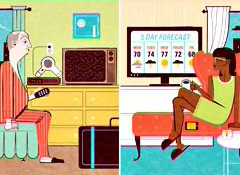
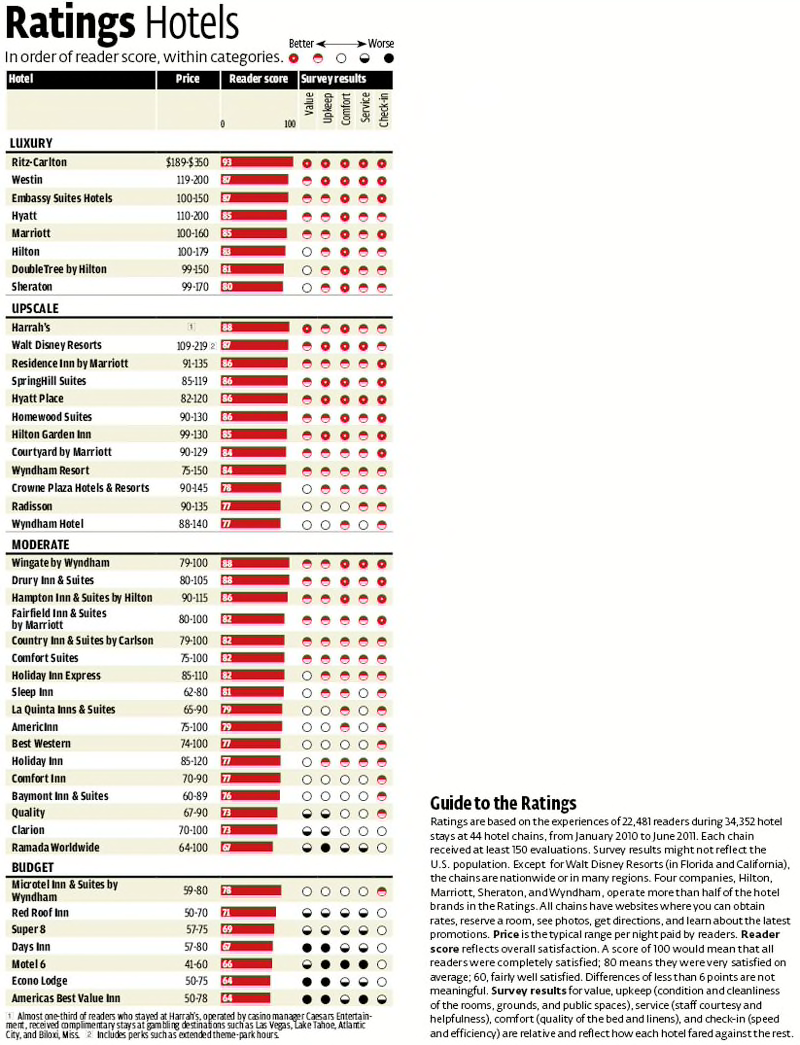
If you're staying at a hotel this summer, you might find that the welcome mat is out. Chains are catching up on long-delayed improvements, freshening rooms, replacing worn mattresses and tattered wallpaper, and updating furnishings. Groceries delivered to your door? Try an upscale Residence Inn. An indoor pool? Even the budget-level Red Roof Inn has them. A butler to draw your bath? OK, that's over the top, but you'll find one at the Ritz-Carlton (and the tub is marble). At more and more hotels, lobbies look a bit like cozy living rooms, wireless Internet is in public areas, and hot breakfasts and evening munchies are on offer. Most hotels even say you can stay free if you have a problem they can't resolve.
But the wooing of guests stops at the price tag. This year, an overnight stay is expected to cost an average of $107, up 5 percent from 2011, according to lodging analyst PricewaterhouseCoopers. You'll probably have to work harder to land a deal; asking the desk clerk for the best available rate no longer does the trick. That's where we can help. Through reporting, dickering with clerks, and visiting hotels, we've identified techniques that stretch your lodging dollar. And through our survey of 22,481 subscribers who spent a collective 94,981 nights at 44 chains, we've identified America's best and worst hotels. Among our findings:
The lines between hotel types have blurred because of "amenities creep," the trickle-down of niceties from expensive chains to cheaper ones, but there are basic differences.
At budget hotels, expect a hair dryer, radio, safe, TV with a few premium channels, and exercise room. Furnishings tend to be more functional than fashionable. Sample perks: Local calls are free at Motel 6, most Days Inns have free copies of USA Today, and many budget hotels accept pets.
Selecting a moderate hotel usually gets you fluffier bedding, more stylish furnishings, better-equipped fitness and business centers, and a free hot breakfast. Internet service is often free—worth noting because Internet service was the second-most-used amenity in our survey, behind parking. Drury Inn offers free long-distance calls, even to Canada and Mexico. Hampton Inn advertises a choice of feather or foam pillows.
Business travelers tend to favor upscale hotels, where many rooms have ergonomic chairs and large desks. Crowne Plaza offers "quiet zones" that ban housekeeping and other worker activity Sunday through Thursday from 9 p.m. to 10 a.m. Courtyard by Marriott has fire pits outdoors and workstations in the lobby.
Luxury hotels, usually in big cities and exotic locales, have round-the-clock white-glove service. Expect spas, personal trainers, massage therapists, baby-sitting, and expensive restaurants. Oddly, luxury hotels are most likely to nickel-and-dime guests on such basics as Internet access (usually $10 to $20 per day).
Once you've picked a price level, consider whether you've liked the chain before (63 percent of survey respondents said a good previous experience was important in deciding where to stay). And go to the hotel's website, not only to research rates and availability but also to see photos of rooms and amenities, get directions, and scope out local attractions. Check online travel sites such as Travelocity and Expedia or aggregator sites such as TripAdvisor (it lists accommodations and prices from many travel agencies), along with travel guides.
User reviews can be helpful, and 21 percent of readers consulted them, up from 17 percent in 2009. "They're highly influential and a really important way for travelers to determine how well a hotel performs relative to expectations," says Carroll Rheem, research director at travel-research firm PhoCus Wright. But parse them carefully: A recent Wall Street Journal article noted that some hotels have offered guests incentives to write raves. Consider the number of reviews, Rheem says. The more there are, the smaller the impact of an oddball review. Check a site's fine print or contact the company to find out who's allowed to write a review. Some sites let anyone comment, whether they've stayed at the hotel or not. Focus on comments about what matters to you, such as the pool or restaurant.
Consumers shelled out an estimated $1.8 billion in hotel fees and surcharges last year, according to Bjorn Hanson, divisional dean of New York University's Tisch Center for Hospitality, Tourism, and Sports Management. That's the highest amount since 2008. It's not that hotels are finding new ways to lard on extras; rather, more hotels are using existing ways. "The chains have discovered which ones are most acceptable and what they can get away with," Hanson says. The fancier the hotel, the more likely it is to add fees beyond room occupancy and sales tax. The most common:
Resort. Charged by hotels with hiking trails, golf courses, or tennis courts, the resort fee usually ranges from about $20 to $50 per day. It applies whether you use the amenities or not and is very difficult to have removed from your bill. Most resorts automatically add staff tips.
Minibar. Guests expect to pay princely sums for chips, nuts, and candy bars but might be startled to see a minibar "restocking" fee of $2.50 to $6. Hotels are also doing away with locked minibars, instead displaying overpriced items in an unlocked fridge or in baskets in the open, where they're more difficult to resist.
Early check-in/late departure. Time was, you might talk your way out of paying extra if you arrived early or left late. Then many chains started charging a $50 penalty or imposed a "day" rate of about 60 percent of the nightly rate. Now more chains charge for a full extra night. To encourage guests to join loyalty programs (usually free), hotels might waive the fee and offer members other perks such as a dedicated, faster check-in/checkout line.
Bag storage. Figure on paying $1 to $2 per bag if you arrive early or need to stow luggage after checkout. Joining a loyalty club might let you avoid that fee, too.
Cancellation. Chains routinely require 48 to 72 hours' notice to avoid a charge equal to one night's stay. If you cancel a prepaid stay during a peak period, you could forfeit the entire amount.
Room service. Ten dollars for a croissant is just the start. There might also be a mandatory tip, often 18 percent, and a $2.50 to $5 service, or tray, charge.
Assorted extras. You might pay to use an in-room safe, send a fax, or have a package delivered to your room.
Because 40 percent of hotel rooms are vacant on any given night, bargains remain, whether you're seeking a spa or a no-frills place to crash for the night.
People who plan ahead and don't mind a little uncertainty can take advantage of the cheapest option of all: an opaque site such as Hotwire or Priceline, where you inquire about a type of room in a certain area and either say how much you're willing to pay or are given a price—and don't find out the hotel's name until you've paid.
But opaque sites aren't everyone's cup of tea. People who like more control over where they stay can call the hotel directly, book through the hotel's website, or use a travel website such as Expedia, Orbitz, or Travelocity. Those sites are less likely to undercut hotel prices now that most major hotels guarantee a rock-bottom rate if you book directly. But there might be other reasons to consider a travel site. "Consumers come to us for a quick and easy way to comparison shop within their price range, read reviews across brands, and check out smaller and independent hotels that we give exposure to," says Joel Frey, a spokesman for Travelocity. In addition, travel sites let you book a hotel along with a flight and a rental car, often at substantial savings over the cost of booking separately.
Whatever way you make your reservation, you'll get the best deal by being flexible. Hotels set rates based on projected demand, and rates rise or fall based on any number of factors: weather, school holidays, the threat of terrorism, higher gas prices, a canceled convention, and when a major sports team qualifies for the playoffs, sending fans scrambling for rooms. Start looking far ahead and nab a room if the price is right. If possible, avoid high-demand times. Change your stay dates by a day or two, book a few miles out of town, or choose from among several chains instead of one. Other tips:
Haggle. Only 28 percent of survey respondents tried bargaining, yet 78 percent of those who did won an upgrade or a lower rate. (Success rates were higher for people who haggled over the phone than for those who did in person.) When we challenged 16 students at the Columbia University Graduate School of Journalism to get hotel rates reduced, all succeeded, scoring discounts of 5 to 32 percent. Ask about nonadvertised specials, and use free parking or a different bed size as a bargaining chip.
Find Internet-only offers. Terms such as "best available" and "corporate" used to indicate an unbeatable rate. Today the cheapest rates tend to be on the Internet. But they come with strings: full payment when booking, no cancellations, and no changes. Wyndham offers discounts of up to 25 percent off the otherwise best available rate for advance purchases; Participating Country Inn & Suites offer 15 to 25 percent off the "standard" if you book 14 days ahead.
Other Internet specials come and go, so check often. Starwood Hotels (Sheraton and Westin) features weekly "Starpicks" destinations, giving 20 to 40 percent off to guests who stay between Tuesday and Friday.
Get in touch if you find a better deal. Almost every chain and online travel site makes the same boast: If you've already booked but find a cheaper advertised price on the same date at the same hotel for the same type of room, submit an online claim within 24 hours of booking and you'll get a refund of the difference plus a bonus. Hilton offers a $50 bonus; Best Western, a $100 gift card. But chains won't match prices from opaque sites.
Be loyal. Frequent guests earn free nights, future discounts, room upgrades, airline miles, and rental-car savings. Among other perks: access to hotel club lounges (Hyatt Gold Passport) and weekend discounts, fast check-in, and late checkout (Marriott Rewards). And you generally accrue points at any of a chain's brands. Thus, if you belong to Hilton HHonors, you get points and receive benefits at the flagship Hilton nameplate or at DoubleTree, Embassy Suites, Garden Inn, Hampton Inn, or Homewood Suites.
Show your age or affiliation. A 10 percent discount is the norm for older guests, particularly at lower-priced hotels. The discount might require an AARP affiliation. At Best Western, you need only prove you're at least 55. Similar discounts often apply to those in the military, government employees, and members of groups such as AAA. Try mentioning other affiliations. At Ramada, for example, members of B.A.S.S., the Bass Anglers Sportsman Society, land 20 percent off the best available rate.
Take a gamble. Hoteliers quietly maintain a "fade" rate, the minimum they'll accept per room for walk-in guests. A few years ago, it applied when occupancy was less than 30 percent, but Bjorn Hanson says some hotels may invoke the rate even if at 60 percent. If you're ready to walk after hearing the lowest rate, the clerk may use the fade rate to earn at least some revenue from a vacant room. You could score a great rate, but be prepared for disappointment.
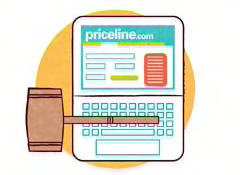
Ads for Priceline's Name Your Own Price option*, Hotwire's Hot Rates, and Travelocity's Top Secret Hotels promise discounts of as much as 60 percent off regular room rates. They're called opaque or blind websites: You don't learn the identity of your hotel until after your bid has been accepted (Priceline) or you've agreed to the site's price (Hotwire and Travelocity). The savings are substantial because hoteliers consider the rooms "distressed," meaning that they'd otherwise go unoccupied that night.
To see how much we could save using one of the services, we requested a room at a high-end hotel near Chicago's Magnificent Mile. One of Hotwire's selections seemed good, based on the description, a rating of four and a half out of five stars, its general location, its standard amenities, user reviews (they don't identify the hotel, though Sherlock Holmes might figure it out), and the price: $133 per night before tax. It turned out to be the boutique James Hotel.
We then backtracked to find a better deal, using every trick in our arsenal. We started by searching BookIt.com, Expedia, and Hotels.com. We also revisited Priceline and Travelocity to see what they charged for rooms at the James on the side of the sites that lets shoppers search for hotels by name. Next, we sniffed out discount and promo codes, contacted AAA, and looked for discounts through other affiliations. Whatever we tried, the price was far higher than Hotwire's—about $230—and didn't budge. We thought we'd hit pay dirt with a rate of $125 through Affinia Hotels, a chain that has a business affiliation with the James. But the rate was a promotion for travel agents.
We called the hotel's corporate toll-free number, then contacted the hotel itself. The price remained about $230. Might we get free parking (a $52 add-on for valet service), a room upgrade for the same price, or a free breakfast? Nope. And if we wanted a $20 AAA discount, it would be deducted from the standard rate of $259. The clerk said our $234 rate was already a discounted price; that rate required payment up front and was nonrefundable.
Bottom line. If you're not loyal to a particular hotel chain and are willing to choose from among a number of brands at a certain price level, consider an opaque site. We've discovered through years of experimenting that they offer some of the lowest rates around, along with enough information about location, amenities, services, and guest feedback for you to make an informed decision. Remember, though, you can't cancel or change a reservation. Opaque travel-site users share strategies, advice, and experiences on several websites. Consult BetterBidding.com, BiddingForTravel.com, and BidLessTravel.com.
*Priceline is unusual because you set your own price. You bid on a hotel in one or more categories in one or more areas and wait a few seconds to see whether you've won. If you don't, you must wait 24 hours to rebid unless you alter your search to include another area or a different level of hotel.

Our survey found a big gap between the best budget hotel, Microtel Inn & Suites, and cellar-dwellers such as Americas Best Value Inn.
To see the differences, we sent reporter Tod Marks to a Microtel outside of Baltimore ($66 for the night including tax) and editor Leslie Ware to the Americas Best Value Inn in Stamford, Conn. ($75.89 for the night including tax but before dog).
Both hotels provided free Internet, an ATM, and continental breakfast. Both rooms were small but well lit and had an iron and an ironing board, a hair dryer, a microwave oven, and a mini fridge.
| Hotel | Check-in | Property/ common areas |
Bedroom | Bathroom | Bottom line |
| Microtel Inn & Suites |
The front desk, a narrow counter, is just inside the entrance. No one else is around on a stormy Saturday evening, and check-in takes less than a minute. | The property seems well maintained. The parking lot is full, yet I neither see nor hear anyone. The lobby does double duty as the continental breakfast room (bagels, cereal, juice, muffins, and coffee). Three TV sets are tuned to different channels, and there's a computer terminal for guests to print out airline boarding passes. The carpeted corridors are rather dim. | The queen-size bed is topped with a duvet and a crisp sheet (no spread), and three pillows, two of them lumpy. The room has a single equestrian print on the faux- stucco walls, one swivel chair, and no freestanding furniture. A pressboard armoire built into the wall has hangers inside and a flat-screen TV on top, forcing viewers to look skyward. Among the channels are two from HBO. Two night stands jut from the wall, and there's a matching wall-mounted desk. Narcissists might enjoy the two large mirrors, one about 3x10 feet. Atop the heater/AC is a bench seat; next to it are two drawers. A stiff, plasticlike curtain covers the lone window. | It's stocked with three sets of unremarkable white towels. Generic toiletries are simple: two bars of soap (one smaller than a Saltine), shower cap, and shampoo. The tub/shower's cottony curtain absorbs water easily. Caulking around the tub is sloppy, and there's no soap dish or shelf where guests could stow a cloth or toiletries. Two floor tiles are cracked, the room's only obvious flaw. A sign offers extra toiletries at the front desk. The clerk cheerfully hands me a toothbrush because I forgot to pack mine. | It's a good value: a bright, clean room with a comfy bed and all the basics in working order. |
| Americas Best Value Inn |
The clerk stands behind a glass wall with a small opening for a credit card and addresses me promptly. I ask whether the rate I was quoted over the phone ($88 including tax) can be lowered. She takes a minute and rakes about $12 off the total. My English setter costs an extra $15. | The hotel is just off Interstate 95, and traffic is noisy at rush hour. The grounds contain an empty swimming pool in disrepair. A large blue tarp covers something in the parking lot near a row of rooms. Out back are open garbage bins. The hotel has a Peruvian restaurant I don't try, but off the small lobby is a breakfast room. In the morning, I find a waffle iron and batter dispenser, cereals in plastic bins, bagels and white bread, a juice dispenser, and coffee. There's no TV. Counters are dotted with crumbs and drippings. | My room is reached via two fairly dark staircases. I need to draw the curtain so that passersby on the walkway outside can't see into the room. There's a king-size bed with a nice-looking bold-print spread, a four-drawer bureau, a safe, one bedside table, a round table with two chairs (the room's only seating), and an old-style TV that gets some cable channels but no HBO. An open-area closet has seven hangers. The two framed prints are crooked, there's unpainted spackling along the ceiling edges, the round table wobbles when I write on it, and the bed's blanket has two little holes. In the morning, a crumpled white tissue sits on the floor outside my door. | The night light is a nice touch, but the bathroom door won't stay closed.Towels (two sets) are flimsy and the bathtub lacks a stopper. The cloth shower curtain and toilet lid have small stains. | It's the little flaws that make Americas Best Value a dubious value. |
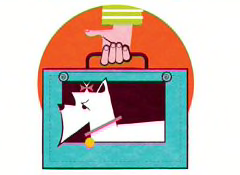
Although many people think of pets as family members, most hotels don't. Still, more and more are welcoming well-behaved dogs and cats. Some hotels offer beds, floor mats, food bowls, special treats in the minibar and, for an extra fee, walking or pet-sitting services, kenneling, even in-house doggie massage.
Choice Hotels (parent of Comfort and Sleep inns, and Quality and Clarion, as well as Econo Lodge, among others) has more than 2,500 pet-friendly locations; Best Western, about 1,600. Even Ritz-Carlton, Hyatt, DoubleTree, and other well-heeled chains roll out the welcome mat for Fido and Fifi. But not all hotels within a chain have the same policy. Hotels may prohibit dogs above a certain size or bar aggressive breeds. Owners usually must sign a waiver accepting responsibility for any damage.
Some hotels reserve specific rooms for pets and their owners; others use any room that's available. Marriott, which doesn't set rooms aside, claims to follow strict procedures after each checkout, including steam cleaning, vacuuming, dusting, and inspecting the premises according to standards set by Ecolab, a company specializing in cleaning services.
Charges vary. The Ritz-Carlton in Sarasota, Fla., charges $125 for "maintenance and restoration"; the DoubleTree Grand in Key West, Fla., charges $75 per stay and reserves the right to tack on $100 for "deep cleaning." Other hotels aren't as demanding. The Quality Inn in Rock Hill, S.C., charges $10 per night per pet. Motel 6 charges no fee.
Bottom line. If you're traveling with a pet, call the hotel ahead of time for information. (On hotel websites, pet policies are often hard to find and vague.) Take vaccination records, required by some hotels. And try to make sure your pet behaves: You could be evicted if he or she is loud, disruptive, or left unattended.
A version of this article appeared in the July 2012 issue of Consumer Reports magazine with the headline "Best Rooms, Best Rates."

 Build & Buy Car Buying Service
Save thousands off MSRP with upfront dealer pricing information and a transparent car buying experience.
 Get Ratings on the go and compare
while you shop