Sign In

Our first comprehensive mattress tests show that you don't have to pay an arm and a leg for the back and side support that can help you get a good night's sleep. Three of our recommended mattresses cost much less than $1,000, while a high-priced Simmons model scored lowest overall. And if you think buying a memory-foam mattress guarantees better support, think again.
We focused on 12 innerspring and foam models in the best-selling queen size for our tests and measured how well each mattress supports the spine—job No. 1 for any mattress, according to sleep experts.
Along with Simmons, we gathered top-selling models from Costco, Ikea, Sealy, Serta, Stearns & Foster, and Tempur-Pedic. Then we enlisted men, women, and machines to see which does best, whether you sleep mostly on your back or side.
Weeks of pushing and pounding with an arsenal of gadgets and weights showed that the same mattress can provide much less support depending on how you sleep. One innerspring mattress from Sealy might keep you up if your sleep partner tosses and turns all night. And three memory-foam models could make changing positions a challenge.
Our test results don't come a moment too soon: About 40 percent of subscribers in our latest survey said they had buyer's remorse about the last mattress they bought. Those readers, plus a nationwide team of secret shoppers, confirm that relying solely on salespeople could leave you lying awake at night. (Read "How to Come Out on Top When Buying a Mattress.") Here's what else we found in our tests.
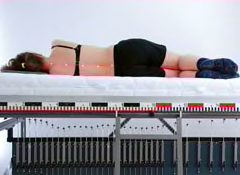
Some are better for back sleepers. Back strain is one reason you might wake up stiff and sore after a night on the mattress you own. Our body-support tests graph the spine's natural curves for a range of adults. Then we record how thoroughly each mattress maintains that curve for back sleeping. We also check how well each mattress keeps the spine relatively horizontal when lying on one's side. The best in those tests provided good or better support for both. That's important, as sleepers typically change positions several times a night. The Serta Perfect Sleeper Elite Pastel Firm Pillowtop innerspring mattress, $835, a CR Best Buy, offers the most support if you sleep on your back. But two Simmons models, a Sealy, and the Ikea lost points there.
You can do better than foam. Memory-foam mattresses are designed to mold to the shape of your body and return to their original shape when you get up. Sealy says its $1,775 Posturepedic Optimum Inspiration will make you feel that your mattress was "made just for you." Simmons says its $1,920 ComforPedic has "hundreds of sculpted cushions" that respond independently to your shape and movement. But both scored lowest overall. And like the tested Serta iComfort Sleep System Genius, they lack the resilience that makes moving and shifting positions easier.
Gel made little difference. Five of our tested mattresses include a layer of foam infused with gel. That's supposed to help a mattress make you feel cooler, especially with memory foam. But those without gel "breathed" about as well.
A few go bump in the night. Some innerspring mattresses can be too resilient, potentially letting a restless sleeper on one side of a bed disturb a sound sleeper on the other. The Sealy Posturepedic Cloveridge LTD Firm, $440, transmitted the most bounce in this test bunch.
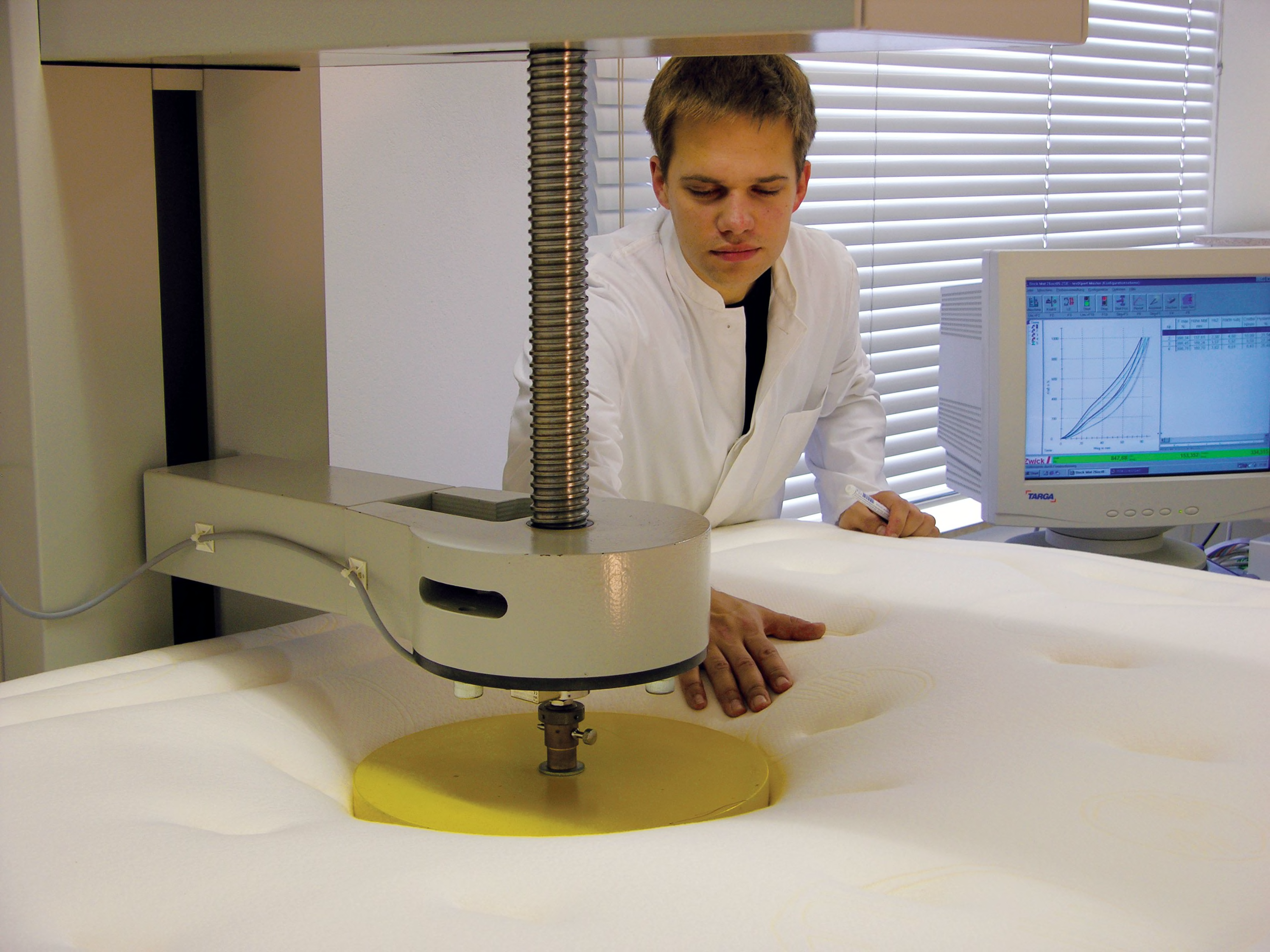
Our new mattress tests confirm our earlier buying advice: More coils, fancier fabric, and other frills you'll typically find on pricier models don't guarantee a better mattress. What's more, the best one for you isn't necessarily the firmest, even if you suffer from pain.
"Any mattress, whether firm or soft, that supports your body as fully as possible without creating pressure points should do for most people," says Todd J. Swick, M.D., medical director of Apnix Sleep Diagnostics in Houston, which has treated more than 20,000 patients. None of the mattresses we tested created notable pressure points. Here's what else to think about before you begin shopping.
Try before buying. Our tests show that you can't necessarily believe manufacturers' softness and firmness claims; almost half of these mattresses we tested proved to be softer than promised.
But even the most supportive mattress might not be what you find most comfortable. To gauge comfort yourself, lie on any mattress you're considering. Spend at least 10 minutes on each side and on your back, and on your stomach if that's how you sleep. You can't try the Costco Novaform mattress at the store; it's delivered to your door in a box. But if you don't like it, pickup and return are free.
Win the name game. Mattress makers offer some lines nationally. But those you'll see at such major retailers as Macy's, Sears, and Sleepy's are typically exclusive to those chains. And retailers often change model names, making it even harder to compare models store to store. All of that makes it extremely hard to shop wisely, which is why we've decided to test mattresses on a regular basis. Our advice: Use our performance Ratings as a guide. And insist on the precise makes and models that scored well in our tests.
Consider the winter months. Three innerspring and three memory-foam mattresses were better at retaining body heat in our temperature-controlled chamber. That should help you keep warm when the weather turns cold without feeling too warm when it's hot.
Weigh latex concerns. Some makers of latex-foam mattresses say their processing removes the proteins that cause latex allergy. Still, we've highlighted in our Ratings those mattresses that contain latex in case you're worried.
Keep your old box spring if possible. Replacing the box spring that goes beneath a mattress can cost $150 to more than $300. Unless your old one is sagging or damaged, you might be able to save by keeping it even if you're replacing your innerspring mattress. About 80 percent of subscribers who responded to our recent survey were satisfied with their new mattress without replacing the box spring. But some brands require you to buy their box spring to receive full warranty coverage.
Don't forget to haggle. Most mattresses have huge markups, which allow retailers to run frequent "sales" of up to 50 percent off. But you don't have to wait for special promotions to save. About one-third of subscribers in our last mattress survey who haggled slashed $150 or more off the price. And consider using a smart phone or tablet to check prices online or at other stores for added bargaining power.

People typically keep their mattresses roughly 10 years before replacing them. But we suggest tossing any mattress that shows sags or lumps. If yours looks serviceable—and you still wake up feeling achy, stiff, or numb—try these quick fixes before buying a new one.
Flip or rotate it. You may be able to do both with some innerspring mattresses, though models with an obvious top layer are limited to rotating only. Mattresses with different firmness levels for each sleep partner, including some memory-foam models, can't be flipped or rotated.
Check the pillow. A firmer or softer one may be what it takes to nod off. Check firmness yourself by putting pillows on a flat surface and compressing them to about half of their original thickness; the more pressure needed, the firmer the pillow. Also be sure that the pillow positions your head and neck as high or low—relative to your shoulders and spine—as it would if you were standing straight with proper posture. And as with mattresses, pricier pillows aren't necessarily better. Our earlier tests with more than 70 staff members found little difference in comfort and quality between high- and low-priced models.
Top it off. A mattress topper can help a too-hard bed. Past tests with foam- and feather-filled toppers found that paying more didn't guarantee more comfort. No topper is best for everyone. Check return policies, since you can't try them out at the store. And be sure that fitted sheets are loose enough to use with a topper.

Buying a mattress is far less onerous than buying a car, going to the dentist, and—by a long shot—doing your taxes. That's according to our latest survey of more than 1,000 subscribers who bought one in the last four years. But it isn't necessarily a joyride, either.
Most of the respondents were satisfied with their shopping experience, but they reported problems including uninformed staff, pushy sales tactics, and firmness prescriptions from self-styled "experts." We heard similar gripes from a dozen anonymous shoppers we sent to 30 stores across the U.S., including Macy's, Mattress Firm, The Original Mattress Factory, and Sears. Here's how to take some of the lumps out of your next shopping trip.
Don't get pushed to pay more. Pressure to spring for a pricier mattress than one on sale was the biggest complaint among subscribers who ultimately bought at another store. Our shoppers also got the price push. A salesman at a Metro Mattress in New York began to eye other customers after our shopper said she was close to a decision but wouldn't commit to the $2,700 mattress he was touting. Another shopper was quickly led to a Tempur-Pedic that cost a princely $3,500.
Be skeptical of "medical" advice. Health experts agree that full support matters more than the firmness of a mattress. Yet almost 10 percent of survey respondents were told to buy a softer or firmer mattress for health reasons. Our shoppers got similar advice after mentioning back problems and sleep issues. A sales staff member at a Mattress Depot USA in Washington suggested that "most people with back pain prefer the plush mattress."
Look for smart sales staff. Sales staff who seemed uninformed about types and brands topped the list of complaints from survey respondents with gripes about where they bought their mattress. Our shoppers also experienced subpar sales help. A sales representative at a Mattress Firm store in Texas asserted that there were no differences among Tempur-Pedic's soft, medium, and firm mattresses. (The brand differentiates firmness levels online.) Another at a Mattress World in Pennsylvania said that firmness depended on the amount of stitching on top. (Stitching is only one of several factors.)
Enlighten yourself. About 40 percent of subscribers had buyer's remorse. Things they would do differently include buying another mattress type, spending more time trying models, and doing more research. Our shoppers also made a case for going to more than one store.
Even a mattress that feels comfortable at a store could prove to be less comfy at home. Here's what to ask up front.
Is there a return period, and can I get a full refund or credit toward another mattress? Ikea gives you 90 days to exchange a mattress. (You must take it back to the store or pay for pickup.) The return period is 60 days for most mattresses at Macy's and 30 days at Sears. And both hit you for shipping costs and a 15 percent restocking fee.
How long is the warranty? Those for the mattresses we tested ranged from 10 to 25 years and covered only manufacturing defects. Coverage is frequently prorated, meaning that it decreases over time.
Is there free pickup if I want a refund or exchange? Otherwise, you'll have to pay for it—or cart the mattress to the store. And you'll be responsible for damage.
Don't accept delivery without inspecting the mattress for stains and other damage (and the box spring, if you buy one). Also be sure that the mattress has a label that states "all-new material" before you send the driver on his way. If it's not there, refuse delivery.

Too little sleep can lead to heart problems, high blood pressure, obesity, type 2 diabetes and other conditions. It also seems to be on the rise, with about 400 percent more accredited sleep centers in the U.S. than a decade ago. Here are ways to nod off without counting sheep.
This month's mattress report is the first that scores body support, along with the durability evaluations we've done in one form or other since the late 1930s. Our first mattress report dates to April 1938, when the magazine was known as Consumers Union Reports. Download a PDF of the article, which warned of subpar manufacturing standards and suspect contents. Also watch this video on Archive.org for a look back at Consumer Reports' testing from 1960, including mattresses at about the 12.5-minute mark.
Below you'll find a look at how we've pounded and pummeled mattresses through the ages—and even slept on the job.

Then: In October 1958, we passed this 265-pound roller over each mattress 250,000 times—or until one or more springs broke.
Now: We use a heaver, 308-pound roller to give both innerspring and foam mattresses an even tougher going-over.
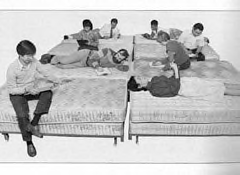
Then: In this March 1986 report, staff judge mattresses for firmness by literally lying down on the job.
Now: We gauge firmness more scientifically using a mechanical device to measure the force needed for deflection.
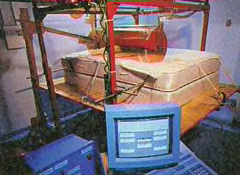
Then: By March 1997, we'd upped the weight of our test roller to 300 pounds to simulate four years of use.
Now: Our latest roller tests simulate eight years of use for a better read on which mattresses should last longest.
A version of this article appeared in the May 2013 issue of Consumer Reports magazine with the headline "Mattresses."


 Build & Buy Car Buying Service
Save thousands off MSRP with upfront dealer pricing information and a transparent car buying experience.
 Get Ratings on the go and compare
while you shop


