Sign In

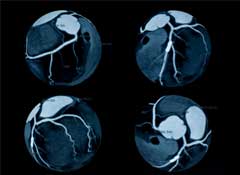
Many healthy patients undergoing CT angiography—a high-tech and widely advertised test increasingly being used to screen for heart disease—are being lured into a prevention trap. That's one of the conclusions I draw from a major study and editorial being published online today by the Archives of Internal Medicine.
Why? I'm concerned that people who undergo the test, which uses multiple CT scans to produce a three-dimensional image of the heart, often go away thinking either that they are free of the disease or, if the results are worrisome, that it saved their life by identifying heart disease early. But the study published today found that while people who got the test were more likely to be treated aggressively, including with invasive and potentially risky procedures, they were not less likely to have a heart attack or other coronary event. In addition, the study hinted that people with reassuring test results might be less likely to continue healthy lifestyle changes.
As a result, the researchers concluded that screening CT scans of the coronary arteries in healthy, low-risk people "should not be considered a justifiable test at this time." And an editorial released at the same time, written by Michael Lauer, M.D., from the National Institute of Health, says that using CT angiography to screen for heart disease could lead to an epidemic of "pseudodisease" of the coronary arteries.
The study looked at 2,000 healthy South Korean adults. Half had CT angiography and half had standard care, including routine checks of their blood pressure and cholesterol levels. After 18 months, the 215 people who had worrisome CT scans were more likely to have additional tests and be prescribed aspirin and cholesterol-lowering drugs than people who didn't have the test. And some even had angioplasty or heart bypass surgery. But they were no less likely to have a coronary event.
Lauer's editorial points out that the study isn't large enough, long enough, or scientifically powerful enough to produce definitive results. But he says the results raise a significant alarm, and point to a larger concern as well: that more screening tests are not necessarily better, and in fact in some cases might cause more harm than good.
That's a point we've been making for years, particularly for CT angiography. Why? For one thing, the test exposes patients to potentially cancer-causing radiation, sometimes significant amounts. Moreover, while the test can identify blockages in the coronary arteries, researchers increasingly understand that heart disease is much more than just a "plumbing problem" caused by those blockages. Instead, it's a systemic disease of the arteries that also involves inflammation, clotting abnormalities, and numerous other factors. Simply identifying and treating the blockages fails to address the underlying problems or the real causes of heart attacks and heart disease. In fact, we've said since 2007 that medication and lifestyle change can be as effective as angioplasty in treating many patients with coronary obstructions. Finally, many if not most of us, lead long healthy lives with some obstructions in our heart arteries that never cause a problem.
That's why we've called both CT angiography and angioplasty a "treatment trap," a term many of my physician colleagues wince at. In addition, we recently rated nine cardiovascular screening tests, identifying those that work and those that don't. While we did not rate CT scanning (we are working on that), we warned readers to be wary of it. And a survey we conducted of 1,200 healthy middle-aged subscribers showed that many are getting screening tests that don't work well, and most know very little about the pros and cons of screening.
Bottom line: The authors of the recent study and editorial should be commended for calling it as they see it. I hope it will help put the brakes on doctors who've let their entrepreneurial enthusiasm for CT angiography get ahead of the evidence. Indeed, we all need to say enough is enough—let's quit letting ignorance and industry marketing guide our approach to disease prevention. And lets make the people who take advantage of our ignorance be accountable for their deception.
See our advice on CT angiography and other tests for heart disease, as well as our advice on how to treat heart disease.
Sources
Pseudodisease, the Next Great Epidemic in Coronary Atherosclerosis? [Archives of Internal Medicine]
Impact of Coronary Computed Tomographic Angiography Results on Patient and Physician Behavior in a Low-Risk Population [Archives of Internal Medicine]
—John Santa M.D.

 Build & Buy Car Buying Service
Save thousands off MSRP with upfront dealer pricing information and a transparent car buying experience.
 Get Ratings on the go and compare
while you shop

